

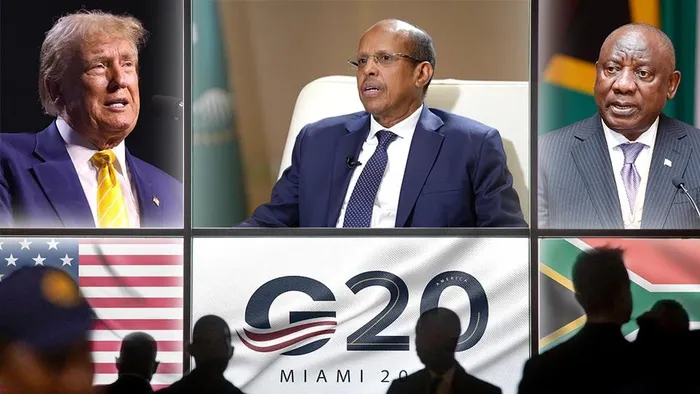
The US has justified South Africa's exclusion from the G20 Summit by claiming there are human rights abuses against Afrikaners.
Image: Supplied
THE African Union (AU) Commission delivered a blistering rebuke to the United States (US) on Wednesday over Washington’s decision to bar South Africa from the G20 Leaders’ Summit.
Speaking in Pretoria, Commission Chairperson Mahmoud Ali Youssouf made it plain that holding a summit on sustainability and development without the continent’s largest industrial economy “makes no sense”, adding: “We are not only worried; we condemn that, we reject that.”
The US has justified the exclusion by claiming there are human rights abuses against Afrikaners. Human rights organisations and the United Nations (UN) have found no basis for these allegations. The claim has been widely dismissed as unsupported.
Youssouf noted that the AU had relied on South Africa to advance the continent’s priorities within the G20, and that South Africa did so effectively during its presidency. Its “triptych” proposal was well received by African public opinion.
By excluding South Africa, the US has acted to negate that contribution, sidelining a member state that had just delivered a widely acknowledged G20 presidency. The AU’s full membership in the G20 was intended to give the continent a voice; the US action has instead treated Africa’s representation as expendable.
The exclusion is not limited to the leaders’ level. Finance Minister Enoch Godongwana and Reserve Bank Governor Lesetja Kganyago were denied accreditation to attend the G20 finance ministers’ meeting in Washington.
Godongwana, stuck in transit in Amsterdam, stated: “We are members of the G20. However, the US has not accredited us, which means that South Africa will not be part of the G20 for the whole of this year.” No official reason was given. The result is a complete lockout of South Africa from the G20 process for the duration of the US presidency.
The impact of US foreign policy is also visible in South Africa’s domestic economy. Fuel prices have risen amid oil market volatility linked to tensions in the Strait of Hormuz and Washington’s sanctions enforcement against Iran.
These policy-driven price movements are transmitted directly to consumer costs, placing a measurable burden on South African households.
Youssouf rejected the notion that the G20 can be treated as an exclusive platform, stating: “It is not exclusive to any country.” The current US approach has, in the AU’s view, turned a multilateral forum into one where participation is conditional on alignment with Washington. The summit’s theme sustainability and development stands in contradiction to the silencing of the continent’s largest economy.
The AU Commission has indicated it will work with the next G20 presidency, to be held by the United Kingdom (UK), to ensure such exclusions do not recur. Youssouf stated: “We will work with the next chair of the next summit so that these things cannot happen.”
The position of the AU is that the US has used fabricated grounds to exclude a fellow member, disrupted the multilateral process, and proven that its commitment to global cooperation is nothing more than a convenience when it serves US interests.
* Sizwe Dlamini is editor of the Sunday Independent.
** The views expressed here do not reflect those of the Sunday Independent, Independent Media, or IOL.