

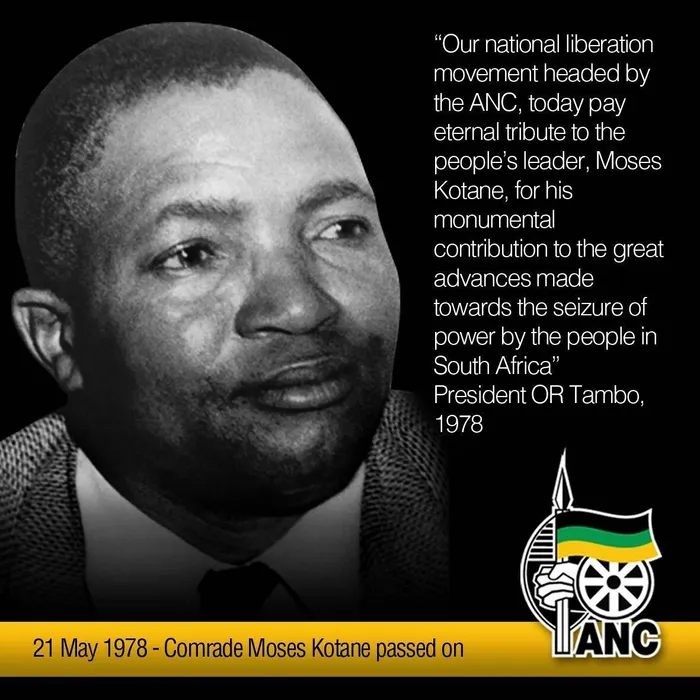
At a time when factions and electoral contestations threaten to fracture this historic unity, it is vital to reflect on the profound legacy of Moses Kotane, a leader who understood that movements do not simply inherit victories; they inherit habits, principles, and a duty to history.
Image: X
THE Alliance — comprising the ANC, the SACP, Cosatu, and SANCO — has, for decades, been the engine of South Africa’s liberation and ongoing transformation.
At a time when factions and electoral contestations threaten to fracture this historic unity, it is vital to reflect on the profound legacy of Moses Kotane, a leader who understood that movements do not simply inherit victories; they inherit habits, principles, and a duty to history.
Kotane, who shaped the strategic and ideological direction of both the ANC and SACP, warned against the seductive dangers of short-term gains at the expense of collective purpose. His legacy is not just one of tactical brilliance but of foundational wisdom.
He insisted that ideology must be grounded in bread-and-butter realities, that international solidarity is worthless without internal accountability, that non-racialism is not an act of charity but a strategy for liberation, and that the working class is not a mere ornament for speeches, but the bedrock of any genuine revolutionary movement.
To speak of the Alliance is to speak of an inheritance much deeper than organisational affiliation. It is to embrace the “productive discomfort” that Kotane championed — a space where leadership is not above challenge, where rivals test and sharpen each other, and where even opposition, once overcome, becomes part of our inheritance.
This is not a sign of weakness, but of strength. The Alliance modelled a politics where differences did not mean division, but a deeper, more rigorous unity forged in the crucible of struggle.
The formation of the South African Communist Party by Kotane and his peers, even as they were members of the ANC, was never an act of division but of ideological enrichment. Kotane and others recognised that the liberation struggle required not only political mobilisation but also a clear class analysis and a commitment to social and economic justice.
The SACP provided this dimension, advocating for the rights of workers and the poor, and for a fundamentally transformed society. Importantly, Kotane and his comrades did not abandon the ANC when they joined or led the SACP—instead, they worked tirelessly to unite the two organisations, believing that the struggle for national liberation and the struggle for social emancipation were inseparable.
Their unity was forged in shared sacrifice and mutual respect, understanding that the strength of the movement lay in its ability to bring together diverse traditions and perspectives into a common front against oppression.
Kotane’s own experience as Treasurer General of the ANC and Secretary of the SACP placed him at the very heart of the alliance’s contradictions and complexities. He understood, perhaps better than anyone, that unity did not mean uniformity. He was adept at navigating the different priorities, cultures, and constituencies of the organisations he led — finding ways to turn potential conflicts into sources of strategic strength.
Kotane believed that robust engagement and open debate were not threats, but vital ingredients for principled unity. He worked tirelessly to ensure that ideological clarity translated into practical outcomes, and that organisational interests were always subordinated to the broader goals of liberation and transformation.
In today’s debates about the future configuration of the Alliance, Kotane would remind us that our differences, when managed with discipline and respect, are not weaknesses, but the very foundation of a resilient and dynamic revolutionary movement.
The temptation for Alliance partners to contest each other in elections, or to drift towards separation, is nothing less than counter-revolutionary. It risks not only undermining three decades of hard-won unity, but also betraying the very principles that propelled the liberation movement to victory.
The ANC, SACP, COSATU and SANCO did not defeat apartheid by acting in isolation, nor did they build the modern South African state by placing organisational ego above the needs of the people. The Alliance’s strength lay in its discipline, its underground resilience, and its unwavering commitment to changing not just the rulers, but the rules of society itself.
Kotane’s insights remind us that the Alliance was never about convenience, but about confronting the most difficult, structural questions facing our society. It kept pressure on the economy, shaped labour’s structure, and ensured that the liberation agenda was not co-opted by elite interests.
To abandon this model now — to engage in electoral rivalry rather than collective strategy — is to risk losing the very soul of our revolution. It is to forget that the struggle was never about personalities or party colours, but about the transformation of society in favour of the working class and the poor.
In an era of uncertainty and global instability, the Alliance must recommit to Kotane’s vision: A revolutionary unity that is accountable, non-racial, grounded in material realities, and always driven by the needs of the majority.
We must guard against the habit of dividing for convenience and instead inherit the habit of unity for transformation. Only through this discipline can we honour our past, meet the challenges of the present, and secure a future worthy of the sacrifices made by generations of revolutionaries.
Let us not inherit only the victories, but the habits that made those victories possible. The Alliance, united, remains our most powerful instrument for changing not just rulers, but the rules of South African society itself.
* Ishmael Mnisi is a member of the ANC writing in his personal capacity.
** The views expressed here do not reflect those of the Sunday Independent, Independent Media, or IOL.