

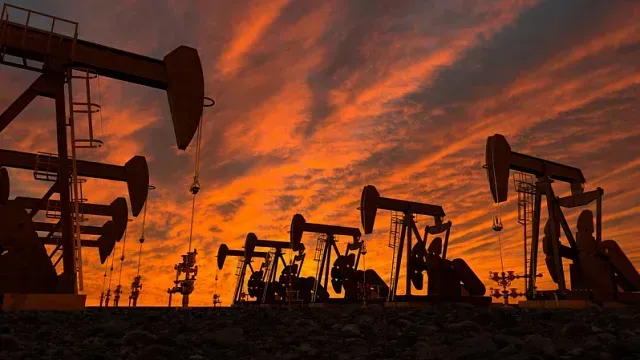
The UAE's departure would not prevent the escalation of the price of the barrel of oil as determined by the Platt’s mechanism.
Image: TV BRICS
WAR is strange, as are its wiles and vicissitudes. It churns out strange fortuities oft’ so unwieldy they make wars predictably unpredictable.
It may or may not have been predictable that the United Arab Emirates, or UAE, may unceremoniously leave both OPEC and OPEC Plus, and without warning, announce its departure from this august body scheduled for the 1st of May.
So bland was the announcement that with a funereal iteration, albeit with a tinge of fatalistic resignation, the Minister of Energy, Suhail Al Mazrouei, announced the Emirates’ decision of departure, emphasising as if it mattered, that it would not perturb the integrity of OPEC’s operations, especially in the context of the Strait of Hormuz’s political complexity, and the fact that neither the supply economics nor the pricing of the commodity would be affected.
In other words, their departure would not prevent the escalation of the price of the barrel of oil as determined by the Platt’s mechanism.
OPEC has been here before, having seen the coming and going of its members. A number of countries have left the Brotherhood. However, all of them left for reasons that are determined by the prescripts of the exporting cartel.
By and large, they could be summarised cryptically, as when an exporting country loses its capacity, or indeed its status as an exporting producer.
Between the years 1992 and 2024, four countries are recorded to have filed notices of withdrawal from the Vienna based body, with Ecuador doing it even twice. In 1992, Ecuador left, followed by Gabon in 1995. Indonesia then traipsed out in 2001, as would Qatar in 2019.
Angola joined in 2007 in the same year Ecuador rejoined after 15 years of self-recusal. Ecuador finally left in 2020 as would Angola, from its own recognisance, bow out in 2024, ostensibly from Joe Biden’s pressure. Gabon has since rejoined.
They left for different reasons. Indonesia became a net importer of crude oil. Qatar became a net exporter of LNG. Angola, much like the UAE, felt that the OPEC production quota limits were too low for them.
Even though the UAE was not one of the founding members of OPEC when it was established in September of 1960, it became a significant contributor ending up as the third largest producer of OPEC and holding a steady fourth place in OPEC plus.
It leaves behind eleven members of OPEC. These are Algeria, Congo, Equatorial Guinea, Gabon, Iran, Iraq, Kuwait, Libya, Nigeria, Saudi Arabia and Venezuela!
Venezuela stands out in this remainder category list. Nobody knows for certain, but Venezuela may have lost its political sovereignty to the Donald J. Trump administration and is wholly incapable of determining the fate of its oil production capabilities and the ability to account for the generation of revenue from its sales.
President Donald J. Trump is on record as stating that over one hundred million barrels of heavy crude oil have been shipped to the USA, ostensibly as a repayment of what Venezuela owes the USA.
How this debt was accrued is a historic oddity. It is best summarised by George W. Bush’s Defence Secretary, Donald Rumsfeld, who is quoted as having said that ‘…it is not our fault that God put America’s oil underneath other people’s countries’.
The singular most binding adhesive among all other members of the cartel, is the quota system, determining how much oil each member should produce, especially if the price of this valuable commodity should be kept at particularly profitable levels for the cartel. That meant that the act of cheating the quotas would not be tolerated.
But delinquency could not be discounted. And in order to countenance the aberration, accounting to any number of things, including war, force majeure and terrorism, certain countries were exempted.
These were Iran, Libya and Venezuela, by the simple reasoning of the establishment that said exempted countries were too sanctioned to limit output. Mexico for its part, joined OPEC Plus but refused to cut production.
Not so with the UAE however. Having expended significant capital that would permit it for the production of 5 million barrels per day of crude oil, they were limited to 3.2 million barrels of crude oil per day by the prescripts of the OPEC quota! This translated into a significant loss of approximately USD 50 Billion per annum!
The feelings of the ruling elites in the UAE, were that consistent with their Doctrine of Sovereign Autonomy, it would be strategic to strike out on their own, outside the constricting edits of the body of petroleum exporting countries.
The timing of war, to our collective dismay, is always inopportune. The announcement, coming at the heels of the kinetic exchanges between the United Staes of America and Israel on the one hand, and the Islamic Republic of Iran on the other, where the UAE had been a vocal proponent for the annihilation of Iran, gave an impression that the withdrawal of the UAE is directly linked to the war with Iran.
The failure of the US -led operation to accomplish the complicated task in quick turn around, exposed the UAE to a possible acrimony with Iran, a veritable founding member of OPEC, and a militarily endowed one at that.
This sudden exit by the Emiratis could potentially trigger the exit of some of the original members of the Brotherhood, who by all historic account, have witnessed the growing tension among the members, and may out of this war, have adequate incentive to abandon the brethren.
With this withdrawal, there is scant motivation for Iran and Iraq to remain in the group, loyally observing its US inspired dictates. They also understand that the departure of the UAE, represents the desire of a top producer to strike it out on its own without accountability to a group.
Understandably, all those Plus members whose relationships with the mother body is tenuous, would be hard pressed to preserve their fealty.
In 2018 or sometime therearound, , Donald J. Trump declared that he would destroy the body called OPEC. In his contemplation, OPEC represented a facility that assisted US adversaries desirous of bringing the US dollar hegemony to its knees.
Indonesia is out. Qatar is out. Angola is out and the UAE is out. In the US President’s mind, he wanted to coax Saudi Arabia out of the 1960 formed organisation. Instead, with the UAE exiting first, and the Bolivarian Republic of Venezuela under US colonial direction, it would not be burdensome for the current US administration to persuade Saudi Arabia to either ditch OPEC or with the power at its disposal, decommission it.
The UAE, in its desire to break from the apron strings of the Saudis, has figured that this moment of crisis could not be left to waste.
The points of discord have been many and the political rifts growing even wider, exacerbated as it were, by issues including but not limited to, the war in Yemen, the relationship with Israel through the Abraham Accords, the war in Libya, the war in Sudan and the centrality of the UAE’s role in the provision of financial services in the GCC region.
In short, who indeed is the leader of the Sunni dominated region, has become a point of contention. Above all, it is the war with Iran.
The UAE is in unique bind. It is at philosophical crossroads with Qatar, and the Kingdom of Saudi Arabia. And in a sudden escalation of tensions, it is at war with the Islamic Republic of Iran. It despises all the GCC countries for their failure to take collective action against Iran
The trigger, as most keen observers would point out, occurred when the UAE went to the United States cap in hand, to ask for a dollar bailout. Scot Bessent was very clear. There could be no bailout without ditching either OPEC or BRICs or both! This will mean the if the UAE gets the approval from the United States, it will have to increase the volumes of sales of crude oil, to be sold in greenbacks.
If the policy utterances of the UAE are anything to go by, they may be withdrawing from so many things presumably under the authorising prescripts of the Doctrine of Sovereign Authority. This may be the same doctrine that suffer them the right to sell out the Palestinians to their newfound friends, the Israelis.
It is fairly apparent that out of the crucibles of this war, the UAE is mortified for a variety of reasons. This kid is angry, feigned or not, notwithstanding. And African parents would know. When a kid is that angry, they are bound to hurt themselves!
* Amb Bheki Gila Esq is a Barrister-at-Law.
** The views expressed here do not reflect those of the Sunday Independent, Independent Media, or IOL.