

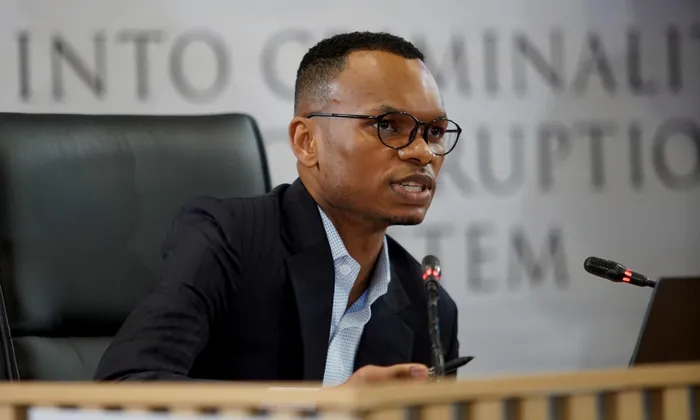
At the Madlanga Commission, Gareth Mnisi defended his actions with a very simple argument. There was no payment. No bribe. No direct business interest. So, he said, there was no conflict.
Image: Oupa Mokoena | Independent Newspapers
THERE comes a moment in public life when explanations stop helping and start hurting. Tshwane has reached that moment.
What is happening around the city’s suspended chief financial officer is not a technical argument about rules. It is not a PR mess that a careful statement can fix.
It is something much darker. It is a clear view of how quietly, how dangerously, our understanding of accountability has changed inside South Africa’s public institutions.
At the Madlanga Commission, Gareth Mnisi defended his actions with a very simple argument. There was no payment. No bribe. No direct business interest. So, he said, there was no conflict.
That argument should not make you feel reassured. It should make you worried.
Because it tells us that at a senior level of city finance, conflict of interest is no longer seen as a risk to avoid. It is treated like a crime that only counts if someone gets caught red-handed. That is not a small misunderstanding. It is a complete flip of how public service is supposed to work.
You see the same thing elsewhere in the testimony. Evidence given to the commission, including WhatsApp messages, shows a private person being pulled into discussions about city invoices and arguments over service providers.
Mnisi later admitted that, looking back, things could have been handled more professionally. But by the time you call something “poor judgement”, the real failure has already happened.
Ethical systems are not meant to react after someone steps over the line. They are meant to make sure you never get close to the line in the first place.
South Africa’s procurement rules are very clear about this. National Treasury’s municipal supply chain laws were written to stop conflicts before they happen, not to argue about them afterwards.
Officials must declare their interests. Bid committees must act fairly. The whole system rests on one principle: public trust must never be put at risk.
That means the real test was never just: “Did you personally benefit?” The real test is harder than that. Were you too close to the decision? Did you tell the whole truth? Would a normal person on the street trust the process after seeing what you did?
Once you replace those questions with the smaller ones about personal gain, something important breaks. The rules are no longer being applied carefully. They are being shrunk down to their weakest possible meaning.
And this is happening inside a system that is already showing deep cracks. The Auditor General reported R87.03 billion in irregular municipal spending since the 2021–22 financial year.
And even that number comes with a warning that the real figure is probably higher because of incomplete reporting. In the most recent audit, 174 municipalities, nearly seven out of ten, recorded spending that was not approved.
This is not background noise. This is the world Tshwane lives in.
Which is why this case matters. Not because Tshwane is uniquely broken, but because it is unusually exposed.
South Africa has gotten used to treating municipal failure like isolated incidents. A suspension here. A scandal there. A list of audit findings somewhere else. Each one quietly forgotten.
But the pattern is no longer subtle.
We do not lack rules. We do not lack forms, checklists, oversight committees, or reporting structures. What we lack, increasingly, is a shared understanding of what those rules mean in real life.
On paper, conflict of interest is about prevention. In practice, we argue about it after the fact.
On paper, the standard is fairness. In practice, the standard becomes: “Did you get caught stealing?”
On paper, ethics is supposed to stop the rot early. In practice, we use ethics later to soften what has already gone wrong.
This is how systems fall apart without collapsing. Not through dramatic explosions. Through the quiet normalisation of behaviour that would have raised alarms just a few years ago.
And the results are not abstract. Residents do not experience this as “non-compliance”. They experience it every day in a city that just does not work properly. Payments are late. Contractors are dodgy. Costs go up. Trust drips away, slowly but surely.
By the time a commission sits down to take evidence, the public has already been living with the mess. So please, do not call the Tshwane matter a misunderstanding. That is not just wrong. It is dangerous.
Because if a senior city finance official can stand up in public and defend his conduct on the grounds that no money changed hands, then this is no longer about one person’s poor judgement. It is about a system that no longer agrees with itself on where the line is drawn.
South Africa does not have a procurement policy problem. We have an interpretation problem. A gap between what the rules say on paper and how people live them on the ground. And inside that gap, standards do not fall overnight. They erode. Slowly, quietly, until what was once unacceptable starts to feel perfectly normal.
Tshwane is not an outlier we can just shrug off. It is a warning sign.
Until we enforce conflict of interest as a preventative discipline, not something we negotiate down after the damage is done, we will keep mistaking government failure for a disagreement.
The bare minimum we should demand is: Any senior official who fails to declare a potential conflict before a decision is made, regardless of payment, should face automatic suspension. No commission required. No softening.
But the deeper fix is cultural. The rule we need is simple enough to write on a postcard and stick on every municipal desk: If you must wonder whether you are too close, you are already too close.
No payment required. No retrospective excuse accepted. Tshwane did not fail because one man broke the law. It failed because no one stopped him when he first walked up to the line.
* Nyaniso Qwesha is a writer with a background in risk management, governance, and sustainability. He explores how power, accountability, and innovation intersect in South Africa’s landscape.
** The views expressed here do not reflect those of the Sunday Independent, IOL, or Independent Media.