

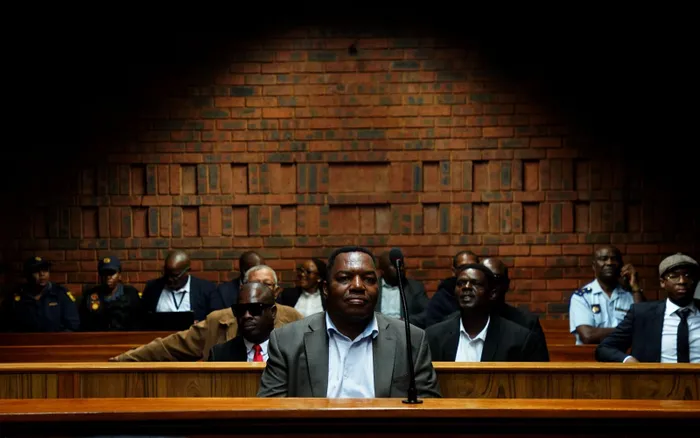
WHEN DAYS ARE DARK: Unfolding legal challenges involving Fannie Masemola may damage public trust in South Africa’s police leadership.
Image: Oupa Mokoena | Independent Newspapers
WHEN Stimela asked: Where Did We Go Wrong?, it was not a nostalgic lament aimed at a lost past. It was a moral audit. A demand that societies interrogate the precise moment judgement was abandoned and direction surrendered. It was an insistence that decline must be explained, not merely endured.
South Africa confronts that question again today, following the cautionary suspension of the National Commissioner of the SA Police Service (SAPS) General Fannie Masemola, after findings by a magistrate’s court on charges brought by the Investigating Directorate Against Corruption (Idac).
This development should not be misunderstood as closure or resolution. It is neither. It is a disclosure, and a late one.
Moments such as these test whether institutions are capable of learning or merely skilled at surviving scandal. When consequences appear only after intervention by courts and external bodies, accountability arrives by default rather than by design.
That reality should trouble us far more than the fate of any individual office bearer. What stands exposed is not simply misconduct but an institutional crisis of recognition — the inability to distinguish acid from water.
Acid and water can look identical. Both may be colourless, contained in similar vessels, and poured with equal confidence. The danger lies not in their appearance, but in their effect. Institutions collapse not because poison announces itself, but because the habit of testing what is being consumed quietly disappears.
In Whispering in the Dark, I argued that public disclosures by senior police officers were symptoms of institutional collapse rather than acts of insubordination. When internal accountability structures are perceived as compromised, truth migrates outward. Whistleblowing becomes an act of institutional self-preservation, not rebellion.
The present moment confirms that diagnosis. When judicial processes are required to intervene where internal oversight should have acted earlier, the institution’s corrective capacity has already failed. Courts and investigative bodies are safeguards, not substitutes for ethical command.
A credible police service resolves its contradictions internally before judges are forced to do so publicly. Once accountability is externalised, the institution continues to function procedurally, but its moral authority erodes.
We went wrong when blind loyalty replaced professional judgment as the organising logic of authority. Loyalty has a legitimate place in disciplined institutions. But when loyalty to individuals eclipses loyalty to law, ethics, and reason, it becomes corrosive.
Commands are followed not because they are just or lawful, but because questioning them is framed as betrayal. Silence is rewarded as cohesion. Competence is subordinated to allegiance.
In such an environment, acid flows freely as water, not because no one suspects danger, but because raising concern becomes professionally hazardous. We went wrong when rank came to function as immunity rather than responsibility.
Authority was mistaken for virtue, and seniority for credibility. Yet institutional history is unequivocal: power unchecked does not preserve systems; it distorts them. When questioning command becomes taboo, truth retreats.
We went wrong when ethical dissent was punished in practice, even as policies claimed to protect it. Those who raised concerns found themselves isolated, marginalised, or labelled difficult, while compliance was praised as discipline. Over time, the organisation learned not to see what it did not wish to confront.
And finally, we went wrong when accountability was outsourced. Oversight drifted from internal mechanisms into the hands of journalists, courts, and commissions. When this happens, institutions lose moral agency. They react only when compelled, not when conscience demands.
Nowhere is the crisis of recognition more visible than in the conflicting responses to the appointment of Dimpane to senior leadership responsibility within SAPS. Supporters of the appointment argue that continuity matters in moments of institutional strain. They contend that experience, operational familiarity, and institutional memory are stabilising assets.
From this perspective, appointing a senior insider is framed as pragmatic, a means of preventing organisational paralysis while legal and disciplinary processes unfold. To them, criticism of the appointment reflects a broader cynicism toward the institution itself, rather than an objective assessment of competence.
Critics, however, raise a fundamentally different concern. They argue that the appointment reflects precisely the organisational reflex that brought SAPS to this moment: recycling authority within the same closed command ecosystem, without sufficiently interrogating culture, allegiances, or historical proximity to dysfunction.
To these critics, the issue is not personal culpability but structural judgement. The question is not who Dimpane is, but what her appointment symbolises, an institution struggling to imagine leadership beyond familiar networks.
These conflicting interpretations are not trivial disagreements. They expose the fault line between procedural legality and moral legitimacy. An appointment can comply with formal rules and still fail the deeper test of institutional credibility. Conversely, rejecting an appointment on symbolic grounds alone risks collapsing governance into optics.
The real failure lies elsewhere. The institution lacks trusted, transparent criteria through which such appointments can be evaluated beyond factional loyalty or defensive rationalisation.
As long as SAPS remains unable to convincingly demonstrate that leadership decisions are filtered through independent ethical and professional scrutiny, every appointment will be contested, and every defence will sound self-protective. This is how acid continues to be poured as water, not because leaders are malicious, but because the testing mechanism is compromised.
The cautionary suspension of a National Commissioner may reassure some that consequences exist. But reassurance must not be confused with reform. If this moment is treated as an ending, the system will learn the wrong lesson, that accountability is episodic, externally imposed, and survivable through silence.
Acid is not removed from water by belief or hope. It is removed through testing, structure, and refusal to consume what has not been verified. The challenge before South Africa is therefore not merely to remove contaminated leadership when exposure becomes unavoidable, but to rebuild the system’s capacity to detect, resist, and neutralise toxicity early.
If SAPS is to regain public trust and institutional credibility, reform must focus on authority, culture, and procedure. Personality-based change will not suffice. The system itself must be rebuilt.
Stimela’s question endures because societies avoid answering it honestly. Where did we go wrong? We went wrong when familiarity replaced verification, when loyalty eclipsed judgment, and when silence masqueraded as stability.
The suspension of a police commissioner, or the contestation around a senior appointment, must not become symbolic full stops. There should be pauses long enough to rebuild institutional clarity.
A credible police service is not one without scandal. It is one capable of recognising danger early, correcting itself without compulsion, and distinguishing what sustains from what corrodes. Clear does not mean clean. Blind loyalty detached from truth is not water. It is acid.
The choice before us is simple but difficult: either this moment becomes another chapter in a long cycle of institutional decay, or it becomes the point at which South Africa relearns how to test what it is being asked to drink.
* Prof Jacob Tseko Mofokeng is a professor of criminology at Unisa and an NRF-rated researcher. He is a recipient of the Unesco University of Connecticut Award for his contribution to human rights and global solidarity. The views expressed are his own and do not necessarily reflect those of Unisa or the official policy or position of Unisa.
** The views expressed here do not reflect those of the Sunday Independent, Independent Media, or IOL.