

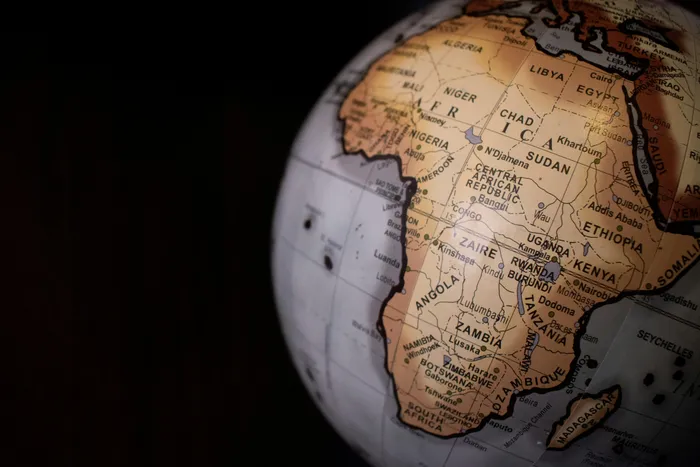
A joint report from the African Development Bank, African Union Commission, and United Nations agencies warns that the war could reduce the continent's GDP by 0.2 percentage points if it extends beyond six months, a seemingly modest figure that translates into millions of people pushed deeper into poverty.
Image: James Wiseman/Unsplash
THE US-Iran war has exposed, once again, the fundamental asymmetry of global power. As major state actors openly fight for influence over energy corridors, regional hegemony and military positioning, the African continent is being left to manage its most severe food crisis in a generation.
Today, while Washington, Tehran, Moscow and Beijing manoeuvre for advantage in the Middle East, Africa is faced with a humanitarian crisis — a crisis directly exacerbated by the resource wars that have fuelled instability from the Niger Delta to the Great Lakes.
While America, Iran, China, and Russia profit from the chaos in the Middle East, whether through elevated energy revenues, expanded military footprints, or strengthened negotiating positions, a different playbook is being written across the African continent.
African nations, particularly those dependent on food and fuel imports, are disproportionately exposed. A joint report from the African Development Bank, African Union Commission, and United Nations agencies warns that the war could reduce the continent's GDP by 0.2 percentage points if it extends beyond six months, a seemingly modest figure that translates into millions of people pushed deeper into poverty.
Projections indicate a 21% increase in food-insecure populations in West and Central Africa, and a 17% increase in East and Southern Africa.
This is a man-made catastrophe, engineered by a global order that prioritises the strategic interests of a few over the survival of many. A structural feature of an international system that has historically externalised its costs onto the Global South.
The war in the Middle East, the closure of the Strait of Hormuz, and the sudden removal of nearly 20% of global oil supply from the market have created a crisis that is reshaping energy markets, inflating costs, and exposing every nation’s vulnerabilities.
It follows the Russia‑Ukraine war, African economies had no choice but to absorb the shocks. Import bills ballooned as global commodity prices spiked, currencies came under sustained pressure as capital fled to safer havens, and inflation ate into the real incomes of households already struggling with stagnant wages and limited social safety nets.
Meanwhile, developed nations, armed with strategic petroleum reserves, domestic production capacity, and industrial policies planned long before the crisis, are in a better position. They were able to cushion the blow and even turn the situation to their advantage.
As of April 2026, more than 87 million people across East and Southern Africa are facing acute hunger. In West and Central Africa, another 52 million are projected to be food insecure by mid-year. Across the continent, 31 African nations now require external food assistance to avert catastrophe.
These figures, drawn from the World Bank, the World Food Programme, and the Food and Agriculture Organisation, describe a humanitarian emergency of staggering scale. Yet the crisis is unfolding largely beyond the gaze of global news cameras, eclipsed by the intensifying conflict in the Middle East that has consumed diplomatic bandwidth and media attention alike.
The numbers tell a story of systemic failure. In Zambia, a brutal El Niño cycle has obliterated 70% of the national maize harvest; in neighbouring Zimbabwe, the figure stands at 80%. Five countries, Lesotho, Malawi, Namibia, Zambia, and Zimbabwe, have declared national disasters over the drought and resultant hunger.
In Malawi, the government faces a funding shortfall for its national relief programme, leaving millions of families dependent on the uncertain goodwill of international donors.
The Horn of Africa is faring no better. Four consecutive failed rainy seasons have scorched crops and decimated livestock across Djibouti, Eritrea, Ethiopia, Kenya, and Somalia.
The World Food Programme has warned of “catastrophic shortfalls” in Somalia, where it urgently requires $95 million to sustain operations between March and August 2026. In West and Central Africa, the outlook is equally grim.
The World Food Programme warns that 10.4 million additional people could be pushed into acute food insecurity if the Middle East conflict persists, adding to the 52 million already projected to face crisis-level hunger by the June-to-August lean season.
Burkina Faso, already grappling with years of armed conflict and political upheaval, has launched a national humanitarian response plan targeting 4.4 million vulnerable people at a cost exceeding 769 billion CFA francs, a staggering sum for a nation where many households are now subsisting on a single meal per day.
It is in this crisis that India's humanitarian aid has arrived on the continent. In recent weeks, New Delhi has dispatched 1 000 metric tonnes of rice to drought-stricken Malawi, 1 000 metric tonnes to Burkina Faso, and 500 metric tonnes plus relief supplies, including tents, hygiene kits, and medicines to Mozambique.
The shipments themselves are modest in scale relative to the continent’s immense needs. But their significance lies not in volume but in timing and framing. India’s Ministry of External Affairs has explicitly characterised the aid as “humanitarian assistance” aimed at “supporting food security for vulnerable communities and internally displaced persons”, describing the gesture as reflecting “India’s continued commitment as a reliable developmental and HADR (Humanitarian Assistance and Disaster Relief) partner to Global South countries.”
India’s rice and food shipments alone cannot reverse a continent-wide food crisis. But they represent something increasingly rare in contemporary geopolitics: a gesture of solidarity in a world obsessed with taking sides and unwilling to analyse the real cost of conflict on the most vulnerable.
In a year when 31 African nations require external food assistance and global attention is fixed elsewhere, that may be the most valuable export New Delhi can offer.
The Middle East war will eventually end. Its geopolitical winners will count their spoils. But for millions of Africans who never fired a shot, the true cost will be measured in inflation, lost harvests, malnourished children, and a future made narrower by forces entirely beyond their control. India, at least, has chosen to notice.
* Phapano Phasha is the chairperson of The Centre for Alternative Political and Economic Thought.
** The views expressed here do not reflect those of the Sunday Independent, IOL, or Independent Media.