

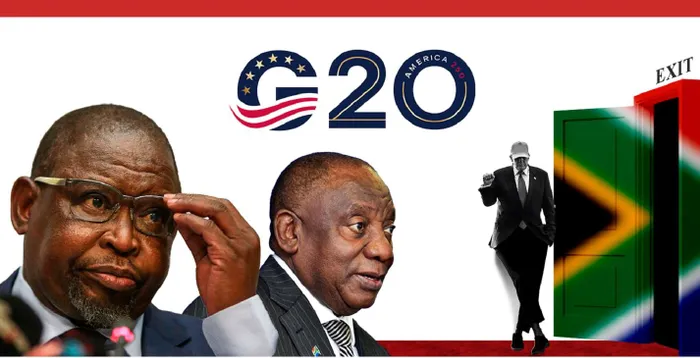
In May 2025, President Cyril Ramaphosa flew to the White House at Donald Trump’s invitation. Trump ambushed him with a multimedia presentation pushing the discredited white genocide narrative.
Image: Supplied
ON April 8, 2026, President Cyril Ramaphosa stood at the Sefako Makgatho Presidential Guesthouse in Pretoria and formally welcomed new US Ambassador Leo Brent Bozell III.
The ceremony was warm. Bozell said he had fallen in love with South Africa after just two months and promised to take the two nations to places they have never been before.
Ramaphosa, ever composed, urged diplomats to rely on quiet, constructive engagement and to avoid publicly criticising their host countries.
That warm ceremony now appears to contrast with subsequent developments. Ramaphosa, a seasoned politician, seems to operate according to traditional diplomatic rules. He received a new ambassador whose government has since taken actions that, in my view, have strained relations over the past three months.
Ramaphosa appears to have continued hoping for a better relationship. However, recent US actions suggest otherwise. The result: Finance Minister Enoch Godongwana has not been accredited to attend the upcoming meeting of the Group of 20 finance chiefs in Washington, which appears to deepen tensions with the US.
South Africa, a founding member of the G20, is excluded from the forum for the entire year of 2026. The positions of the two countries are now critically different. In my opinion, this relationship will not recover under the current approach.
In May 2025, Ramaphosa flew to the White House at Donald Trump’s invitation. Trump ambushed him with a multimedia presentation pushing the discredited white genocide narrative.
Ramaphosa pushed back calmly, a damage control exercise, nothing more. Since then, the Trump administration imposed a 30% tariff on South African goods. It boycotted the G20 Leaders Summit that South Africa hosted in Johannesburg in November 2025.
It pressured France to withdraw Ramaphosa’s invitation to the G7 summit in June 2026. And now Godongwana and the SA Reserve Bank governor Lesetja Kganyago cannot obtain US visas to attend the G20 finance ministers' meeting in Washington. Godongwana called it a holiday. This situation appears to reflect calculated tensions.
Why? In my analysis, Washington seems to want South Africa to drop its genocide case against Israel at the International Court of Justice, filed in December 2023. Ambassador Bozell arrived in Pretoria with what appears to be that mission high on his agenda.
He publicly told South Africans: “I don’t care what your courts say.” Then Ramaphosa welcomed Bozell with full honours and urged quiet engagement. That approach follows traditional diplomatic norms. US actions, however, suggest a strategy of leverage instead.
Tariffs, boycotts, and visa denials appear to be all calibrated to make the ICJ case too costly for Pretoria. This pattern suggests: withdraw the case, and the doors may open. Refuse, and South Africa stays locked out.
Also, the US has doubled down on its investigation into South Africa, expanding scrutiny of Pretoria’s trade and diplomatic conduct. That means Agoa benefits, agricultural exports, and every trade deal are now under a microscope.
This lands on ordinary South Africans — farmers, factory workers, small traders — not just diplomats. The pressure is real and escalating. South Africa’s economy, already struggling with high unemployment and slow growth, cannot afford this continued confrontation. Yet Pretoria shows no sign of backing down.
South Africa refuses to move. International Relations Minister Ronald Lamola calls the ICJ case a moral duty rooted in South Africa’s own history under apartheid. The court ruled in January 2024 that a plausible case exists.
Dozens of countries — Colombia, Cuba, Mexico, Spain, Turkey, Belgium, Brazil and others — have formally intervened in support of South Africa. The legal battle is now fully internationalised. Pretoria will not budge. Washington will not let up. The gap between the two nations has never been wider.
Ramaphosa keeps extending his hand, seemingly hoping the political climate in Washington will change. In my view, this strategy appears challenged by recent events, such as South Africa’s finance minister not being allowed into the room.
Quiet, constructive engagement may not work when the other side appears to refuse to engage constructively. The door stays locked until Washington gets what it appears to came for.
South Africans should stop pretending otherwise. In my opinion, the old gentlemanly rules are dead. And Ramaphosa appears to be still playing by them.
* Sizwe Dlamini is editor of the Sunday Independent.
** The views expressed here do not reflect those of the Sunday Independent, Independent Media, or IOL.