

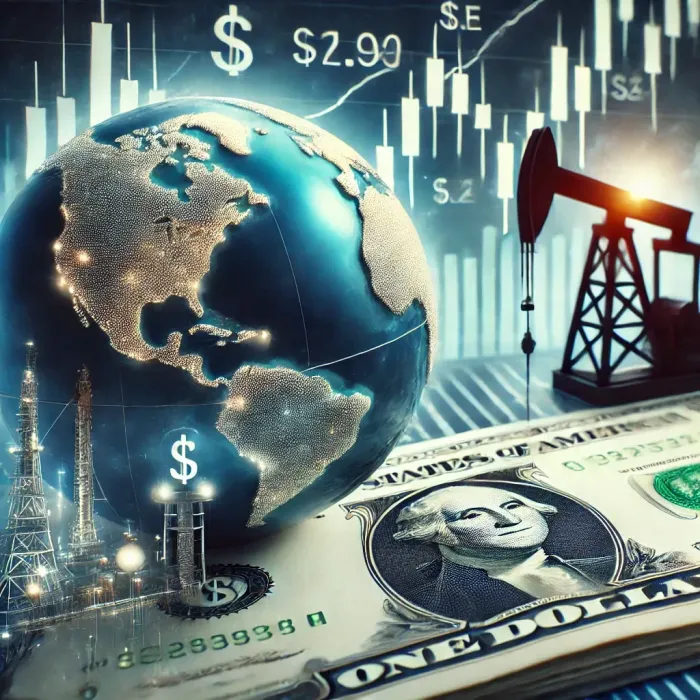
The petrodollar system, which mandates that most oil transactions be made in US dollars, has controlled the world oil market for decades.
Image: File
IT IS very difficult to imagine a war where the United States fought for its survival, as it is currently pre-occupied in Iran. Arguably, in most wars of aggression instigated at its instance since the end of World War II, these were adventures of ideological conquest.
Even when emerging less than victorious, it did not matter. For, they did not put the survival of the empire in mortal jeopardy. They would insouciantly write them down to experience.
The evolutionary graduation of the empire manifested in 1974, through the agency of an innocuously sounding phenomenon called ‘petrodollar’. Far from it being innocuous, it is a well contrived cog in the engine of the empire, arguably the most important one at that.
Prof. Richard Wolff of the US has a specific predilection to describe this phenomenon. In his words, ‘the petrodollar was a deal that’s best understood as if we were talking about gangsters- and maybe that’s what we are.’
In order to fund the war in Vietnam, the US had to print more dollars than it could underwrite with its gold holdings. This resulted in the delta between the value of the minted fiat and the value of the underlying bullion, which was widening at an astronomical pace, to the alarm of the US policy makers.
The situation was further inflamed by the French in 1971, whilst the US was engrossed in a losing war in Vietnam, where the US had just replaced the French, the erstwhile coloniser. Paris sent two naval ships to claim gold by returning the accumulated US dollars.
President Nixon was deeply perturbed that the French petition would diminish American bullion stockpiles. Predictably, on the15th of August of 1971, he decided that the convertibility of US dollars to gold was thenceforth suspended indefinitely. So did the gold standard forever perish!
The Yom Kippur war in 1973 rendered the US economy particularly more vulnerable to sudden crises as the one wrought by the oil embargo by all the OPEC member countries. The impact on oil prices was spectacularly devastating, having quadrupled from USD 3.00 to USD 12.00. With daily consumption of 57 million barrels of oil globally, the US conspired with the Kingdom of Saudi Arabia to do several things under the cognem of ‘petrodollar’!
The Kingdom of Saudi Arabia, would, for reasons befitting its vulnerability, only sell its oil in US dollars. The received dollars shall be re-invested back into the US through the purchase of bonds, treasuries, equities and other forms of investments including holding physical accounts in US banks.
In return, the US will provide military protection to the kingdom. And as Prof. Wolff suggests, just like the mafia would muse, it was only humane to remind the Saudis that ‘nice place you’ve got here. It would be a shame if something happened to it.’ So soon thereafter, other Gulf countries followed suit, as did the entire OPEC bloc subsequently.
If ever there was need to justify the starting of wars against any country, the survival of the petrodollar which is a critical prerequisite for the survival of the economic polity of the US, provides unassailable warrant.
This started a new era of assassinations of heads of state, coups, regime change operations and proxy wars. The concept of an international rules-based order became shorthand for America making the rules, with everyone obliging except America.
The strategy of the petrodollar is rather quixotically simplistic. First, the US must exercise control over the 93 million barrels of crude oil consumed everyday globally. Second, the dollar contraption seeks to destroy the organisation called OPEC. And finally, sow discord among BRICS members, and where possible, vanquish their ambitions.
Both Saddam Hussein and Muammar Mohammed Abu Minyar al-Gaddafi wanted to sell oil in currencies other than the US dollars. Their demise at the hands of respective US invasions, is written in the annals of controversial history dripping with their own blood from a gory violence.
Oil wars are generally disruptive, portending an imponderable power of destruction. They visited untold misery on the peoples of Iraq and Lybia. However, the Iranians keep having these nightmarish episodes as they did in 1952, 1980-1988 and recently, 2025 and 2026.
Within the context of the hegemon’s oil strategy in pursuance of global primacy, Iran represents one of the three countries that provide bulwark against the dominance of the greenback. The other two are Russia and China.
Ergo, no matter the puerile reasons advanced for the incessant violent attacks against Iran, the history of all the other interventions over the years, bear the hallmarks of oil wars. In 1952, it was to remove Mossadegh as Prime Minister because he nationalized the oil wells of Iran. In 1979, it was on account to a people’s revolution that toppled a Shah-led regime that paid oil fealty to the collective West.
When operation Midnight Thunder announced in June of 2025, and as it repeats in 2026 under the guise of Epic Fury, the excuse rhymes the same, but more nuanced each time. The trick is to get the Iranians negotiating for many years on the monitoring of nuclear enrichment facilities, make them believe an agreement had been reached and therefore sign for them. At the height of the fanfare, the US would immediately cancel the long-negotiated agreement. And then bomb them!
In the case of the Russian Federation, the collective West is keeping them busy with Ukraine, their useful proxy. Kept pre-occupied along the long battle contact line stretching from Kharkiv to Kherson, the US would in the meantime concentrate in west Asia.
And then there is China! In 2017, the Chinese surpassed the US as the world’s largest importer of crude oil. Consistent with China’s long game in geopolitics, renowned for its all-scenario planning and decisive implementation, they have been preparing at so many levels to remonstrate with the petrodollar behemoth. The front end of their efforts had been concentrated in using the renminbi to purchase a panoply of commodities.
With the commencement of the Russian Special Operations in eastern Ukraine, the US and EU sanctions regime against the Kremlin rained a fortuitous political windfall. Russia and China solidified their relations in ways the planners of the proxy war against Russia did not anticipate.
Suddenly, crude oil was traded in local currencies of both countries and by extension, so would all other commodities between them. India started buying Russian crude oil in Rupees and for reasons understandable to both, subsequently in Yuan. Saudi Arabia would, against the petrodollar construct, sell its crude oil to the Chinese in Yuan.
Iran did not prevaricate. Accounting for over 2 million barrels of oil to China every day, Tehran was indubitably fully on board. The fate of the petrodollar was sealed. It was bleeding from a thousand cuts. What to do. What to do!
The plan was deceptively simple. This was to make a ruse about enriched uranium and ballistic missiles, then attack Iran, engineer a regime change and in quick order, take over their oil and voila, Venezuela 2.0 is accomplished. However, the results were scripted from hell. The beleaguered Strait of Hormuz has now become a Yuan toll booth at a staggering USD 2 million equivalent a passage.
At this moment, the petrodollar, or the Donald, whoever gets to the trigger first, may be desperate for options. If attacking China indirectly via the Strait of Hormuz is taking longer and is costing the US far much more than its tolerance threshold can bear, perhaps changing strategy could work.
Considering that of all the wars that the US has ever started gratuitously, it can be said without equivocation that this is the Waterloo for the petrodollar. It is the last war of survival for the US dollar. The US military will continue to be strong and menacing no doubt. But it will be desperately haemorrhaging from its behind from a thousand holes.
The quintessential question beckons. Can the US survive without the petrodollar? To respond to that enquiry, Hilary Clinton had an urgent declaration to make.
It is time to pivot to China!
* Amb Bheki Gila Esq is a Barrister-at-Law.
** The views expressed here do not reflect those of the Sunday Independent, Independent Media, or IOL.