

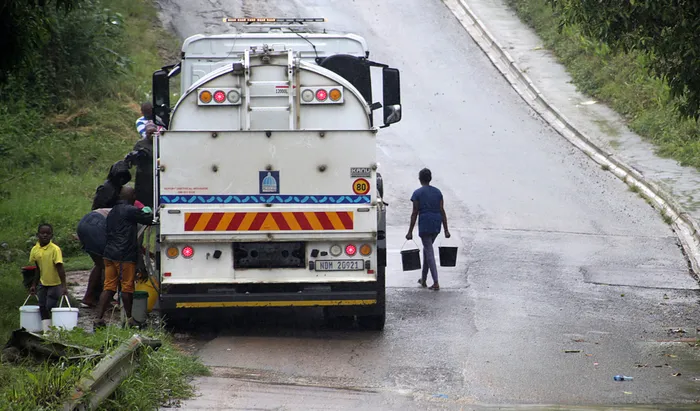
South Africa’s water challenges have reached a level of urgency that demands clarity, honesty, and, above all, a decisive shift in how solutions are approached.
Image: Khaya Ngwenya | Independent Newspapers
SOUTH Africa’s water challenges have reached a level of urgency that demands clarity, honesty, and, above all, a decisive shift in how solutions are approached. Recent reflections in the public discourse have helped sharpen this conversation.
While perspectives may differ in emphasis, there is a growing convergence on one fundamental point: the water crisis is systemic, and the response must be equally systemic.
What emerges from this evolving discourse is a clear and unavoidable conclusion. Partnership is not a complementary option in addressing South Africa’s water challenges, but the only viable solution.
At the heart of the issue is a persistent misunderstanding of the nature of the crisis. South Africa is indeed a water-scarce country, but the current situation is not defined primarily by a lack of bulk water resources.
It is defined by the failure of systems that are meant to manage, treat and deliver that water effectively. Ageing infrastructure, inadequate maintenance, governance weaknesses, financial instability at the municipal level, and high levels of non-revenue water have combined to create a system that too often fails at the point of delivery.
This is a critical insight that must be carried forward. It shifts the focus from inevitability to responsibility. If the challenge lies in systems, then it can be addressed through coordinated reform, disciplined management and shared capability.
To appreciate why partnership is indispensable, there must be an understanding of the structure of South Africa’s water value chain. At the national level, the government acts as the custodian of water resources, responsible for dams, bulk raw water systems, policy and regulation.
At the bulk supply level, institutions such as Rand Water treat and distribute potable water at scale, sustaining economic hubs and supplying municipalities. At the local level, municipalities are responsible for reticulation, maintenance, billing and service delivery to households and businesses. Each layer depends on the other. When one part weakens, the entire system is affected.
At present, the most acute challenges are concentrated at the municipal level, where capacity constraints, financial pressures and infrastructure deterioration are most evident. This is not a failure that can be isolated or contained. It has system-wide implications, which is precisely why isolated responses will not suffice.
From a government perspective, the responsibility to lead remains absolute. The state is strengthening oversight, enforcing accountability, investing in infrastructure and coordinating interventions across all spheres.
Efforts such as the National Water Crisis Committee, led by Cyril Ramaphosa, reflect an understanding that the response must be integrated and sustained. However, leadership cannot be equated with acting alone. The scale of the challenge requires the mobilisation of capabilities that extend beyond the state.
This is where the role of the private sector becomes central, not peripheral. The private sector must move from being a passive observer or a defensive actor to becoming an active co-architect of solutions.
This is because water security is foundational to economic activity. Without it, production is disrupted, costs rise, investment decisions are delayed, and growth is constrained. Businesses that focus solely on insulating themselves through self-provisioning may achieve short-term resilience, but they do so within a broader system that continues to deteriorate. That trajectory is neither sustainable nor economically rational.
The more strategic approach is for the private sector to invest directly in strengthening the water system itself. This is not a matter of corporate social responsibility, but a matter of long-term economic interest.
A functional water system reduces operational risk, stabilises costs, improves predictability and enhances the overall investment climate. It also opens opportunities for innovation, infrastructure development and service delivery.
Partnership with established public institutions, particularly water boards such as Rand Water, provides a credible and structured platform for such engagement. These institutions bring technical expertise, operational discipline and governance frameworks that can anchor private sector participation.
They are uniquely positioned to translate investment and innovation into system-wide impact, while ensuring alignment with public interest objectives.
Equally important is the role of academia. Discussions at the Water Imbizo recently hosted by the University of South Africa highlighted a critical gap in South Africa’s response. The country does not lack research, data or technical knowledge. What it lacks is the consistent translation of that knowledge into implementation.
Universities and research institutions must therefore play a far more active role, ensuring that scientific capability informs real-world decision-making, infrastructure management and service delivery. This alignment between knowledge and practice is essential. Without it, the country risks remaining in a cycle of diagnosis without resolution.
What becomes evident when these elements are considered together is that water security cannot be achieved through fragmented efforts. It requires a whole-of-society response in which each actor plays a clearly defined and complementary role.
Government must lead, regulate and enable. Water boards must anchor the system and provide technical stability. The private sector must invest, innovate and participate actively in system strengthening.
Academia must provide the scientific and technical foundation. Communities must remain engaged and hold the system accountable. There is no alternative configuration that can deliver the scale of change required.
There is also a broader responsibility that must guide this collective effort. Investment in water is not only about addressing immediate pressures, but about shaping the country’s long-term trajectory.
The systems built today will determine whether future generations inherit resilience or fragility, inclusion or inequality, capability or constraint. Water supports public health, economic development, food security and social stability. It is, in every sense, a foundation of national progress.
The reflections that have emerged in recent discourse serve as an important reminder that the crisis is both serious and solvable. But solving it requires a shift in mindset, moving from isolated action to coordinated partnership, from policy ambition to execution discipline and from short-term responses to long-term system building.
South Africa does not face a shortage of ideas, but it faces a shortage of alignment. Partnership is the mechanism through which that alignment can be achieved. Without it, the system will continue to fragment. With it, the country has the capacity to stabilise, rebuild and secure its water future.
The task now is not to restate the importance of partnership and to implement it with urgency, scale and unwavering commitment.
* David Mahlobo is the Deputy Minister of Water and Sanitation.
** The views expressed here do not reflect those of the Sunday Independent, Independent Media, or IOL.