

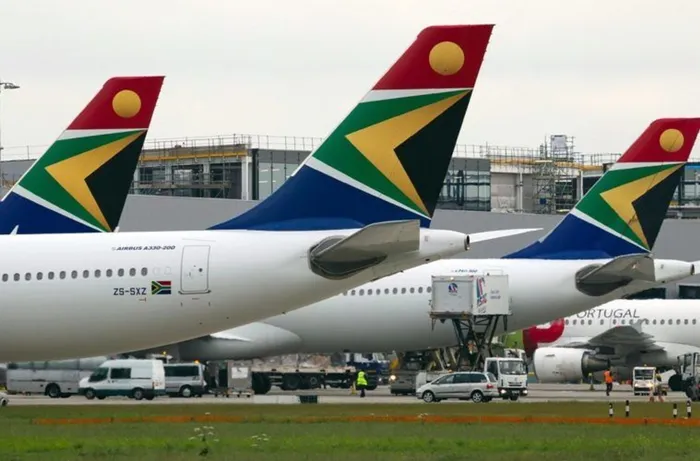
The real question is not whether SAA made a profit, but how it made it, whether it can repeat it, and what it reveals about the institution beneath it.
Image: IOL
SOUTH African Airways has reported a profit of R155 million. On the surface, it is a headline that invites relief.
After years defined by bailouts, business rescue, route cuts, and reputational damage, the figure appears to signal something South Africa has long been waiting for: a national carrier finding its footing again.
This conclusion is misleading.
Profit does not prove genuine recovery. It is a single indicator that reflects either necessary reductions or meaningful reform.
South Africa has seen this pattern before. State-owned enterprises are often declared to be “turning around” precisely when they have been resized, stabilised, or temporarily contained. The risk lies not in the number itself, but in how quickly we convert it into meaning. In doing so, we confuse financial relief with structural repair.
The real question is not whether SAA made a profit, but how it made it, whether it can repeat it, and what it reveals about the institution beneath it.
Measured against its history, the R155 million surplus is modest. Over the past decade, SAA has absorbed tens of billions of rand in bailouts, guarantees, and restructuring costs. Business rescue alone required significant public support to keep the airline solvent.
Against that backdrop, the current profit looks less like a turnaround and more like early stabilisation.
There is also a more uncomfortable possibility. Profit can come not from growth, but from shrinkage.
The post-restructuring airline is significantly smaller than its pre-crisis predecessor. It operates a leaner fleet, a reduced route network, and a tighter cost base. These changes lower risk and improve financial control, but they also limit revenue potential and global reach. A smaller airline can appear healthier precisely because it is doing less.
A smaller airline is not a stronger one; it is simply less extensive.
This is where headline interpretation becomes dangerous. Financial results do not fully capture institutional health. An organisation can report a surplus while still operating within constrained conditions, relying on residual state support, or carrying governance vulnerabilities that are not immediately visible in annual numbers.
Public perception fills gaps. In a country where confidence in public institutions is low, a positive figure is quickly seen as a sign of recovery, but recovery is a pattern, not a moment.
SAA’s history makes that caution unavoidable. Years of mismanagement, political interference, and operational instability not only produced financial losses.
They weakened institutional memory, disrupted operational continuity, and damaged credibility with passengers, partners, and lessors. Those are not problems that a single profitable year can resolve.
Trust in aviation is built slowly and lost quickly. It is restored not through headlines but through consistency across cycles, leadership changes, and economic shocks.
This is why language matters. A “turnaround” suggests a completed shift in direction, a system that has regained its internal momentum. What SAA appears to be experiencing is something more limited but still important: stabilisation. Stabilisation stops the decline. Recovery sustains forward movement. Resilience proves itself under pressure.
Merging the stages of stabilisation and recovery promotes complacency and weakens necessary oversight.
There is also a broader national question at play. South Africa has repeatedly justified support for state-owned enterprises on the basis that they are strategic assets. That argument carries weight. But it also carries an obligation. Strategic importance cannot substitute for performance indefinitely.
The issue now is transparency. Is SAA operating independently of extraordinary support, or is its profitability occurring within a tightly managed environment still underpinned by the state? The difference is critical. One point to genuine viability. The other managed survival.
None of this diminishes the progress that has been made. Returning to profitability in a capital-intensive, highly competitive global aviation market is not trivial. Cost discipline appears stronger. Operational focus is clearer. Management has restored a degree of control that was previously absent. Improvement does not equal recovery or resilience.
The real test lies ahead: Can SAA sustain profits without support, expand routes without instability, and regain lasting trust from passengers and partners?
Most importantly, can it maintain governance discipline and shield itself from past political interference?
These are the measures that matter.
For genuine change, look for repeated, consistent performance, strategic expansion, and proven tough governance, not just another single profit.
Until SAA achieves consistency, the R155m profit marks only a checkpoint, not an endpoint.
South Africa has a habit of mistaking early improvement for final resolution. We elevate stabilisation into transformation and treat relief as success. The cost of that habit is not only analytical. It is fiscal and institutional because it reduces scrutiny when it is still required.
A more disciplined reading of SAA’s results resists that temptation. It asks harder questions about sustainability, structure, and governance before allowing comfort to set in.
Because in the end, the measure of a national airline is not whether it can report a profit once. It is whether it can remain viable without extraordinary support, operate consistently across cycles, and repeatedly earn back the trust that had to be rebuilt after near collapse.
Profit is just the beginning, not proof. The real case for recovery is still to come.
* Nyaniso Qwesha is a writer with a background in risk management, governance, and sustainability. He explores how power, accountability, and innovation intersect in South Africa’s landscape.
** The views expressed here do not reflect those of the Sunday Independent, IOL, or Independent Media.