

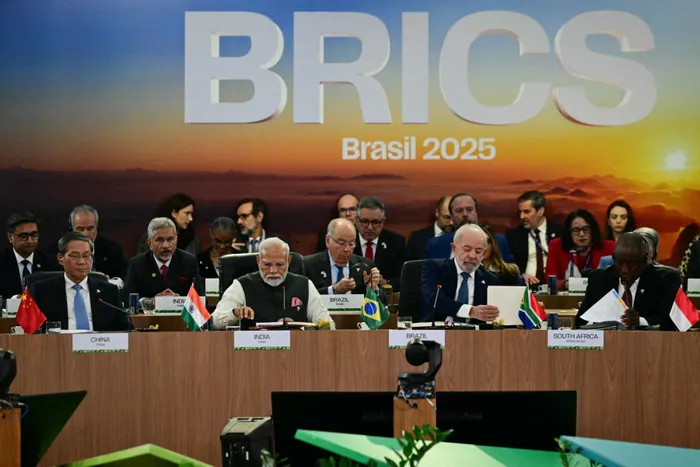
BRICS leaders at the 2025 summit in Rio de Janeiro, Brazil, on July 7, 2025. BRICS 2026 offers host India an opportunity to deepen a global agenda rooted in the UN Charter and the Pact for the Future, says the writer.
Image: AFP
THE current raging war in Iran and the wider Middle East once again raises pertinent questions about the coherence and feasibility of the BRICS+ (Brazil, Russia, India, China, South Africa and six other countries — namely Egypt, Ethiopia, Iran, Saudi Arabia, the United Arab Emirates (UAE) and Indonesia — which joined them over the past year).
These questions revolve around how feasible and coherent the group is and whether it can be, given the divergent and conflictual interests within and between its countries.
This question once again confronted the group when India, which presently chairs it, reportedly signed multibillion-dollar defence deals with Israel just hours before the United States and Israel launched heavy military attacks on Iran, killing its leader, Ayatollah Ruhollah Khomeini and other senior figures of the government.
Though the very conservative and indeed repressive and reactionary government of India, under the leadership of Prime Minister Narendra Modi, was always the weak link in the group, it is this action that raises this most important matter more sharply than anything he said or did before.
Indeed, it must represent a crucial turning point for the group. How the rest of the group and especially its founding leaders regard this matter will be of critical importance, upon their reflection on what happened.
There must be no doubt whatsoever that the unjustifiable, unlawful and terribly destructive war on Iran will invest the response of the rest of BRICS+ with an unprecedented sharpness. But the fact that it took place before this most brutal aggression against Iran will itself raise questions about the feasibility of the BRICS+ coalition as it is currently constituted.
The fact that Modi did not see a very serious violation of the integrity of BRICS+ by those military deals with Israel is itself very revealing of the incoherence and indeed fragility of the group. It also said much of him and his leadership, especially given the blatantly genocidal war of Israel in Gaza since October 2024.
While there are many other things that leaders of the group said and did in the past, which raised alarm bells about its makeup and purpose, this is the most damning and revealing development within BRICS+ to date.
Aiming to substantially increase its global influence, especially in relation to the West, led by the US, and its economic and financial domination since the late 1940s, the strategic significance of BRICS+ must be very clear. In fact, in opposition to global imperialism, led by the US, the birth and growth of BRICS+ is the most important development since the end of World War II.
But how is a coalition with many internal problems, weaknesses, and, in fact, fractures going to sustain itself and gain an appreciable momentum in its mission to build a formidable coalition against the Western world and forge a new world order?
While there might be weaknesses with the socialist Left who see BRICS+ in several respects as a sub-imperialist coalition, as in the book BRICS: An Anti-capitalist Critique, edited by Patrick Bond and Ana Gracia, there are certainly important elements in the book which draw sharp attention to instances which appear to lend credence to the notion.
For example, some actions by BRICS+ countries, such as South Africa, China and Russia, do indeed raise legitimate questions of sub-imperialism which we need to constructively and openly discuss and debate.
The Russian invasion of Ukraine in 2024 and its dynamics are just one example of the kind of issues that we must openly discuss and debate. There are many other examples, such as relations between China and Taiwan or between China and African countries, as there might be between South Africa and other African states.
In fact, given our strong anti-apartheid history of activism, especially by trade unions, community organisations and social movements, it is incumbent to address any questionable or problematic issues in BRICS+ openly and honestly.
But the socialist Left also has to realise that given the enormous weight of the historical differences within it, it is inevitable that there will be many weaknesses, failures, inconsistencies and even contradictions within BRICS+, as alluded to earlier.
My point is that these matters must be raised in an open, constructive and fraternal spirit and not be exploited for ulterior motives. BRICS+ is here to stay, whether some on the Left like it or not. These are contentious matters that the socialist Left must itself openly debate among themselves and indeed with BRICS+ itself.
The main thing is that the more countries join BRICS+, the greater the impetus will be to pose, confront and answer those difficult questions.
It is also vitally important to acknowledge the fact that, for whatever weaknesses and failures there might be in BRICS+, it represents a very important development on the global stage and especially in forging an alternative anti-imperialist global order, which is based on equality, mutual respect and the sovereignty of each state.
It is these matters, even if we wish to point fingers at the countries mentioned above, as examples, that matter very much. It is within BRICS+ that these issues must be openly discussed, debated and decided upon, and not conveniently avoided.
But a major matter around which much common purpose and solidarity could be built and harnessed in BRICS+ and outside it is its New Development Bank (NDB), founded in 2015. Though there were great and indeed worrying teething problems, the NDB has become a very important institution for the funding of various projects, especially infrastructural.
The NDB was a critically important development because it gave rise to using it to progressively lessen its dependency on the nakedly imperialist International Monetary Fund (IMF) and the US dollar, both of which have made great strides over the past few years.
The huge achievements of the de-dollarisation movement over the past few years are a direct consequence of the leading role in this regard by China and Russia, the biggest powers in BRICS+.
Today, with all its weaknesses, failures and indeed inconsistencies and contradictions, BRICS+ has achieved a lot under very difficult global circumstances, especially from the menacing aggression of the US, particularly since President Donald Trump was re-elected in 2024. It provides a potentially powerful fulcrum around which solidarity between civil society and itself can be built in the years ahead.
However, one of the big challenges facing civil society is that it is itself divided on how BRICS+ is seen and its own wider struggles against the imperialism of the West and its policies. On the other hand, there is the socialist left in civil society who are aware of the composition of BRICS+ and leaders such as Modi, which somewhat discredits it.
Yet Modi also earlier played an important part in the formation of BRICS and stressed then that it must be based on meeting human needs and aspirations. But on the other hand, he has done more than any previous leader of India to impose unprecedented repression on civil society activism there.
However, the global importance of BRICS+ is vividly evident from its size, geographic spread and control of and access to global resources. It represents around 45% of the global population, accounts for roughly 36% of global GDP and 20% of global trade.
Furthermore, its expansion in 2024 brought in the major oil producers, such as Saudi Arabia, Iran and the UAE.
What furthermore enhances the strategic importance of BRICS+ is the indisputable fact, especially after the terrifying attacks on Iran by the US and Israel since February, that the legal framework governing disputes between countries has been increasingly under attack for a long time.
In this regard, the US and Israel have openly defied the authority of the United Nations. In fact, they don’t have any respect for it, and that has been a widely evident fact for many years.
What this means is that BRICS+ provides a platform not only for its own vision and mission, but also engages with wider issues which a new global order must represent. This noble objective fits in neatly with its overriding aim, which is to build a new world order, with a complete and irrevocable break from that past and all it represented.
On a sobering note, unless BRICS+ forges strong and enduring links with the organisations of civil society, especially the trade unions and community, their future will be imperilled. In fact, it must itself take the lead in building BRICS+ from below. This can only mean that it must turn more decisively towards the civil society currents which want to build BRICS+ from below.
The final few words are to call attention to the fact that the broad media urgently needs to place BRICS+ and the issues raised in this article much more often and more prominently in the media.
And did BRICS+ say and do enough to make its voice heard loud and clear about the brutal and ongoing war waged by the US and Israel against Iran? I don’t think so. Is it a result of a crucial crossroads? Yes.
* Dr Ebrahim Harvey is a political writer, analyst and commentator.
** The views expressed here do not reflect those of the Sunday Independent, Independent Media, or IOL.