

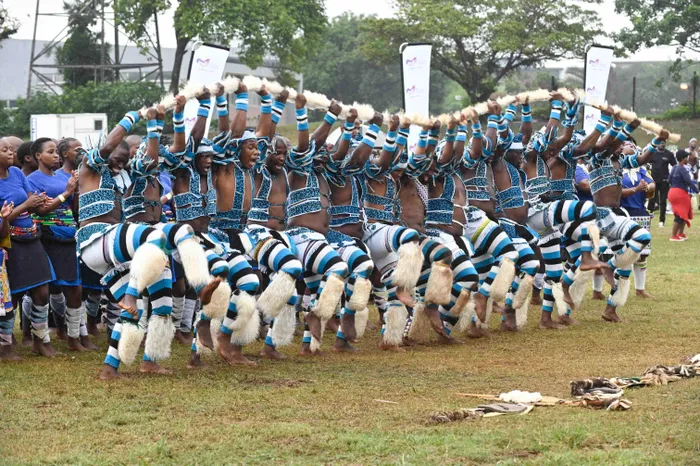
For cultural practices, beliefs, and values to be passed down through generations, stability in society and families is essential.
Image: Supplied
IF you want to destroy a people, you start with their identity — because in identity lives memory, and in memory lives power. And that is exactly what history has always been: not just dates and events, but the story of who we are allowed to believe we are.
For too long in South Africa, that story has been fractured on purpose.
Now, South Africa is being handed a rare, almost uncomfortable opportunity to finally tell its own story properly. Not in fragments. Not diluted. Not filtered through the cold, distant lens of colonial archives and Eurocentric syllabi that have long dictated what counts as “real” history.
The minister's call to overhaul the history curriculum is not merely cosmetic — it is an admission that what we have been teaching is, at its core, devastatingly inadequate. It has been the bane of the development and upliftment of Black families across our nation.
Over 30 years ago, at the dawn of independence, we inherited an education system that still carries the heavy imprint of apartheid and colonial knowledge systems. Systems that did not simply misrepresent us but actively erased us.
Oral histories dismissed. Indigenous knowledge is treated as folklore. African intellectual traditions pushed to the margins, while Europe remained the centre of gravity. We are living in a neocolonial afterlife, blindly swallowing a version of the past that is partial, distorted, and far too comfortable with silence.
And that should unsettle us. Because it means generations have been taught to understand South Africa through frameworks that were never designed to tell the truth about it.
And so even after political liberation, epistemic liberation never fully arrived. We inherited freedom, but not full authorship over our story. What got taught in classrooms was a frequently watered-down version of struggle — selective, sanitised, carefully curated.
We remember a few heroes, a few names elevated into permanence, while countless others have been forced to disappear into silence. Yet liberation was never the work of a few individuals. It was movements. It was communities. It was ordinary people who refused erasure in every corner of this country.
But of course, our inherently foreign curriculum — adopted from far-removed Europeans and Westerners — has always been incapable of grappling with that complexity. And this has been ridiculously evident — from the #FeesMustFall movements to the decades-long calls to decolonise our curriculum.
This moment demands more than cautious reform — it demands serious honesty. A reimagined curriculum is our chance to centre African perspectives not as an afterthought, but as the foundation. To teach land, labour, resistance, and memory from the vantage point of those who lived it — not those who recounted it from positions of manipulative power.
This is a prime time to move beyond a history that explains us to the world and instead build one that explains us to ourselves. Because this is the real work: dismantling the lingering authority of imperial narratives and replacing them with something far more grounded, far more uncomfortable, and far more true.
If we get this right, we are not just changing what is taught in classrooms — we are reshaping how a nation understands its past, and in doing so, how it imagines its future.
The problem with our curriculum is not only what was left out — it is the lens through which everything was framed. South African history has too often been taught through a “European” timeline, a “white” archive, a “Western” starting point that so blatantly forces the false narrative that Africa was empty until it was “discovered”.
That is not history. That is distortion. And when that becomes the foundation of education, it doesn’t just misinform — it disorients. It teaches young people, especially Black learners, to see themselves as an afterthought in their own country’s story.
Meanwhile, across the world, nations do not apologise for centring themselves. From China to India to Cuba, nations unapologetically embed their histories, their struggles, and their philosophies into every layer of education and culture.
Their children grow up knowing not only where they come from, but why it matters. These nations have shown what it means to develop through rooted identity — through education systems that take cultural philosophy, history, and worldview seriously as part of national development.
And we must ask — why has South Africa not done the same? Where is our sense of conviction? Why has African knowledge so often been treated as optional, supplementary, or “informal”, while foreign frameworks are treated as the default truth?
The hard truth is staring us in the face: South Africa cannot afford to continue treating its own intellectual heritage as secondary. Not if we are serious about transformation.
An esteemed academic specialising in education has argued that “history is fundamentally about identity”. If people do not know where they come from, they cannot fully understand who they are. Colonisation — and its continuation in the barbaric apartheid regime — worked precisely to break that link.
It actively dismantled indigenous systems of knowledge, eroded African languages, erased oral traditions, and disrupted the very ways African societies recorded and transmitted education, memory, and identity. These horrific systems didn’t just take land; they fractured our continuity. They dismantled the chain between past and present.
What we are attempting now is not invention — it is repair. It is restoration. A return to something that was never meant to be lost: African systems of knowing, African ways of recording truth, African worldviews that understood community, land, and spirituality as deeply interconnected.
Ubuntu. Botho. These are not decorative cultural concepts — they are philosophical foundations. They are the core of African indigenous identities. Yet they have been persistently stripped from formal education, as if they are incompatible with modernity, when in fact they are central to how African societies have always understood human life.
This is why decolonising the curriculum is not an abstract academic debate. It is an act of justice. A necessary correction. Because you cannot speak about inclusion, access, or equality in education when the knowledge system itself remains one-sided decades after our so-called “Liberation”.
And you certainly cannot expect black learners to fully identify with an education system that rarely reflects their histories, languages, or lived realities. That disconnect is not accidental — it is intentional, structural, and disrespectfully deliberate. It seeks to wholly undermine humanity and the inherent value of modern-day indigenous African people.
And this is where the opportunity lies. If we get this right, education stops being an exclusive space reserved for academics and formal historians alone.
It becomes something bigger, more alive, more communal. Because this is, in fact, opening the door for indigenous knowledge holders, elders, storytellers, language custodians, and, more importantly, ordinary South Africans to contribute to what counts as knowledge.
To decide what and how our future generations understand about our homeland. Oral histories, lived experiences, cultural narratives — all of it must enter the classroom not as decoration but as legitimate, authoritative educational resources.
This is the real shift we are being called into: not just rewriting textbooks, but reclaiming legitimacy over what knowledge itself looks like in South Africa.
And if we are brave enough to do that, then we are not only correcting the past — we are rebuilding the intellectual foundation of the future, and taking a critical step in meaningfully transforming our entire society for the better.
* Tswelopele Makoe is a gender and social justice activist and editor at Global South Media Network. She is a researcher, columnist, and an Andrew W Mellon scholar at the Desmond Tutu Centre for Religion and Social Justice, UWC.
** The views expressed here do not reflect those of the Sunday Independent, IOL, or Independent Media.