

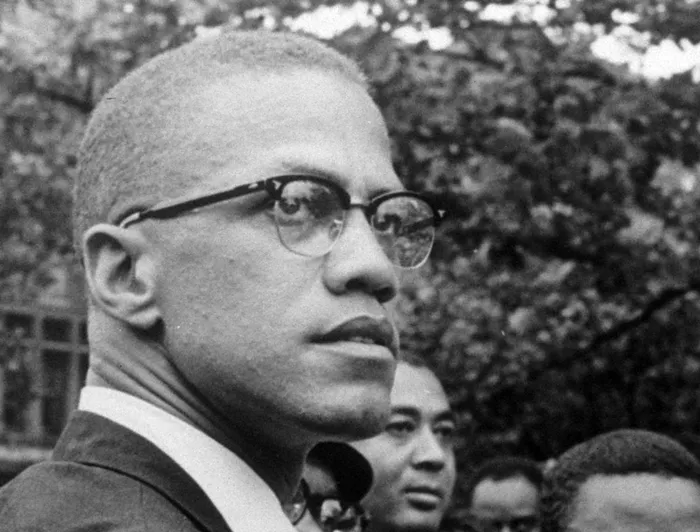
In this 1963 file photo, Black Nationalist leader Malcolm X attends a rally at Lennox Avenue and 115th Street in the Harlem neighbourhood of New York.
Image: Robert Haggins | AP | File
SIXTY years ago, on April 3, 1964, Malcolm X delivered the most famous version of this speech at the Cory Methodist Church in Cleveland, Ohio.
Amid the intense fight for civil rights in America, Malcolm X issued an ultimatum that still stands as the clearest assessment of the democratic effort: The Ballot or the Bullet.
As I sit here in the South African academic world, a place still haunted by the shadows of colonial buildings, I see that Malcolm’s words are not just history. They are a current, living critique of today.
To speak from my position as a Black Motswana scholar, both socially and intellectually, is to speak from the “underside of modernity”. It is to see the “bad faith” of a post-apartheid government that has given people the vote but has kept land, wealth, and Black dignity out of reach.
When we reinterpret Malcolm X through the philosophical ideas of Lewis Gordon and George Yancy, we understand that the “ballot” was never only about voting, and the “bullet” was never only about weapons. They symbolise the choice between silent, managed invisibility and a deep, radical break from oppression.
Gordon, in his work on existential phenomenology, describes “bad faith” as a flight from reality, a collective lie we tell ourselves to avoid the demands of justice. In South Africa and across the Global South, the ballot has often become a tool of this bad faith.
We are told that voting is the pinnacle of liberation, yet as Gordon argues, the state often engages in a “political theodicy”. It treats the system as inherently good and perfect, suggesting that if Black people are still suffering, it is a failure of the people, not the system.
Malcolm X saw through this theodicy in 1964. He recognised that the “ballot” in an anti-Black world is often a form of ventriloquism, where the oppressed speak the language of the master to validate the master’s house.
For those of us navigating the “post-colony”, the ballot has too often been a “suturing” device: It stitches up the wounds of history without cleaning the infection of coloniality underneath.
This is where Yancy’s work becomes essential. Yancy discusses the “white gaze” as a force that “sutures” (or sews up) Whiteness into a position of safety, invisibility, and unquestionable authority.
To the “white gaze”, the Black subject is either a “loyal voter” or a “menace”. Malcolm X’s rhetoric of the “bullet” was a psychological and epistemic projectile aimed directly at this suture.
By refusing to promise “non-violence” to a state that was structurally violent, Malcolm was “un-suturing” the white consciousness of his time. He was forcing the oppressor to see their own reflection in the barrel of the crisis they created.
In my own work on decoloniality, I observe this tension daily. The “white gaze” of the global academic and political order demands that the Black intellectual be “civil”, “measured”, and “reasonable”.
But Malcolm teaches us that “reasonableness” in the face of systemic dehumanisation is a form of complicity. The “bullet” symbolises the moment when the Black subject refuses to be a “problem” to be solved and instead becomes a “human” to be reckoned with.
A pivotal moment in Malcolm’s 1964 speech was his move to shift the struggle from “civil rights” to “human rights”. In decolonial terms, this was a rejection of the “geography of reason” imposed by the nation-state.
Malcolm aimed to bring the case of the Black man to the United Nations, elevating it from a domestic issue to a global crime against humanity. As a scholar of the politics of translation, I see this as a prophetic act.
It marks a shift from the “law of the land” (often the law of the coloniser) to a higher epistemic position. Citing Gordon and Yancy, we observe that the “ballot” is constrained by national borders, yet the “bullet” of decolonial thought knows no borders. It calls for a complete “un-homing” of colonial logic.
From my position in the South African “post-colony”, the warning is clearer than ever. We have experienced thirty years of voting rights. Yet, the “white gaze” still dominates boardrooms and classrooms, and the “bad faith” of politicians has left most people in a state of existential uncertainty.
Malcolm X’s warning was not a call for reckless violence; it was an insightful observation of how history functions. When voting doesn’t bring a “new humanity”, the “bullet” inevitably becomes the language of the unheard. This “bullet” is already showing up in our service delivery protests, radical student movements, and the complete loss of trust in official institutions.
To avoid the “bullet”, we need to do more than just “vote better”. We must engage in what Yancy calls a “shattering of the ego”, a complete dismantling of the Whiteness that still anchors our social and economic lives.
We need to move beyond the “bad faith” of colonial democracy and toward a decolonial reality where Black life is not a “problem” to be managed but the very centre of a new geography of reason.
Sixty years later, the clock still ticks. The ballot is in our hands, but the shadow of the bullet grows long. The question is no longer whether we will choose, but whether we have the courage to choose a world where the ballot truly means freedom.
* Prof Itumeleng Daniel Mothoagae (PhD) is head of the Institute for Gender Studies, College of Human Sciences at the University of South Africa in Pretoria.
** The views expressed here do not reflect those of the Sunday Independent, IOL, or Independent Media.