

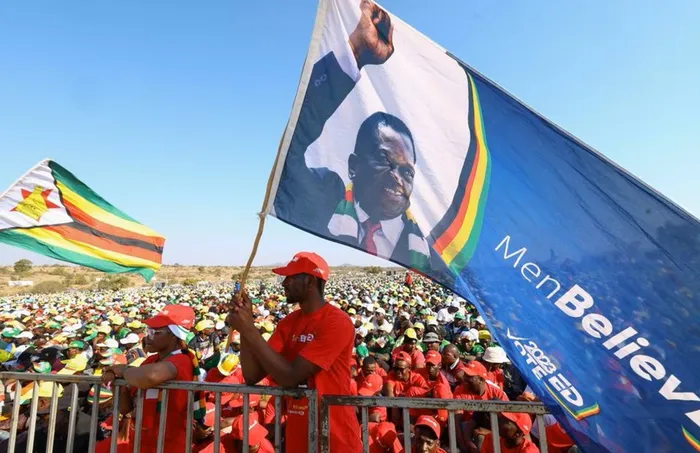
Elections are treated as the ultimate expression of accountability, the point at which citizens pass judgement on those who govern.
Image: Siphiwe Sibeko | Reuters
ACROSS Southern Africa, democracy is often understood through a single, defining moment: the vote. Elections are treated as the ultimate expression of accountability, the point at which citizens pass judgement on those who govern.
But this narrow view raises a deeper and more important question: What happens after the vote is cast?
In Zimbabwe’s current political system, accountability tends to be episodic. It intensifies during election periods, when leaders are most exposed to public scrutiny, and then recedes once power is secured. The presidency, by design, operates with considerable autonomy between elections, with limited mechanisms for continuous, institutional oversight.
This is not simply a matter of leadership style. It is a structural outcome.
The 2013 Constitution, while introducing important reforms, also revealed gaps over time. One of the more consequential shifts was the removal of the running mates clause, which would have tied the election of a president and vice president to a single electoral mandate.
In its absence, vice presidents, including Constantino Chiwenga, have assumed office through presidential appointment rather than direct electoral endorsement.
The result is a concentration of authority at the apex of the executive. Accountability flows upward, towards the presidency, rather than outward across a network of institutions. Succession, too, becomes less transparent, often shaped by internal political processes that are not always visible to the public.
This is where the debate on constitutional reform, particularly in the wake of recent public hearings, takes on regional significance.
A shift towards a parliamentary system offers a different model of accountability. In such a framework, executive authority is not fixed for a set period regardless of performance. It is conditional, sustained by the confidence of Parliament, which itself derives legitimacy from the electorate.
This creates a more continuous form of oversight. Leadership is subject to regular scrutiny, debate, and, where necessary, correction. The relationship between the executive and the legislature becomes more dynamic, with power distributed rather than concentrated.
For countries across the region, this issue is not unfamiliar terrain. In South Africa and Botswana, parliamentary systems have embedded this principle of ongoing accountability into governance. While not immune to political challenges, these systems demonstrate how institutional design can create more consistent checks on executive authority.
Within this context, the proposal to extend Zimbabwe’s presidential term to seven years should not be viewed in isolation. On its own, a longer term could raise legitimate concerns about reduced electoral accountability.
But paired with a parliamentary framework, it reflects a different logic: shifting accountability from periodic elections to the daily functioning of representative institutions.
In other words, accountability is not diminished. It is relocated.
Critics often argue that such a system risks concentrating power within political elites. But this concern overlooks a key point. Members of Parliament are themselves elected. Strengthening Parliament is, in effect, strengthening the role of citizens within the governance process, not weakening it.
It also changes political incentives. A parliamentary system requires ongoing negotiation, coalition-building, and engagement across party lines. It reduces the dominance of winner-takes-all outcomes and introduces a greater degree of cooperation into political life. Competition does not disappear, but it is balanced by the necessity of collaboration.
For Zimbabwe, and for the broader Southern African region, the question is not whether elections should remain central to democracy. They should. The question is whether elections alone are sufficient to guarantee accountability.
Experience suggests they are not.
Democratic systems are judged not only by how leaders are chosen, but by how they are governed once in office. Accountability must be continuous, visible, and embedded within institutions, not confined to electoral cycles.
In this sense, the current reform debate is not a departure from democratic principles. It is an attempt to deepen them.
The ballot remains essential. But it cannot carry the full weight of accountability on its own.
* Linda Tsungirirai Masarira is a Zimbabwean politician, labour rights advocate, and President of the Labour Economists and Afrikan Democrats (LEAD). She also heads Zhizha Natural Dried Foods, a women-driven agro-processing enterprise promoting food security and sustainable livelihoods. A strong Pan-Africanist and gender equality advocate, Masarira is known for her bold stance on governance, anti-corruption, and Africa’s self-determination.
** The views expressed here do not reflect those of the Sunday Independent, Independent Media, or IOL.