

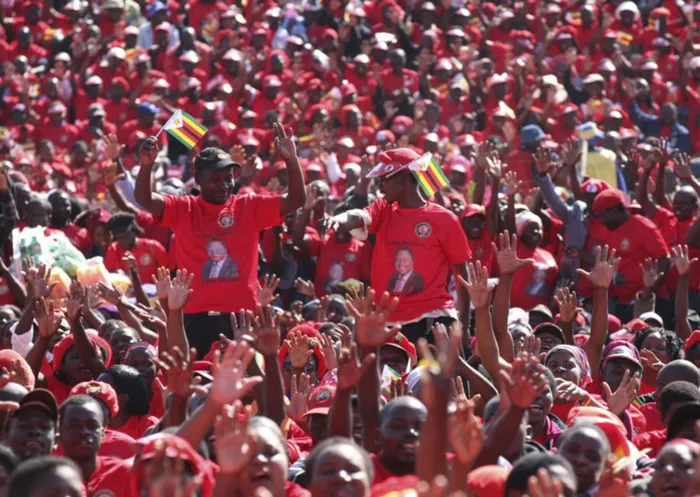
Crowds cheer Zimbabwe opposition Movement For Democratic Change leader Morgan Tsvangirai at the launch of his party's election campaign in Marondera about 70km east of Harare. In 2013, when the Movement for Democratic Change sought a delay of elections through the Southern African Development Community, the argument was not simply about political advantage.
Image: File
ZIMBABWEAN politics carries a familiar tension. It is the tension of a nation that has waited decades for meaningful change yet expects that change to arrive quickly, cleanly and without friction.
It is an understandable impatience, but it is also a dangerous one. Because history is clear on one point: change is not an event. It is a process. And processes take time.
This is what makes the current debate around extending the presidential term and reforming the electoral system more than a political contest. At its core, it is a design question. It asks what kind of system gives a society the best chance not just to change leadership, but to transform outcomes.
Zimbabwe has been here before. In 2013, when the Movement for Democratic Change sought a delay of elections through the Southern African Development Community, the argument was not simply about political advantage. It was about timing and structure.
The concern was that without sufficient space for reforms to take hold, elections risked becoming procedural exercises rather than vehicles for real change. It was a warning that rushing to the ballot can sometimes mean postponing transformation.
More than a decade later, that warning still hangs over the system.
The five-year presidential term, often treated as standard, reveals its limitations in practice. It is rarely five years of uninterrupted governance. The early years are consumed by political consolidation and contestation. The middle period offers a narrow window for policy movement.
Then, almost inevitably, the system slips back into campaign mode. What remains is a cycle where governing is squeezed between elections, rather than elections serving governance.
This is the context in which a seven-year term is being proposed. Not as a political indulgence, but as a structural adjustment. The argument is straightforward: meaningful policy requires time.
Infrastructure cannot be judged at the point of announcement. Education reform does not produce results within a budget cycle. Health systems do not stabilise on electoral timelines. Extending the term is, in this view, an attempt to align political time with developmental reality.
But time, on its own, does not guarantee better outcomes. It can just as easily entrench stagnation if the underlying incentives remain unchanged. That is where the second part of the debate becomes critical.
Zimbabwe’s current system of directly electing a president has, over time, reinforced a politics centred on individuals rather than institutions. It rewards visibility, simplifies complex policy questions into campaign slogans, and often produces leaders who are electorally effective but structurally constrained once in office. The system is designed to win mandates, not necessarily to build consensus.
A shift to a parliamentary model would alter that logic. It would make leadership contingent on negotiation rather than declaration. It would require coalitions, force compromise, and anchor authority in collective legitimacy rather than singular personality. In such a system, power is not simply won; it is continuously maintained through agreement.
Critics argue that such a system dilutes democratic choice. But that argument assumes democracy begins and ends at the ballot box. It does not. Democracy is also measured by what follows: the quality of decisions, the stability of institutions, and the extent to which governance delivers tangible improvements in people’s lives.
A system that produces repeated deadlock or shallow victories may be procedurally democratic, but substantively weak.
Zimbabwe now faces a more profound question than whether to amend its Constitution. It must decide what it values more: immediacy or impact. The current model prioritises speed.
It produces regular electoral moments, clear winners, and visible transitions. But it struggles to sustain long-term change. The proposed reforms suggest a different philosophy, one that privileges depth, continuity and structural coherence.
There is no perfect system. Extending terms carries risks. Shifting electoral models introduces uncertainty. But maintaining a system that compresses governance into narrow windows while expanding the theatre of politics is not a neutral choice. It is a choice with consequences, one that the country continues to live with.
The real question, then, is not whether Zimbabwe can afford to give itself more time. It is whether it can afford to keep operating without it.
* Mabasa Sasa is a veteran journalist with over 20 years of experience covering politics, governance, and regional affairs in Southern Africa. He has served as Editor of The Southern Times in Namibia and The Sunday Mail in Zimbabwe, and contributor for New African, bringing deep regional insight and a strong track record in shaping cross-border public discourse.
** The views expressed here do not reflect those of the Sunday Independent, Independent Media, or IOL.