

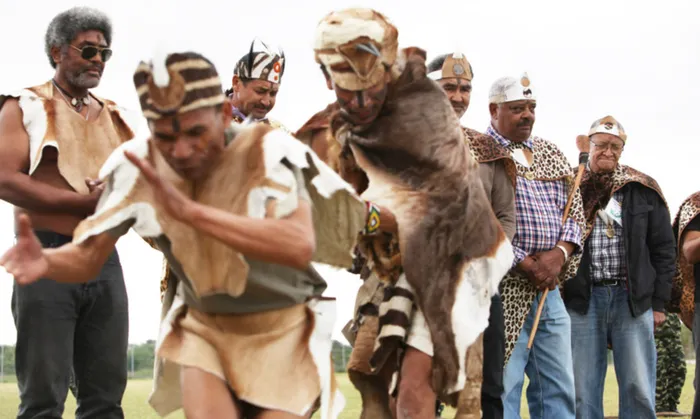
The Khoisan people were increasingly absorbed into the “Coloured” population, following the divide and rule strategy.
Image: File
WE must concede that oppressed and exploited black people, especially the poor black working-class majority, including many progressive activists and even some intellectuals, failed to fully understand what had really happened or not happened during the negotiations between the discredited white Nationalist Party (NP) and the unbanned African National Congress (ANC) between 1991 and 1993.
By this I mean that there was an increasingly clear realisation by the Left, especially by those socialists outside of the ruling ANC-alliance with the Congress of South African Trade Unions (Cosatu) and the South African Communist Party (SACP), that the political negotiations between the ruling Nationalist Party (NP) and the African National Congress (ANC), the largest and leading organisation of the broad national liberation movement, was not going to result in any fundamental transformation of the economy.
In fact, crucial matters regarding the economy were deliberately either not raised or properly dealt with during those negotiations.
What clearly had happened was that the release from prison of former President Nelson Mandela and many other ANC leaders and the unbanning of the ANC, the Pan Africanist Congress (PAC) and the South African Communist Party (SACP) had intentionally produced an unprecedented political and social euphoria of fundamental changes in the making.
This is what the then-ruling white Nationalist Party (NP) had wanted South Africans, especially the Black majority, to believe was happening during those negotiations. On the other hand, the white minority had reluctantly agreed to democratic, non-racial and free and fair elections, as the only way in which this country would not descend into a protracted, fierce and bitter war between black and white people.
Then, after 42 years in power, the NP, especially after the gigantic and explosive mass black struggles of the 1970s and 1980s and the effective sanctions campaigns of the 1980s, decided to change course and abandon classical racist apartheid.
But what was far more important politically was to ensure that in the negotiated process, which began soon after Mandela and other political prisoners in 1990 were released, the capitalist economic system survived virtually intact.
This strategic objective was arguably the most important and indeed central pillar of the NP throughout the negotiations process, which began in 1992 and ended in 1993, and culminated in the 1994 Uhuru elections, the first-ever such event in the entire history of South Africa.
Remember that virtually since the arrival of Jan Van Riebeeck and his men in the Cape in 1652, material and economic interests went hand in hand with the increasingly racial and racist conduct of these Dutch colonisers.
Colonisers, because it soon became clear that it was impossible to take root in the Cape and advance their interests, which grew exponentially since their arrival in 1652, without seeking to take the land and other resources which belonged to the indigenous Khoi-Khoi and San people.
From seeking to establish a refreshment station on their travels to the East and elsewhere, this mission turned into the initial steps towards outright Dutch colonisation of the Cape and later the country that is today called South Africa.
But if we study other forms of Dutch, British and French colonialism in Africa and elsewhere, we will find similar initial benign intentions and wishes, driven by circumstances.
The white people generally in this country, and not just the Afrikaners, are the ancestors of those people. They indeed stole and dispossessed the land from its original inhabitants, the Khoi Khoi and San peoples.
These were the original natives of this country and not black Africans or “Bantu” as the NP referred to them. They migrated to our shores much later, from Central and East Africa, but ultimately became the most oppressed and exploited of all Black people in this country.
The Khoisan people were increasingly absorbed into the “Coloured” population, following the divide and rule strategy of initially the Dutch and later our new colonisers, the English. But instead of giving them the historical recognition they fully deserve, they have been the stepchildren of South African history.
Instead, white people and the Dutch and English colonisers have been presented as the forerunners and heroes of South African history. Today, in purportedly “post-apartheid” South Africa and a new and liberated country, they are still the best off in the entire population of this country.
Instead, it is the Black working-class majority who are poorer in socio-material terms and even worse off than they were under apartheid. Altogether, socioeconomic inequalities between white and Black people have increased after 1994, so much so that we are recognised as the most unequal country in the world.
In fact, no area of life and work after 1994 has been untouched and unaffected by the legacy of race, including the media. It is an undeniable fact that white journalists, utilising the privileges they and their parents enjoyed under apartheid, have been at the forefront of new media developments, such as the Daily Maverick.
But it is also very important to realise that, though valid questions have been raised about their funding sources, Daily Maverick has played a leading role in raising key and critical questions about what has happened under the rule of the African National Congress (ANC).
They exposed massive corruption and mismanagement of state resources, which has also had a very negative impact on the daily lives of the black working-class majority, siphoning enormous resources that should have been utilised to raise their low standards of living.
However, a very important exposition of such corruption and mismanagement has also taken place by Independent Media, which is black-led. In fact, upon closer examination, they have, through their various publications, both in print and online, been at the forefront of forging a more radical media, especially in exposing the shenanigans in the state and government and providing space for the setting of an alternative agenda for both the media and South African society.
Unfortunately, this role by Independent Media has not received the recognition it deserves. Instead, allegations of malfeasance and mismanagement within it have received prominent attention in other forms of media, especially around the executive leadership of Iqbal Surve.
Any close scrutiny of Independent Media publications will show that they have been in the forefront of critiques of corruption and mismanagement in the government and state, more than any other publications.
These are among the reasons why I continued to write for various publications of Independent Media for two decades, despite all the unbridled and fierce criticism levelled at Surve and the Sekunjalo Group, of which it is a subsidiary.
However, several white-dominated publications have still not seriously addressed the question of what has happened to white people after 1994, probably because to do so will inevitably give rise to their own trajectory, and since their inception, they have been essentially white-dominated and controlled publications.
There is absolutely no way in which race can be divorced from the contentious media landscape. The privileges white journalists enjoyed under apartheid essentially continued after 1994, which enabled them to secure the skills and resources to play the role they have in Daily Maverick, the Mail & Guardian and other publications, including having a big focus on black corruption or allegations thereof, not that such action needed to be justified.
* Dr Ebrahim Harvey is a political writer, analyst and commentator.
** The views expressed here do not reflect those of the Sunday Independent, Independent Media, or IOL.