

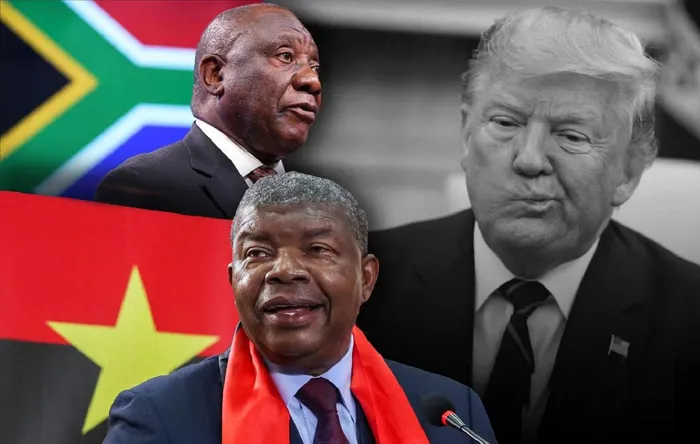
Trump’s confrontation of Ramaphosa, the Bozell episode, the aid cuts, the tariffs, and the unilateral military action in Iran without consultation with Nato partners have all combined to push countries that were, by no means, hostile to the US toward new arrangements and new language.
Image: Supplied
SINCE US President Donald Trump returned to the White House in January 2025, no African nation has found itself more squarely in Washington’s crosshairs than South Africa.
The deterioration in relations began almost immediately. In February 2025, Trump signed an executive order suspending the majority of foreign aid to Pretoria, cutting off HIV programme funding that supported more than 8 000 healthcare workers.
The administration simultaneously declined to renew the African Growth and Opportunity Act (Agoa), ending South Africa’s tariff‑free access to the US market that had been in place since 2000.
On May 21, 2025, President Cyril Ramaphosa travelled to Washington for an Oval Office meeting intended to reset the bilateral relationship. Trump dimmed the lights and played a video compilation alleging violence against white South Africans.
Ramaphosa, who had brought business figures including Johann Rupert and golfers Ernie Els and Retief Goosen to lend the meeting credibility, pushed back directly. In the spirit of his remarks, he rejected the “Afrikaner farmer genocide” narrative, saying that if such a pattern existed, these figures would not be present.
Several analyses later confirmed that some of the footage shown had been misrepresented and, in certain cases, depicted violence from other countries entirely.
The appointment of Leo Brent Bozell III as US ambassador to South Africa in late February 2026 added a further flashpoint. In March 2026, Bozell publicly challenged South Africa’s affirmative action legislation and its diplomatic ties with Iran.
Foreign Minister Ronald Lamola summoned the ambassador and told him he “must not take us back to a polarised society along racial lines”. Bozell subsequently softened his remarks and clarified his position. Pretoria, for its part, responded to the accumulated pressure by accelerating its economic diversification.
In November 2025, European Commission President Ursula von der Leyen and EU Council President Antonio Costa travelled to Johannesburg and signed a Clean Trade and Investment Partnership, together with a critical minerals agreement backed by €750 million in new EU investment.
South Africa also continued to deepen its BRICS ties, the grouping that includes Brazil, Russia, India, China, and a growing number of new members. The direction of South Africa’s trade and diplomatic strategy was becoming clear: Pretoria was not going to be held hostage to Washington’s demands and would not allow its hostility to determine its economic future.
When the US‑Israeli military offensive against Iran began in 2026, Ramaphosa made South Africa’s position unmistakable. On March 29, 2026, speaking at the African National Congress elective conference in Limpopo, he delivered remarks that have been widely interpreted as condemning the war as “another act of imperialist aggression that has placed the global economy and international security at great risk.”
He framed South Africa’s position on Iran in the same terms as its broader foreign policy stance, affirming that the country “has stood firm in the face of very powerful and vicious global forces that are working to undermine the standing and the sovereignty of other nations”, and that it “will not be pushed around”.
He reiterated South Africa’s support for Palestine, Cuba and Western Sahara, describing these as consistent with an independent foreign policy that Washington had failed to pressure into submission.
South Africa was not alone among African nations in pushing back against Washington’s posture. On March 28, 2026, at the 11th Summit of the Organisation of African, Caribbean and Pacific States (OACPS) held in Malabo, Equatorial Guinea, Angolan President João Lourenço used Angola’s final day as the organisation’s rotating president to deliver the most direct condemnation of US foreign policy to come from an African head of state in recent years.
His remarks were not addressed to Washington by name, but the context left no ambiguity. Angola was completing a three‑year tenure leading the 79‑nation bloc, and Lourenço chose the occasion to lay out a comprehensive critique of what he described as a return of colonial logic in the conduct of major powers.
The backdrop to Lourenço’s speech was the ongoing US‑Israeli military offensive against Iran, which had begun in 2026 and prompted Iran to threaten closure of the Strait of Hormuz, through which a major share of the world’s oil supply passes daily.
Speaking in Malabo, the Angolan president drew an explicit link between the military action against Iran, the earlier invasion of Iraq, and the historic logic of colonial intervention. “Today, with the most different arguments, but with the same objectives, those of controlling the main energy sources on the planet, oil, gas, and critical and strategic minerals, military interventions are carried out at any point on the planet,” according to his summarised remarks.
Lourenço then challenged the legal basis for pre‑emptive military strikes. “The world has become a jungle, where any superpower invokes a non‑existent right under international law, the right of pre‑emptive attack, supported only on the presumption that someone is preparing to attack and destroy me,” a paraphrase of his broader critique, he told the assembled heads of state and government.
Lourenço rooted his critique in the shared historical experience of the OACPS’s member states. “We, the peoples of Africa, the Caribbean and the Pacific, having lived for centuries a bitter experience, know that the same motivations that were at the basis of colonialism, the control and plunder of our wealth, persist unfortunately today in the full 21st century,” in the spirit of his address.
He called on the organisation to break decisively with a model of dependence and move toward what he described as a strategic partnership between regions that share global responsibilities.
“We decided to abandon the model of assistance‑based partnership of the past and established the basis for a strategic partnership between regions that share global responsibilities and common objectives, so as to give substance to the fundamental principle of a more balanced and dynamic multilateralism by which the world must be governed,” reflects his central argument.
At the close of the summit, Angola formally handed the rotating OACPS presidency to Equatorial Guinea’s President Teodoro Obiang Nguema Mbasogo.
The weight of Luanda’s criticism was further highlighted by the context of recent bilateral relations. Under the Biden administration, Angola had been positioned as a key partner in the Lobito Atlantic Railway corridor, a US‑backed infrastructure initiative connecting Angola, the Democratic Republic of the Congo, and Zambia, presented as Washington’s flagship alternative to Chinese investment on the continent.
The public rebuke from Lourenço placed that investment in question and signalled that Angola was not prepared to subordinate its foreign policy positions to American preferences, regardless of the economic stakes involved.
That two heads of state from the Southern African Development Community (Sadc), Ramaphosa and Lourenço, condemned Washington’s conduct in Iran within 24 hours of each other, independently and from different platforms, was not a coincidence. It reflected a shared regional reading of US foreign policy.
The resistance to Washington’s approach was not confined to Africa. On April 1, 2026, French President Emmanuel Macron, speaking in Tokyo alongside Japanese Prime Minister Sanae Takaichi, offered the sharpest public criticism of American conduct to come from a traditional Western ally in recent memory.
Trump had posted on social media the day before that France had been “very unhelpful” during the Iran campaign, after Paris refused to allow US military supply planes to fly over French territory.
Macron’s office confirmed that France had not been consulted and was not part of the offensive “from day one”. In the words of his public remarks, Macron praised Europe’s “predictability”, a word that carried obvious weight against the backdrop of US behaviour.
“But predictability has value, and we have demonstrated that over all these past years and, dare I say, even these past weeks: we are where you know we will go,” according to his summarised comments.
He then criticised partners that move fast but where “you don’t know whether the day after tomorrow they will still be in that position, and whether tomorrow they won’t make a decision that could hurt you without even informing you,” a paraphrase of his broader point.
Macron and Takaichi jointly called for a ceasefire and for the restoration of free navigation through the Strait of Hormuz. Japan, which sources 95% of its oil from the Middle East and had been drawing on strategic reserves since the conflict began, had concrete practical reasons to align with Paris rather than Washington.
What is taking shape across both Africa and Europe is a realignment that Washington’s own conduct is accelerating. The Biden administration spent years rebuilding US influence on the African continent through Agoa, the Partnership for Global Infrastructure and Investment, and direct bilateral engagement with countries like South Africa and Angola.
That work is being undone at speed. Trump’s confrontation of Ramaphosa, the Bozell episode, the aid cuts, the tariffs, and the unilateral military action in Iran without consultation with Nato partners have all combined to push countries that were, by no means, hostile to the US toward new arrangements and new language.
Angola, South Africa, France, and Japan are not natural critics of Washington. The fact that all of them are now speaking plainly about coercion, the absence of consultation, and the logic of great‑power resource competition is a direct measure of how much ground the US has lost.
* Sizwe Dlamini is editor of The Sunday Independent and the views expressed here are his own.