

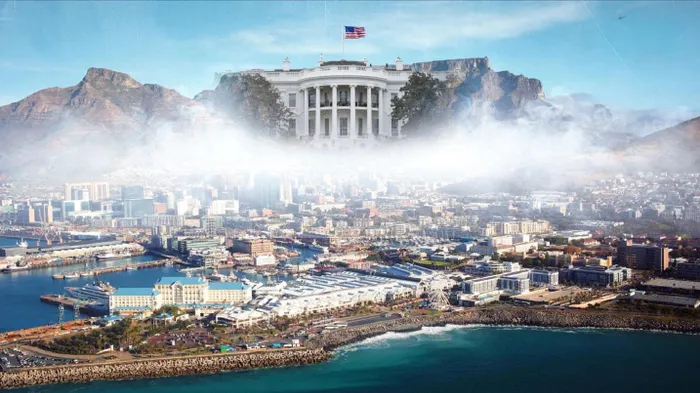
The US government functions as the force behind the effort.
Image: File
ON 10 March, United States Ambassador Leo Brent Bozell III stood before South African business executives at the BizNews Conference in Hermanus and told them, plainly, that America was running out of patience with their government.
He urged those executives to speak out against Broad-Based Black Economic Empowerment (BBBEE). Within two days, the South African government had issued a formal diplomatic protest.
Within three days of that protest, Gayton McKenzie, a sitting Cabinet minister and leader of the Patriotic Alliance, was at the ambassador’s official residence in Pretoria for a private meeting. His party released a statement afterwards calling Bozell a man of discernment, experience and the trust of Donald Trump.
At the same Hermanus conference, Bozell met AfriForum chief executive Kallie Kriel. AfriForum had spent the prior year in Washington lobbying against South Africa’s Expropriation Act, BEE, and the Constitutional Court ruling on the kill the Boer chant.
The organisation now had direct access to an ambassador who had just made those same positions official US policy from a public platform in South Africa. The US Embassy later published on its official social media account a photograph of Bozell with Bosa’s Mmusi Maimane, describing their meeting as an engaging discussion about South Africa's political landscape.
Bozell had arrived in South Africa having been appointed not from a diplomatic career but from the leadership of the Media Research Center, a conservative US advocacy organisation. He is President Donald Trump’s man in Pretoria, and his conduct in March 2026 made that role visible.
Fifteen days after Hermanus, on 25 March 2026, AfriForum held a media briefing at its Centurion headquarters and released a 21-page document targeting ANC Secretary-General Fikile Mbalula.
The National Prosecuting Authority had already examined the matter and declined to prosecute, finding no evidence of criminal conduct. AfriForum rejected that finding. Advocate Gerrie Nel, head of AfriForum’s Private Prosecution Unit, wrote directly to newly appointed National Director of Public Prosecutions Advocate Andy Mothibi, demanding that the NPA reverse its position and prosecute.
Kriel then announced that the dossier would simultaneously be submitted to US authorities, with a request that the US invoke the Global Magnitsky Act against Mbalula personally, imposing asset freezes and a travel ban.
Kriel framed the submission to Washington around Mbalula’s public speech and linked that speech to the risk of US economic punishment falling on South Africa. The ANC rejected the dossier as a politically motivated smear.
National spokesperson Mahlengi Bhengu stated that matters of law enforcement were handled within South Africa’s own legal framework and not by foreign governments acting at the request of lobby groups.
Mbalula said he would not be intimidated by an organisation representing less than 10% of white South Africans and directed his lawyers to put AfriForum on notice for reputational harm.
The political alignment running through all of these events is consistent and documented. Bozell's demands at Hermanus covered five areas: that South Africa withdraw from its International Court of Justice genocide case against Israel, abandon BEE, repeal the Expropriation Act and distance itself from Iran and China. AfriForum has long campaigned on the same ground.
Both McKenzie and Maimane carry prior ties to Israeli political leadership on record. McKenzie visited Israel in July 2023, met President Isaac Herzog, and declared publicly that Israel held answers to South Africa’s problems.
Maimane met Prime Minister Benjamin Netanyahu in 2017 and, in January 2024, when South Africa filed its ICJ case, stated that the case would not bring peace. The ambassador's meetings, AfriForum’s dossier, and the political statements of Maimane and McKenzie are not isolated events. They share a single set of targets and a single direction of pressure.
The coalition that has taken shape around Ambassador Bozell's presence in South Africa is now visible. AfriForum operates on the legal and lobbying front. Maimane and McKenzie serve as political faces with access to Parliament and Cabinet.
The US government functions as the force behind the effort. The targets of this coalition are equally clear: The ANC’s foreign policy, its transformation legislation, the Expropriation Act, South Africa’s genocide case against Israel at the ICJ, and every policy that expresses this country's right to govern itself on its own terms.
The Mbalula Dossier is not the beginning of this operation. It is its first public product, and South Africans deserve to understand precisely what they are looking at.