

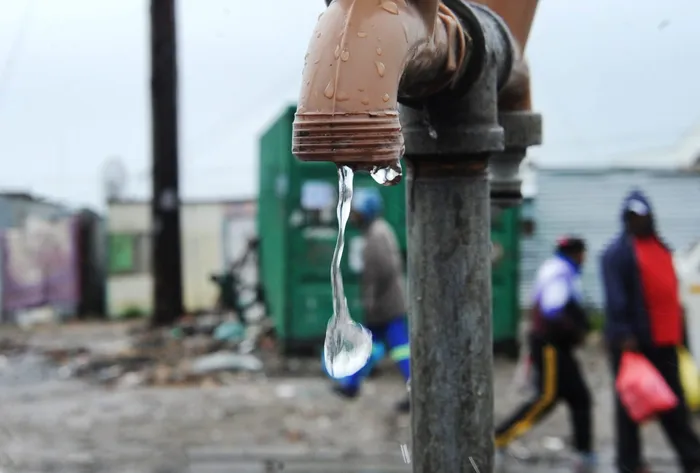
Government says fixing failing infrastructure and reducing massive water losses is now an urgent national priority.
Image: Cindy Waxa / Independent Newspapers Archives
SOUTH Africa’s water crisis did not arrive overnight. It is the slow, predictable consequence of years of neglect, underinvestment, cadre deployment, and political denialism.
Today, millions of South Africans live with dry taps or, worse, contaminated water that poses a direct threat to public health.
Yet, astonishingly, those in power still downplay the severity of the problem. When Water Minister Pemmy Majodina claims “there is no crisis”, it raises a simple question: What reality is she living in?
When Gauteng Premier Panyaza Lesufi complains on national television that he has to shower at a hotel, it reveals a political class detached from the daily indignity faced by ordinary South Africans.
The Blue Drop Report shows that nearly half of South Africa’s drinking water fails to meet safety standards. Of the water that does enter the system, an estimated half is lost through leaks in collapsing infrastructure.
From Johannesburg, where reservoirs are full but taps inexplicably run dry, to Makhanda, where a R400 million treatment plant remains incomplete after a decade, the effects of this crisis are felt countrywide.
Warnings were issued years ago. Experts cautioned that population growth would outstrip infrastructure capacity. Instead of acting, the government delayed. Critical bulk supply projects such as the Lesotho Highlands Water Project and the Clanwilliam Dam Project have been bogged down by delays, mismanagement, and corruption.
But the crisis is not only about failing infrastructure, but it is also about failing institutions.
Across the water value chain, South Africa faces a severe shortage of technical skills. Reports indicate that 20% of water board members have no engineering expertise. Municipalities have been hollowed out and are unable to attract or retain skilled professionals.
On some oversight visits, the situation borders on the absurd. Unqualified individuals are placed in technical roles, such as in Mokopane municipality, where a former teacher was appointed to the water and sanitation department with no technical skills or expertise.
In Stellenbosch, the two most senior positions remain vacant, with the municipality acknowledging that it cannot attract engineers and technical staff because it is too expensive and it cannot compete with market-related salaries.
In Sol Plaatjie, 61 funded posts remain unfilled despite high unemployment, leaving critical vacancies open and billions allocated without the capacity to spend effectively.
National Treasury’s own reports confirm the problem. Municipalities are underspending on water infrastructure, not because they lack money, but because they lack the competence to use it. Throwing R156 billion at broken institutions will not resolve the crisis if those institutions cannot deliver.
And yet, amid this bleak national picture, there is a single glimmer of hope.
In Tshwane, a quiet turnaround is underway. After successive failed administrations, and under the leadership of Dr Nasiphi Moya, the city is demonstrating that competent and accountable governance can deliver results.
Nowhere is this clearer than in Hammanskraal, a community that became a symbol of state failure after years of neglect at the Rooiwal Wastewater Treatment Plant led to a deadly cholera outbreak.
Today, that project is finally being implemented with urgency, supported by the Development Bank of Southern Africa. Progress is being tracked, oversight is being enforced, and, for the first time in years, residents are gaining access to safe, clean water.
According to the National Treasury, Tshwane has spent 100% of its capital budget for water infrastructure, far outperforming cities such as Johannesburg (15.8%), Nelson Mandela Bay (3.4%), and even Cape Town (27.6%).
Because it has delivered, Tshwane has unlocked additional performance-based grant funding of R341 million, which means more leaks can be fixed, and key treatment plants can be upgraded more quickly. This has been achieved in just one year; imagine the progress that can be made over five more, or even a decade.
This is the lesson: When government works, it is rewarded, and when it is rewarded, it can do even more.
The contrast with failing municipalities is stark. Across much of South Africa, budgets go unspent, infrastructure decays, and communities are left to suffer. This exposes a fundamental truth: The water crisis is not primarily a resource problem; it is a governance problem.
Water is life. It underpins public health, economic growth, and human dignity, yet it has become another casualty of corruption, cadre deployment, and neglect.
But it does not have to be this way.
Tshwane’s progress shows that the crisis can be reversed. It requires leadership that prioritises delivery over rhetoric, accountability over excuses, and competence over cadre deployment.
South Africans deserve more than denialism and dysfunction. They deserve a government that recognises the scale of the crisis and acts with urgency to fix it.
* Malebo Kobe is an ActionSA Member of Parliament.
** The views expressed here do not reflect those of the Sunday Independent, Independent Media, or IOL.