

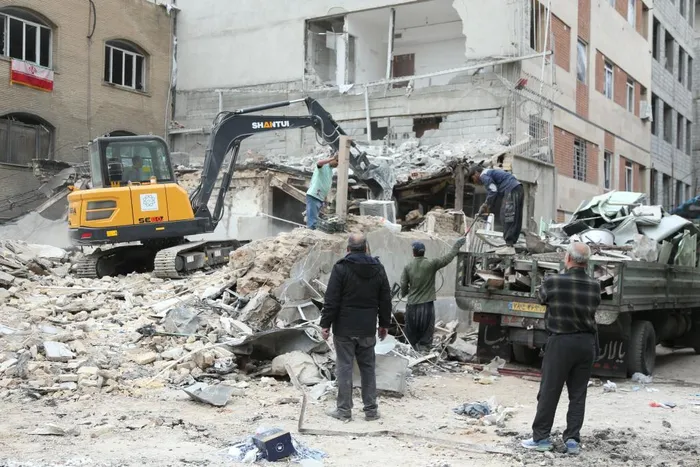
People clear the debris among destroyed buildings at a residential area in Tehran, Iran.
Image: XINHUA
THE storming of the Iranian Kharg Island in the Persian Gulf by the US military expeditionary units, known as MEUs, and other paratrooper forces, is imminent. About 3000 marines tasked with this special mission are destined to arrive in the Persian Gulf as early as the first week of April.
Their arrival, and even their commencement of the offensive operation, is likely going to coincide with the 110th anniversary of the attack on the Dardanelles Strait in Turkiye, a battle once popularised as the Gallipoli Campaign of 1915.
At this rate, history has graduated from a farcical tragedy into a never-ending disharmony punctuated by demented and horrific episodes. For an onslaught that commenced on the 25th of April 1915, ending on the 9th of January of the following year, it recorded an astronomical quarter of a million Allied casualties.
The taking of Kharg Island is somewhat perplexing. By strength and vantage comparison, the Ottomans, now known as the Turkish, were not as militarily equipped as the Iranians currently are, nor did they possess Iran’s unique advantages of horizontal retaliation and escalatory capabilities. Yet both, each in their own way, stood to benefit from the hubris of their foes.
Churchill, like Trump, proceeded from the intoxicating superiority of his empire, both economically and militarily, especially in the naval sphere. But this hubris abandoned the four most critical principles of classical warfare.
First, amassing of critical numbers of combat-ready troops with rotatable standby support. Second, avoid encirclement by the enemy at all costs. Third, protect the logistics supply lines. And lastly, maintain escalatory dominance. Winston Churchill, the First Lord of the Navy, threw caution to the wind, abandoning a time-tested military strategy, and suffered the most humiliating defeat of his military career.
Dubya Bush glorified this failed Churchill strategy with a fast and loose catchphrase, ‘shock and awe’. This strategy is predicated on three essentials.
First, the attacker must wholly believe in the superiority of his might. Second, he must believe that the target of attack, notwithstanding their reaction, would not conceivably withstand the overwhelming shock of the first wave of the blitz. Third, the attacking force should believe in its own predictions of the kind of socio-economic events that would result from the attack.
President Donald J Trump, giving his attention to this matter, took a shine on Bush Jr’s ‘shock and awe’ approach. He liked what he saw. With a Trumpian embellishment, he named it ‘the Discombobulator’!
The conundrum of the Pentagon and President DJT in their planning is in getting the Iranians to de-escalate their ballistic missile attack on the Gulf countries in general and Israel in particular.
In fact, every time Israel needs temporary respite from battle losses, whether in Gaza or from ballistic missiles, as was the case on the 22nd of June 2025 with Iran, the US would contrive some unachievable 20-point peace plan. The enemy kept busy with considering the preposterous proposition that Israel would be recruiting more men and amassing more munitions.
In this case, the US seeks to convince Iran that the 15-point negotiation proposal represents a genuine desire by the Trump administration to resolve this conflict diplomatically. But the Iranians have learnt from the best, the master of the ‘shock and awe’ doctrine himself, George W Bush.
“Fool me once, shame on you”, he once mused. “Fool me twice, shame on me”, his admonition ended with a flourish. The question is, why would the Iranians be fooled for the third time, and whose shame will it be?
The Strait of Hormuz facilitates the export of an approximated 20% of the world’s crude oil. So critical is this Strait in the stability of global commerce that it engenders the export of 33.3% of the world’s fertilisers to market.
Controlled by Iran in the northwestern enclave of West Asia, the southwestern Strait of Bab-el-Mandeb, which facilitates the movement of an additional 11% of the crude oil, is controlled by the Al Ansar movement of northern Yemen, a staunch ally of Iran. Together they control a whooping 31% of oil exports in the world.
Inevitably, any US attack on the Kharg island to forcefully commandeer the control of the Strait’s terms of passage in and out of the Persian Gulf will inadvertently result in the al Ansar movement blockading the mouth of the Strait of Bab-el-Mandeb from free passage.
The Strait of Hormuz is a strategic leverage on steroids, much the same way as the Kharg Island is an indispensable strategic hydrocarbons infrastructure for Iran. In the US war calculus, taking over Kharg Island would shut down Iran’s oil economy, much the same way as militarily occupying that island, would lend critical US vantage in ensuring that the Strait is both open and under US control.
This is, of course, dependent on whether or not there has been a successful regime change operation in Iran or worse, the country’s resolve to survive has been bludgeoned to complete submission. In other words, for the US forces to securely shut down Iran’s oil facility and sustainably control the Strait of Hormuz, the war should have ended in their favour.
For the Iranians, the Strait, via the facility of a US/Israel attack, has spawned an unforeseen and unplanned windfall. It now costs the equivalent of $2 million, payable in Chinese Yuan, to cross the Strait.
This development can herald a very complicated first. Outside the canals, all of which impose tariffs for crossing, there is no known strait that imposes a similar thoroughfare toll. But Iran has reason to be apprehensive.
Their existence as a viable state is dependent on their keeping the Strait under their control. However, with the unfolding political crisis, they recognise that the strait coursing through their territorial waters may turn out to be the agency for the destruction of their current socio-cultural and legal order.
An epic battle elevated a poet into the peerage. The prescience of Lord Alfred Tennyson’s lines of the Charge of the Light Brigade dripped with emotion as they captured the last imagined sentiments of 600 men destined to their inevitable death in the 1853 Battle of Balaklava.
Those marines in their mission of empire did not have the opportunity to recite the delectable lines composed in their honour. The lines of the second verse were as instructive then as they are now.
In the battle for the island of Iwo Jima in Japan, the Americans had all the offensive advantages, both seaborne and air power. They also had 110 000 men to fight against 26 000 Japanese. For a raging battle that lasted a whole month and two weeks, it took 7000 US lives.
In this planned Kharg offensive, none of the advantages of the Iwo Jima expedition exist, yet the Americans are sending an advanced force of approximately 3000 stormtroopers.
At this point, the ignorers of the experiences of the past will soon learn to their chagrin that history is a teacher of brutal lessons. Trump, like many other US presidents before him, desperately needs the ending tagline of their speeches.
May God bless these United States of America!
* Amb Bheki Gila Esq is a Barrister-at-Law.
** The views expressed here do not reflect those of the Sunday Independent, Independent Media, or IOL.