

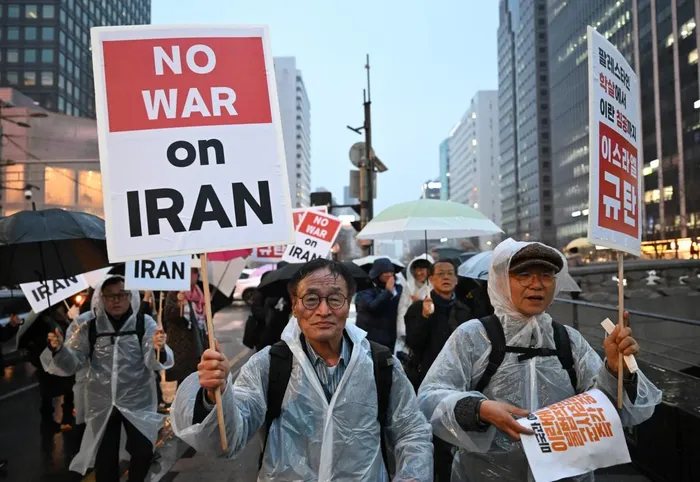
the war in Iran is enabling select governments and corporations to rapidly secure long-term strategic and financial windfalls.
Image: AFP
WHERE does Africa sit in the value chain, where crises and shocks are routinely weaponised for profit?
Despite the devastating human and economic toll, the war in Iran is enabling select governments and corporations to rapidly secure long-term strategic and financial windfalls.
The war, which is also in the Middle East, and the closure of the Strait of Hormuz, the sudden removal of nearly 20% of the global oil supply from the market, have created both a crisis and a set of opportunities: A crisis that is reshaping energy markets and weapons sales, inflating costs, and exposing every nation’s vulnerabilities and an opportunity for those positioned to exploit the disruption.
This pattern followed the Russia‑Ukraine war, when African economies once again found themselves on the receiving end of the crisis, absorbing the shock; import bills ballooned as global commodity prices spiked; currencies came under sustained pressure as capital fled to safer havens; and inflation ate into the real incomes of households already struggling with stagnant wages and limited social safety nets.
Meanwhile, developed nations, armed with strategic petroleum reserves, domestic production capacity, and industrial policies planned long before the crisis, were able not only to cushion the blow but also to turn the situation to their advantage, using the disruption to expand their own energy exports, strengthen their military industrial bases, and capture new markets.
Geopolitical analyst Simon Watkins exposes exactly this dynamic in his latest article, Who Really Benefits from the Iran Conflict? Follow the Oil. He zeroes in on three explosive factors: Skyrocketing oil prices that funnel billions to certain producers; a massive surge in weapons demand that replenishes corporate and state coffers, especially American and Chinese companies and the ever-present threat of the Strait of Hormuz being closed, which disrupts global energy flows to the advantage of Iran and Russia.
As a result, Iranian, American, Chinese, and Russian oil companies and military-industrial complexes have already generated billions of dollars in profits from this war as of March 2026.
Market research firms estimate that the two biggest US oil companies alone stand to gain an extra $47 billion in profits from the war-driven price surge. Iranian oil networks, despite the chaos and ongoing disruptions, continue to channel tens of billions of dollars in revenues by sustaining export volumes, largely to China.
Meanwhile, Russia benefits from elevated global oil prices and reduced sanctions pressure, enabling it to sell more crude to Asian markets at narrower discounts, while China secures discounted Iranian oil and strengthens its position as a major buyer and alternative supplier in the tightened global energy market.
While a handful of oil exporters such as Algeria, Angola and Libya may see modest revenue gains from higher prices, the vast majority of African nations face surging energy costs, imported inflation, currency pressure, and disrupted supply chains through the Strait of Hormuz.
At the same time, African leaders with transactional relationships with these advanced economies are frequently pressured to pick diplomatic or ideological sides in a conflict far from their shores, often at the risk of alienating key trading partners or inviting economic retaliation. In this classic shock doctrine dynamic, the continent risks absorbing the highest costs while the real dividends flow elsewhere.
African leaders would do well to study this pattern closely, as their nations bear the cost and their citizens are largely exposed to the inflationary side while their “friends” pocket the dividends.
This point is succinctly elucidated by one of the most influential thinkers of the twentieth century, Nobel laureate and economist Milton Friedman, in his 1962 book Capitalism and Freedom. (The often-cited version of the idea appears in the preface to the 1982 edition.) Friedman wrote: “Only a crisis, actual or perceived, produces real change.
“When that crisis occurs, the actions that are taken depend on the ideas that are lying around. That, I believe, is our basic function: to develop alternatives to existing policies, to keep them alive and available until the politically impossible becomes the politically inevitable.”
In the context of the current discussion, this insight helps explain how crises, including geopolitical conflicts, create openings for rapid shifts in power, policy, and profit, often to the advantage of those best prepared with ready-made ideas and agendas.
For developing economies like Africa, the same shock is almost always experienced as an aftermath of capital flight, inflation, supply disruptions, and the sudden exposure of structural vulnerabilities that had been papered over.
Ngozi Okonjo‑Iweala, the director‑general of the World Trade Organization (WTO) and a former finance minister of Nigeria, made a related point in a recent address. Speaking on the state of global trade and the challenges facing developing economies, she made the following observation: “I really think that this is a time of crisis, but also out of crisis comes opportunity. And I think the opportunity is for Africa to seize at the moment.”
Her words capture the essence of the crossroads and the conundrum Africa finds itself in today, while the world is undoubtedly in a period of crisis; such moments also carry opportunity. For Africa in particular, this is the time to seize the moment, to move from being a passive observer of global events to an active participant in shaping its own economic destiny.
Advanced economies and their powerful corporate allies have long mastered this playbook. While the human and economic toll continues to mount in the conflict zone, US and Iranian oil majors are locking in tens of billions of dollars in extra profits from elevated crude prices.
Iran, despite the chaos, sustains significant petroleum revenues by maintaining export volumes, largely to China, and retains the strategic ability to influence global oil prices through potential disruptions or closures of the Strait of Hormuz.
At the same time, the US, Chinese, and European military-industrial complexes are seeing surging demand for weapons and defence systems, while Chinese and Russian energy firms capitalise on discounted Iranian supplies, redirected trade flows, and expanded market share.
These countries treat crises not as disasters, as most countries in the Global South often do, but as calculated opportunities to consolidate resources, rewrite supply chains, and strengthen their geopolitical position, often with a cold acceptance of casualties.
Where, then, does Africa sit in this value chain, where crises are routinely weaponised for profit? A few oil exporters, most notably Nigeria, may receive a temporary fiscal boost from higher crude prices.
Yet even these gains remain sharply constrained: As of March 2026, Nigeria continues to underperform its Opec quota of 1.5 million barrels per day, with actual output hovering around 1.4–1.47 million bpd due to persistent production challenges. Most African nations will absorb imported inflation, currency pressure, and threats to food security, while gaining little strategic upside.
This unequal dynamic makes the current moment a critical crossroads, as Ngozi Okonjo-Iweala recently observed. Her words capture the conundrum Africa faces today. While superpowers treat conflicts as calculable risks, prepared to accept casualties in pursuit of dividends, African leaders behave as passive observers or ideological pawns.
African nations should urgently convene the strongest regional economies to drive deeper integration rather than competition.
Nigeria as Africa’s leading net exporter of oil and energy; Egypt leveraging its strategic control of the Suez Canal, broad industrial manufacturing base, and position as a vital trade gateway between Africa, Europe, and the Middle East; South Africa harnessing its sophisticated financial sector as the continent’s premier financial hub, its advanced retail and consumer goods distribution networks, and its position as the largest exporter of manufactured goods and agricultural products to other African countries; Morocco contributing world-class logistics, industrial manufacturing, and global phosphate fertiliser dominance; Algeria providing substantial hydrocarbon resources and North African energy exports; and Kenya and Rwanda anchoring East Africa and Central East Africa with their dynamic services sector, fintech innovation, and regional trade networks.
Such coordinated regional value chains, driven by these regional powers acting deliberately in the interest of both their own economies and the continent’s struggling smaller nations, would build collective resilience, bargaining power, and inclusive growth.
Above all, Africa must internalise a timeless principle in international relations: There are no permanent friends or enemies, only permanent interests.
By refusing to reflexively take sides in distant superpower contests, African leaders can shield their economies from unnecessary retaliation, avoid costly alignments, and focus instead on harnessing crises for domestic transformation.
The lesson from developed economies is clear: those who endure shocks without a strategy remain victims; those who seize the moment shape their own destiny.
* Phapano Phasha is the chairperson of The Centre for Alternative Political and Economic Thought.
** The views expressed here do not reflect those of the Sunday Independent, IOL, or Independent Media.