

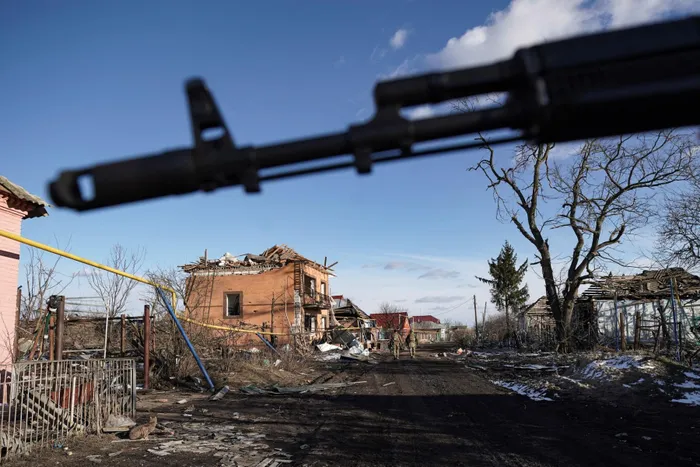
South African men were among fighters in the Russia/Ukraine conflict zone, where buildings lie in ruins. Ukraine resembles a victim of President Volodymyr Zelensky’s lack of foresight and Europe’s mischievously underlying objectives to turn Ukraine into a pawn in their push to weaken Russia as a superpower so that Western dominance would be threatened no more.
Image: Tatyana Makeyeva / AFP
THE plight of Ukraine is rapidly slipping through US President Donald Trump’s fingers with dangerous signals to a bleak future for the embattled nation and its leader, Volodymyr Zelensky. The ominous signs do not shield Europe from the brewing storm either.
Two public statements on Ukraine by the Trump administration this week point to a looming winter of discontent for the rest of beleaguered Europe.
First, responding to the damning utterance of the German Chancellor Friedrich Merz, during which he argued that Europe ought not to join the US and Israel in their war on Iran because it is not Europe’s war, Trump hit back: “They say it’s not their war — Ukraine isn’t ours either.”
Trump also blasted NATO as a “Paper tiger” after the North Atlantic Treaty Organization refused to intervene to “liberate” the Strait of Hormuz from the clutches of Iran, where maritime traffic has been severely disrupted after Tehran barred “enemy vessels” from passing through.
An estimated 20% of the global trade, particularly the transportation of crude oil, passes through the strategic Strait of Hormuz that geographically falls squarely under the jurisdiction of Iran. Similarly, about 30% of the world’s fertilisers are also transported through the same route, which has become a major bone of contention after Iran unleashed it as a retaliatory weapon of war.
There are growing fears that if the war in Iran does not come to an end soon, the entire global economy will crumble under the weight of the scarcity of oil and gas production from the Gulf States.
I paint this picture to illustrate the drifting attention of Europe and the international community from Ukraine. Sporadic reports of corruption and money laundering by the Zelensky administration also add to the growing indifference.
Only this week, US Director of National Intelligence Tulsi Gabbard ordered that the USAID activities in Ukraine be audited to verify allegations of a plot from Kyiv to fund former US President Joe Biden’s aborted 2024 presidential contest. Gabbard wants the FBI to investigate the matter.
Trump had earlier shared a Just the News report, which read: “US intercepted Ukraine government messages discussing plot to route money to Biden re-election.” He further said: “Newly unclassified documents show that in 2022 Ukrainian officials discussed diverting hundreds of millions of US tax dollars — earmarked for clean energy — back to Biden’s ill-fated 2024 campaign.”
These developments do not bode well for Ukraine and its leader, who has a chequered relationship with Trump. These latest developments matter because, not too long ago, Ukraine was front and centre of the US foreign policy as well as EU’s and NATO’s.
But since Trump’s return to the helm of US politics, having done so on the anti-war ticket, Washington’s astronomical Ukraine budget has been whittled down markedly.
The US refocusing of attention on Israel and the Jewish State’s never-ending Middle Eastern wars has seen the US gradually take away eyes — and resources — from Ukraine.
By all accounts, Ukraine is no longer the centre-piece of the US foreign policy. And in Europe, disagreements about support for Kyiv have blown into the open. Recently, Hungarian Prime Minister Viktor Orban blocked the EU’s $90 billion aid package to Ukraine.
It is easy to wish that time could go back. Go back to a time when Moscow was overly keen to smoke a peace pipe with Ukraine, until that war-mongering former Prime Minister of the UK, Boris Johnson, intervened to dissuade Kyiv from signing the deal during the Turkey-brokered talks a year into the conflict that broke out in 2022.
Impacted by a domineering cohort of hawks across Europe, Zelensky continued to exhibit a glaring lack of appetite for direct peace talks with Russia. He instead addressed one parliamentary sitting after another — in-person or virtually throughout the West — receiving standing ovations at every turn and additional promises of unwavering support by Europe and the Biden administration that promised support “for as long as it takes”.
The conundrum for all involved is that Europe has been too overtly reliant upon the generosity of the US — economically, militarily and diplomatically.
When Trump unleashed indiscriminate tariffs on all the nations of the world, the deepest pain and greatest embarrassment were particularly felt by the EU, which had thought of itself as the US’s special untouchable ally.
Furthermore, Trump’s threat to annex the Greenland also rattled Western hegemony. For the first time, the threat of intra-NATO conflict loomed ever so large, sending rare panic across Europe.
In Brussels, EU political leadership hurried to reset relations with the US, looking elsewhere around the world for renewed friendships, including Africa and China. But Europe remains undoubtedly in the firm grip of the US, dancing to every tune set by the Trump administration.
A good example of this is when Trump unilaterally lifted economic sanctions on Russia recently, so that nations could purchase Russian oil in the wake of rising commodity shortages due to the war in Iran.
In fact, the US also lifted oil sales by Iran, sanctioned since 2016, the aim being to alleviate the global shortages amid plunging supplies struggling to match the demand.
These developments further revealed the extent of the firm grip of a US-led unipolar world order, where unilateral imposition of sanctions by the US on adversaries is as binding as though approved by the UN Security Council.
The constantly moving geopolitical pieces on the world stage have therefore left Ukraine teetering on the brink of irrelevance and relative obscurity. France, the UK and Germany are strenuously wrestling to keep the pro-Ukraine propaganda alive. But it is dead, at least in large parts of Europe and the West, where it was propped up by a huge wave of intentionally choreographed Russophobia.
I’ve argued before that all conflicts end up at the negotiating table, and that Ukraine did not need to be as foolish as to allow the whole-scale devastation of their country to persist when Russia had earlier made it categorically clear that a truce could be reached.
The war-monger in chief, former President Joe Biden, is now in the wilderness, and his foreign policy persuasion is in the dustbin of history. Similarly, the ailing economies across Europe have meant that domestic dynamics supersede focus on unending Ukraine conflict, which is NATO’s proxy war against Russia.
The further isolation of Ukraine appears inevitable, at least in the immediate future. Trump has already warned that the “paper tiger” that is NATO cannot fight Russia without the involvement of the US. This factor is beyond question. With relations between Washington and NATO at an all-time low, the rift will likely simmer unless Trump loses power to the Democrats in the midterm elections in November.
Lastly, in my book, Ukraine resembles a victim of Zelensky’s lack of foresight and Europe’s mischievously underlying objectives to turn Ukraine into a pawn in their push to weaken Russia as a superpower so that Western dominance would be threatened no more.
* Abbey Makoe is the founder and editor-in-chief of the Global South Media Network (GSMN).
** The views expressed here do not reflect those of the Sunday Independent, Independent Media, or IOL.