

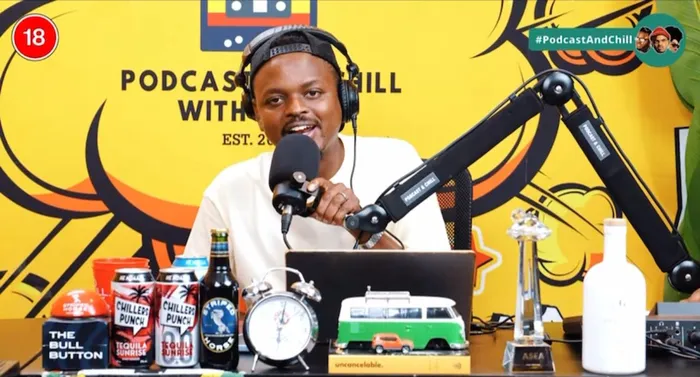
"Podcast and Chill" host MacG. Podcasting arrived as a kind of democratic correction. It broke open the gates. It lowered the cost of entry.
Image: File.
A MAN sits alone in a studio. Three cameras. One microphone. No interruptions. No editor. No one is counting him down.
For three unbroken hours, he speaks. By the time he finishes, more people will have absorbed his thoughts than tuned into the evening news. By morning, fragments of his voice are everywhere: clipped, shared, memed, and believed.
Nothing authorised it. No institution filtered it. And yet something subtle has shifted — not just what people think, but how certain they feel.
This is the podcast age.
And we still don’t fully understand what it’s doing to us, especially in South Africa. Podcasting arrived as a kind of democratic correction. It broke open the gates. It lowered the cost of entry.
It handed the microphone to voices long excluded from traditional media. In a country hungry for depth beyond slogans and soundbites, it revived long-form conversation. It allowed nuance. It allowed time.
For a moment, it felt like progress.
But the power of podcasting is not just about reach. It is intimacy. A host does not sound like a broadcaster. He sounds like someone you know. He pauses. He laughs. He circles ideas out loud. Over time, listeners stop merely hearing him and begin to feel they understand him. Trust forms not through verification but through familiarity.
And that is where the shift begins. Because familiarity is not the same as truth.
Podcasting does not just distribute ideas. It softens the distance between speaker and listener. It lowers the instinct to question. Disagreement starts to feel less like analysis and more like disloyalty. Opinion slides into insight. Insight hardens into something that feels like fact.
Not because it has been tested but because it has been felt.
Traditional media, for all its flaws, imposed friction. Editors challenged assumptions. Fact-checkers slowed publication. Legal risk forced caution. None of it was perfect, but it created resistance, the kind that makes bad ideas work harder to survive.
Podcasting has stripped much of that away. Claims made casually, even recklessly, can settle into the public mind as “common sense” long before they are ever challenged, if they are challenged at all. South Africa has already seen how quickly that can turn dangerous.
In 2025, a widely shared podcast clip detonated across the country. In the easy, unguarded flow of conversation, guests reached for shock value and landed on something uglier: crude, baseless stereotypes about the Coloured community framed as if they were observations, even truths.
Within hours, the clip had spread far beyond its original audience. Outrage followed. Political parties intervened. The matter escalated to the South African Human Rights Commission. Contracts fell away. Apologies were issued.
But by then, it was already too late.
Because the damage was not just in what was said. It was in how it was received. Spoken in a conversational tone. Delivered without challenge. Heard in the intimate space where listeners feel they “know” the speaker. It did not arrive as provocation. It arrived as something closer to insight.
That is the risk.
In a country still carrying the fractures of its past, where identity and belonging remain sensitive, the casual packaging of prejudice as conversation is not harmless. It travels faster. It embeds deeper. And it is harder to dislodge. Podcasting does not create division. But it can accelerate it quietly, persuasively, and at scale.
Politicians are increasingly stepping away from adversarial interviews and into the softer glow of long-form podcast appearances, where questions are friendly, time is abundant, and narratives can unfold without interruption. It is message control, repackaged as authenticity. And beneath all of this sits a simple, uncomfortable truth.
Accuracy does not travel as well as certainty.
The economics of attention reward confidence, clarity, and emotional charge. “I might be wrong” does not go viral. “This is what’s really going on.” So humility recedes. Nuance thins out. Complexity becomes a liability.
What grows in its place is conviction often untested, often unearned, but deeply felt. None of this erases what podcasting has given us. It has opened space. It has diversified voices. It has forced difficult conversations into the public sphere. In many ways, it has made our discourse richer.
But it has also made it more volatile.
Because we are not simply becoming more informed. We are becoming more certain. And certainly, when it outruns scrutiny, it becomes combustible. South Africa is only beginning to confront this reality.
The conversation around regulation has started to surface, but it remains tentative, fragmented, and reactive. Existing legal frameworks around hate speech and discrimination offer recourse, but they move slowly, often long after the moment of impact has passed.
And in the podcast age, delay matters.
Because influence no longer builds over weeks. It crystallises in hours. The answer is not blunt control. Heavy-handed regulation would do real damage, chill expression and open the door to political interference in a space that thrives on openness. But doing nothing is not neutrality. It is permission.
What is needed is something more precise. A form of co-regulation that recognises the unique power of this medium, its reach, its intimacy, and its speed, and introduces just enough friction to match it.
Clear boundaries around incitement and harmful stereotyping. A culture of visible, timely correction. Transparent pathways for accountability. Platform responsibility that goes beyond amplification without sliding into censorship.
Not to police conversation, but to protect the conditions that make meaningful conversation possible. Because ultimately, this is not just about creators or platforms.
It is about us.
Every listen, every share, every clipped moment we pass along, we are not just consuming the ecosystem. We are shaping it. The greater danger of the podcast age is not that it misinforms.
It is that it can create the feeling of being informed without the discipline of being challenged. And in a society as complex and as fragile as ours, that feeling is enough to harden views, deepen divides, and make persuasion not just difficult, but suspect.
The microphone is not going away. The shift has already happened. What remains is the harder task: building a culture that can hold this new power without being quietly reshaped by it. Because democracies do not always unravel in moments of crisis.
Sometimes they erode in long, comfortable conversations where everything sounds right, nothing is tested, and certainty laced with prejudice settles in unnoticed.
By the time it reveals itself, it will not feel like a distortion. It will feel like the truth.
* Nyaniso Qwesha is a writer with a background in risk management, governance, and sustainability. He explores how power, accountability, and innovation intersect in South Africa’s landscape.
** The views expressed here do not reflect those of the Sunday Independent, IOL, or Independent Media.