

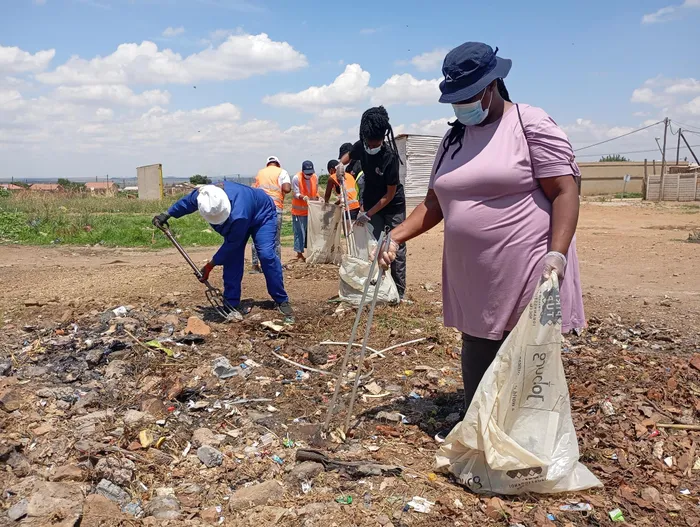
Areas such as Alexandra, Soweto, Diepsloot, Orange Farm, Cosmo City, Riverlea, and Eldorado Park experience sustained exposure to harmful pollutants from vehicle emissions, informal waste burning, and wind-blown mine dust.
Image: Supplied / Seriti Institute
EVERY day in Johannesburg, people are breathing in a threat they cannot see, and often cannot escape. It hangs in the air, settles in the body, and over time, quietly erodes health.
Air pollution is no longer a distant environmental concern. It is a public health crisis unfolding in real time.
For many communities across the city, poor air quality has become a silent killer. Its impact is not immediate, but cumulative. It builds slowly in the lungs, in the bloodstream, and in the lives of those most exposed. By the time the consequences are visible, the damage is already done.
Recent work by Seriti Institute, in collaboration with Breathe Cities and the City of Johannesburg, highlights the scale and complexity of the challenge. Air pollution in the city is driven by rapid urbanisation, industrial activity, traffic congestion, waste burning, and dust from historical mine dumps.
But exposure is not evenly distributed.
Communities located near industrial zones, major transport routes, and mining areas carry a disproportionate burden. Areas such as Alexandra, Soweto, Diepsloot, Orange Farm, Cosmo City, Riverlea, and Eldorado Park experience sustained exposure to harmful pollutants from vehicle emissions, informal waste burning, and wind-blown mine dust.
In early March this year, residents across parts of Johannesburg reported a persistent sulphur-like smell, often described as resembling rotten eggs, lingering in the air for days. This was not an isolated incident, but part of a recurring pattern that continues to raise concerns about pollution sources and accountability.
Episodes like these highlight a deeper reality: Pollution does not always originate where it is experienced. Air pollutants can travel across regions, often linked to industrial activity and energy production beyond the city, yet their impact is felt most acutely by local communities.
The health consequences are severe. Prolonged exposure to polluted air is directly linked to respiratory illness, heart disease, stroke, and an increased risk of lung cancer. For many, persistent coughing and breathing difficulties are not occasional symptoms, but a daily reality.
Children growing up in polluted environments face particular risks. Breathing difficulties affect not only their health, but their ability to concentrate, learn, and thrive in school. For older persons and those with existing conditions, poor air quality can be life-threatening.
The Covid-19 pandemic made this vulnerability visible, exposing how respiratory health is deeply shaped by environmental conditions. Yet, despite this, air pollution continues to be treated as a secondary issue rather than the urgent crisis it is.
There are, however, important efforts underway at the community level.
Through partnerships between Seriti Institute, Breathe Cities, and the City of Johannesburg, 35 community-based organisations are actively working across the city to raise awareness and mobilise action.
To date, these organisations have conducted more than 62 campaigns focused on clean-up initiatives, community dialogues on air pollution, waste management awareness, tree planting, and recycling practices such as ecobricks and reusable materials.
These campaigns are not only raising awareness. They are shifting behaviour, building local ownership, and demonstrating that communities are already part of the solution.
As Harmony Khoza, Community Response Manager at Seriti Institute, explains: “Communities are not passive recipients of pollution. They are already organising, responding, and leading change at the local level. What is needed is sustained support, stronger systems, and recognition that community-led action is central to any lasting solution.”
But awareness alone is not enough.
Addressing air pollution requires stronger, more coordinated action from government. This includes enforcing environmental regulations, improving waste management systems, monitoring industrial emissions, and actively addressing pollution from mine dumps.
It also requires transparent, accessible air quality data so that communities are not left in the dark about the risks they face.
At the same time, communities must be supported to deepen their role through monitoring, advocacy, and education, particularly among young people who will shape future environmental outcomes.
Individual actions matter, but they cannot substitute for systemic change. The responsibility cannot rest solely on residents who are often already living in conditions not of their choosing.
Clean air cannot be treated as a privilege reserved for a few. It is a basic human right.
The reality is that air pollution sits at the intersection of public health, inequality, and environmental justice. Those who contribute the least to pollution are often the most exposed to its consequences.
Johannesburg does not lack the knowledge, partnerships, or community leadership needed to address this challenge. What is required now is urgency, accountability, and the political will to act decisively.
Because the cost of inaction is already being paid quietly, daily, and disproportionately in the lungs and lives of the city’s most vulnerable residents.
As Earth Day approaches, the urgency to act on air quality has never been clearer.
Seriti Institute, the City of Johannesburg, and Breathe Cities will work alongside community-based organisations and 35 schools across Gauteng to plant trees and promote environmental awareness. This is not just an event. It is a call to action.
* Harmony Khoza is an author at the Seriti Institue and Getrude Mamabolo is a communications and content officer at the Seriti Institute.
** The views expressed here do not reflect those of the Sunday Independent, IOL, or Independent Media.