

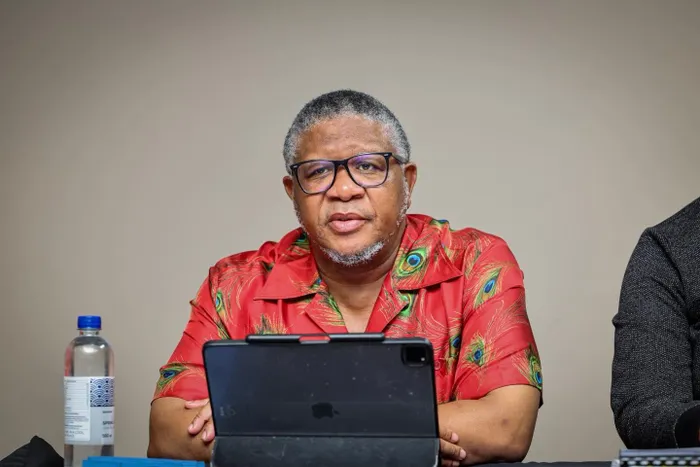
AfriForum's dossier seeking to trigger sanctions against ANC Secretary-General Fikile Mbalula raises a critical question: Is the objective to seek justice for financial misconduct and corruption, or is it to punish an official for his foreign policy alignments?
Image: Facebook / Fikile Mbalula
IN THE realm of international law and anti-corruption efforts, the “Magnitsky Act” serves as a powerful tool to hold individual officials accountable for human rights violations and corruption.
However, a recent dossier seeking to trigger these sanctions against ANC Secretary-General Fikile Mbalula raises a critical question: Is the objective to seek justice for financial misconduct and corruption, or is it to punish an official for his foreign policy alignments?
By analysing the structure and rhetoric of the document, it becomes increasingly clear that the “corruption” at the heart of the complaint is being sidelined in favour of an intense critique of Mbalula’s ideological worldview.
The document’s architecture is telling. Before the reader encounters a single piece of evidence regarding the 2016 Dubai holiday scandal or the Public Protector’s findings, they are presented with five pages of political analysis. Section 1 is dedicated entirely to “Mbalula’s anti-Western statements and support for authoritarian regimes”.
The dossier painstakingly tracks Mbalula’s social media posts and speeches, highlighting his criticisms of the United States and United Kingdom, his support for Russia and Iran, and his embrace of BRICS.
While these stances are politically controversial, they are not illegal. By leading with this “ideological framing”, the report risks rendering itself incredible to legal experts who look for criminal evidence rather than political disagreement. After all, South Africa is a constitutional democracy that guarantees freedom of speech and ideological conviction. And it leaves it up to voters to decide which political party they support.
The dossier makes a strategic calculation that for the international community—specifically Western powers like the US — to take an interest in a local South African corruption matter, the target must be framed as a geopolitical adversary.
The report explicitly argues that Mbalula’s “anti-Western beliefs” and his labelling of US actions as “fascist characteristics” or “imperialist aggression” are reasons to apply sanctions. This framing suggests that the corruption allegations are being used as a “vehicle” to address Mbalula’s political influence.
When a legal document relies so heavily on a subject’s voting record or diplomatic preferences, the “corruption” charges begin to feel like a secondary justification for a primary goal of political neutralisation.
The legal basis of the dossier is based on a case that has already been dismissed by the National Prosecuting Authority (NPA) due to a lack of evidence. While the authors of the dossier argue that this decision was “irrational”, Afriforum undermines their own legal position by admitting that they have a “lack of experience and interest” in the very political issues they outline in the first part of the document.
Furthermore, the dossier frames corruption as an “opportunity to develop the law” because Mbalula “actively supports the current political and especially foreign affairs policy of South Africa”. This admission is perhaps the most damaging to the report’s credibility; it suggests that the legal pursuit is not being driven by the severity of the alleged crime but by the “opportunity” to strike at a political opponent's international standing.
For an anti-corruption report to be credible on the world stage, it must remain clinically focused on the flow of money, abuse of power and the violation of national laws.
By peppering the report with grievances about “anti-Western” rhetoric and “socialist policies”, this dossier moves from the courtroom to the arena of political rivalry.
Ultimately, the document reveals more about the ideological divisions in South African politics than about the criminal charges against the individual in question. In the attempt to make Fikile Mbalula a global pariah, Afriforum’s own political biases are instead exposed.
* Christo van der Rheede is the chief executive of the FW de Klerk Foundation. This article is written in his personal capacity, not the Foundation’s.
** The views expressed here do not reflect those of the Sunday Independent, IOL, and Independent Media.