
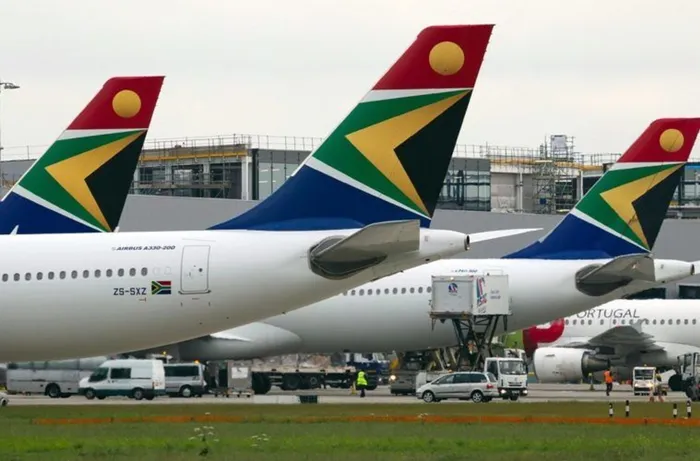
SAA monitoring Middle East crisis as fuel price pressures mount. The prices of jet fuel have risen from $2.28 per gallon to $3.95, a whopping 73.2% increase in about 10 days of conflict.
Image: IOL
IT IS very tempting to hypothesise that the most pressing, urgent and burning questions of the day are wholly perplexing, especially in that order. In deference to the war in the Persian Gulf, however, or as Donald J Trump would gesticulate in his right hand, a US excursion into Iran, what is perplexing is burning, requiring the urgent attention of those whose responsibility it is to heed its urgency, with everyone else hard pressed to find solutions.
It has become apparent that the effects of this clumsy regime excursion, at the importunate insistence of the instincts of a war-mongering Benjamin Netanyahu, have been devastating. The effects of such devastation, as layered in their profusion as they are complex, are widely distributed. Their iteration, too, is both profound and cataclysmic.
Starting with the airlines. They are a sensitive bunch, these airlines! They are reeling under an avalanche of flight cancellations, 14 000 of them in the first six days of the kinetic exchange. They have risen to 40 000 to date. Whatever redeeming schedule that is still operative, it is not meant for tourism but mainly focuses on diplomatic evacuations as a priority.
The prices of jet fuel have risen from $2.28 per gallon to $3.95, a whopping 73.2% increase in about 10 days of conflict. The sensitivity of the jet fuel pricing is exacerbated by the inflexible 30% crack spread, or colloquially, the refining margin. It is currently sitting above that sensitive threshold and rising.
The last time such a spread tightening occurred was during Hurricanes Ivan and Kathrina respectively, resulting in both Delta and Northwest Airlines being declared bankrupt.
The G-7 countries have committed to releasing strategic stockpiles, whether in the form of refined jet fuel where it is so kept, or as crude oil, ready to be refined. Either way, it matters very little. There is no empirical evidence that the airlines, in the case of released jet fuel stockpiles, or in the case of refineries, the crude oil to be refined, will be given either for free or cheaply.
The European airlines, for their part, were not helped by the fact that the edicts of the European Union forbade them from flying over the extensive territory of the Russian Federation en route to Asia.
This re-routing has significantly impacted their flying times and, accordingly, flying costs. The addition of the Iranian airspace as a forbidden route has resulted in these airlines uncompetitive to their Asian counterparts. In short, more bankruptcies are looming.
Then there is the United Arab Emirates in general and the Dubai Emirate in particular. There is no doubt that so many of the Gulf states took a significant amount of pounding from Iranian drones and short-range ballistic missiles, covering as many countries as Bahrain, Jordan, Kuwait, Iraq, and, on the odd occasion, the Kingdom of Saudi Arabia.
None of these territories, however, has taken as much concentration of attacks as the United Arab Emirates.
To date, it has endured the barrage of 268 short-range ballistic missiles, 15 cruise missiles and 1500 attack drones. Dubai, its centrepiece, plays an important pioneering role in shaping the vision of a post-oil West Asia. It had fashioned itself as a financial and logistics hub, thereby turning itself into a catalytic nerve centre for development.
At the commencement of this war, the Dubai Financial Centre was hosting 290 banks, 102 hedge funds and 500 wealth management funds, a significant concentration of capital leverage indeed.
As the US and Israel started targeting oil assets and related infrastructure of Iran, invariably, the war targets of every other country embroiled in this conflict, especially in the Gulf, also turned character from pure military infrastructure to financial and other economic strategic facilities.
The things that had become the symbols of wealth and envy about Dubai suddenly became targets. High-rise buildings, data centres, the Dubai Financial Centre, the most frequented airport and luxury hotels, among others, are constantly shown taking pounding from drones and other projectiles of war.
Paid enough attention, Trump is a lesson that keeps teaching. The more the US President espouses his love for hydrocarbons, kidnapping a sitting Venezuelan president for oil and gas and attacking Iran to control its oil, invade the Kharg island by relentless bombardment and plan to occupy the Strait of Hormuz, the more silent the climate change activists become.
It is not because they are unaware that the bombing of the Nordstream gas pipelines by Ukraine and its allies was the single most environmentally damaging event of our times. Nor are they oblivious to the fact that the bombs that the US and Israel utilise, including their gas-guzzling fighter jets, portend a deleterious effect on the collective effort of the global commons to attenuate CO2 accumulations in the atmosphere.
In fact, their silence speaks to something more perturbing. Their restraint in speaking for the environment against Trump’s wars of aggression for oil, his sinking of ocean-going vessels carrying large quantities of marine fuel, and generally their cheerleading for a US dollar hegemony predicated on the petrodollar system, simply unmasks them as an ISIS-like terror outfit, wearing suits and gouging on the largesse of the political magnanimity of an oil dripping US dollar.
It almost feels as if climate change activists have one job only. And that is to scare witless any country that may discover crude oil, thereby unwittingly perturb the dominance of the Yankees. So much so that if Trump could discover oil in South Africa, the climate change activists, bought and paid for by the USAID or its networks, would contrive new reasons why such a discovery should be celebrated. O, South Africa. Cry the beloved country!
This leaves an important question to be asked, as pressing as it is urgent. What would the definition of winning for the US and Israel look like? In other words, what does winning for the US/Israel/Gulf States consortium connote, and what would losing for Tehran look like?
It is hard to tell how the calculus of a winner/loser matrix would be immutably transfixed on this turbulent geopolitical chessboard. Depending on the starting point, the paths on which the various options must traverse are announced with their own inherent limitations.
Commencing with the regime change option, when generalised and oversimplified, it looks less complex than its contending peer options, and therefore more appealing. Inebriated from the kidnapping of Nicolas Maduro, the President of Venezuela and his wife Celia Flores, the war planners in the US endorsed the regime change objective, as well as its speed of manoeuvre and specificity of targets.
For purposes of Iran, this would have meant the decapitation of the Ayatollah, followed immediately by the hordes of colour revolutionaries, galvanised clandestinely to specifically topple the current democratic construct of Iran. If successful, this would have led to Trump appointing the new leader of Iran. Evidently, it did not happen!
The failed attempt quickly mutated into a motley of desperate attempts, as chaotic as they are imprecise, including killing 150 innocent schoolgirls.
In this phase, President Donald J. Trump demands a total and unconditional surrender of the Iranians, whatever that means in the context of the current crisis. In his half-hearted call, which has no bearing on the prevailing material conditions, it is equally uncertain as to how the boisterous and egregiously high-falutin head of state will force Tehran to surrender unconditionally.
Beyond this point, the option spectrum becomes less certain. Pete Hegseth, the US Secretary of War, for his part, is promising more fire and more brimstone. In his hubristic version of Luke 17 verse 29, his intensity of lapping flames, vaingloriously titled Epic Fury, will eviscerate the Iranians and destroy them all, so he claims!
However, there is no historic precedent where regime change has ever been achieved by raining air fire power over the targeted adversary and cowering them to unconditional submission.
It is hoped that the legacy of President Trump in the Persian Gulf would eschew the tragic comparison to that of Emperor Crassus of Rome. Probably considered the wealthiest man in Rome, who had an obsessive love for gold, he became Emperor due to his wealth. At the height of his hubris, he attacked the Parthian empire, or Iran, as we know it today.
Not only did he lose spectacularly, but he was captured by the Parthians, and hot molten gold was poured down his throat, in final mocking of his gargantuan greed for wealth and power.
Perhaps at this point, we could easily ask the same question again, but differently. What does an Iranian victory look like?
But that is a whole ’nother story.
* Amb Bheki Gila Esq is a Barrister-at-Law.
** The views expressed here do not reflect those of the Sunday Independent, Independent Media, or IOL.