

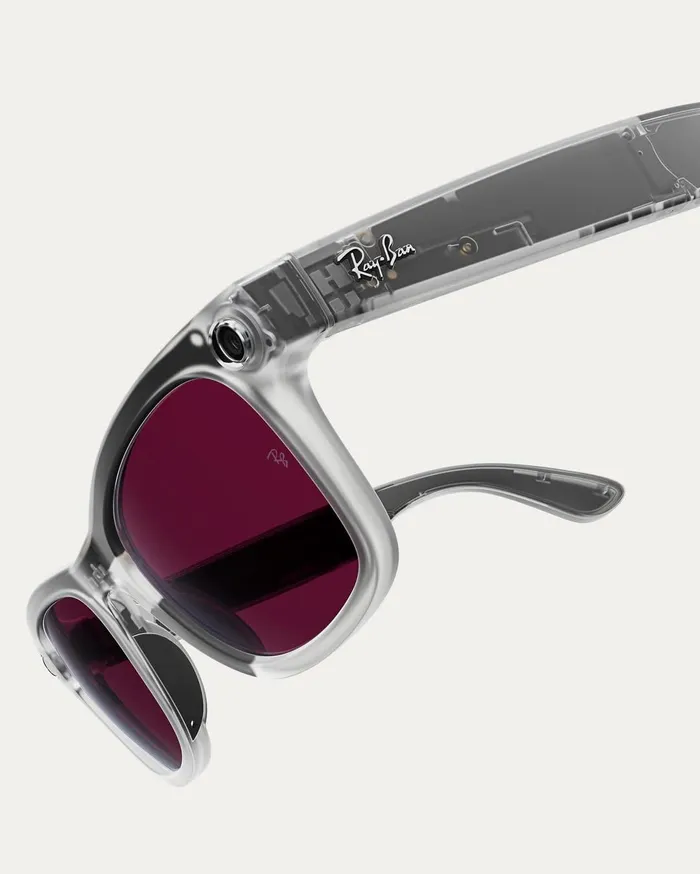
Meta glasses have left people legitimately unnerved, and rightfully so. They record in public, regardless of promises about blurred faces and anonymity.
Image: Ray-Ban Meta Limited Edition
THE META Smart glasses are nefarious work. A deeply disturbing revelation has left Meta embroiled in a class action lawsuit in a US Federal court, after some profoundly sinister privacy implications of its Ray-Ban Meta Smart Glasses were uncovered.
The case follows a Swedish investigative report which exposed a Kenyan subcontractor who had been tasked with reviewing and labelling private camera footage captured by the glasses.
The footage was shockingly intrusive, blatantly exposing almost every aspect of people’s daily lives — from private activities to financial information, from sexual activity to people using the toilet, and so much more.
Naturally, this revelation sparked outrage worldwide, forcing us to once again confront how rapidly advancing tech and AI are not only ignoring privacy laws — they’re mining and manipulating our data, data that they never even asked for.
According to Ray-Ban maker EssilorLuxottica, more than 7 million smart glasses were sold in 2025 alone. What many don’t realise is that everything those glasses record is dumped into a data pipeline for review — and users have no way to opt out or stop it. And in the AI era, that footage can be warped, distorted, and manipulated in ways endless, invasive and terrifying ways.
Needless to say, the Meta glasses have left people legitimately unnerved, and rightfully so. They record in public, regardless of promises about blurred faces and anonymity. It is one thing if you want AI-generated prompts floating in your lenses, and another entirely to discover that an hour-long conversation has been silently recorded by the pink frames perched on someone else’s face.
What immediately struck me about this debate is that society still refuses to see the full scope of surveillance. Your cellphone — and specifically smartphones — are the most-used and transformative devices of the 21st century.
Yet, they’re also our most relentless trackers and eavesdroppers. Add laptops, smart doorbells, security cameras, CCTV, Face-ID scanners, and countless other gadgets; they’re all part of a massive ecosystem of devices quietly collecting our most sensitive information, ready to be auctioned off to the highest bidder.
Among all of this outrage, there are still many who remain indifferent, shrugging that the glasses, functionally, are “basically just like a phone”. And this, perhaps, is the crux of the issue. Phones have been spying on us for years; harvesting our photos, videos, and conversations — and now these glasses make that violation seamless, invisible, and inescapable.
YouTube’s Attorney Danielle hit the nail on the head: the real problem with Meta’s AI glasses isn’t that they surveil — phones already do that, everywhere. The real danger is how invisibly the recording blends into everyday life.
When someone lifts a phone, you know something might be captured. Glasses erase that signal entirely. With no warning and no knowledge, it’s as if these Meta glasses are attempting to normalise intrusion, blending relentless surveillance seamlessly into every life.
Hence, the outrage behind this Meta glasses debacle is quite justified. People can rationalise their data being mined from devices they knowingly use — but being secretly recorded? That hits differently. Being unknowingly recorded is intimate, invasive, and infuriating. It is the unavoidable tension between tech’s relentless expansion and the simple, inalienable right to privacy.
Meta (formerly Facebook) boldly markets that their AI glasses are “controlled by you” and “built for your privacy.” The irony is not only staggering, but it’s wholly laughable. This is the same company that has — both in the past and present — amassed a mountain of scandals: from spying to secret surveillance to repeated violations of user privacy.
Furthermore, Meta’s empty promises go far beyond corporate rhetoric. Time and again, they’re proving that privacy is absolutely meaningless to them. From secret experiments to public stunts, the company has habitually treated personal boundaries as disposable and performative. Why would that suddenly change today?
What’s worse is that it is not only powerful companies — but also individuals — that manipulate tech for their own interests. A prime example happened a mere two weeks ago, when Facebook founder Mark Zuckerberg pulled a reckless stunt, having his entourage wear Meta glasses in a court case where recording was strictly forbidden.
This isn’t just about governments spying on us. What happens when a company like Meta has its tech everywhere — in buildings, public spaces, even in your home through smart devices? Do they get to record your every move inside? Do they have access to footage of you anywhere you may be, simply because their cameras or glasses are present? What happens to the individual when this footage is harvested, twisted and manipulated?
These aren’t just real-life concerns; they are a chilling forecast of the very near future.
But from this argument, the overarching question remains: Are Meta glasses presenting an actual danger, or are they just exposing a surveillance culture we already accepted? What is abundantly clear is that technology is increasingly shifting social norms around surveillance.
Don’t be fooled: Meta glasses aren’t the problem. The problem is us, quietly accepting a world where our lives are catalogued, our movements tracked, our private conversations stripped bare — and these glasses are just holding up the mirror.
Meta glasses didn’t invent surveillance, they simply weaponised what we’ve already allowed! Now, as a society, we face a future where being watched is the default, where consent is simply a fantasy.
It is daunting to think that the conversations around the power of tech and AI have only just begun. These technologies are increasingly entrenching themselves into our lives, our choices, and our freedoms — in ways that we aren’t even aware of.
While we stand around debating, our actions, our words, and our very existence are quietly being catalogued. We have reached a terrifying reality check: that the age of invisible surveillance is here. In fact, it has been here. We’re only just waking up to it now.
* Tswelopele Makoe is a gender and social justice activist and editor at Global South Media Network. She is a researcher, columnist, and an Andrew W Mellon scholar at the Desmond Tutu Centre for Religion and Social Justice, UWC.
** The views expressed here do not reflect those of the Sunday Independent, IOL, or Independent Media.