

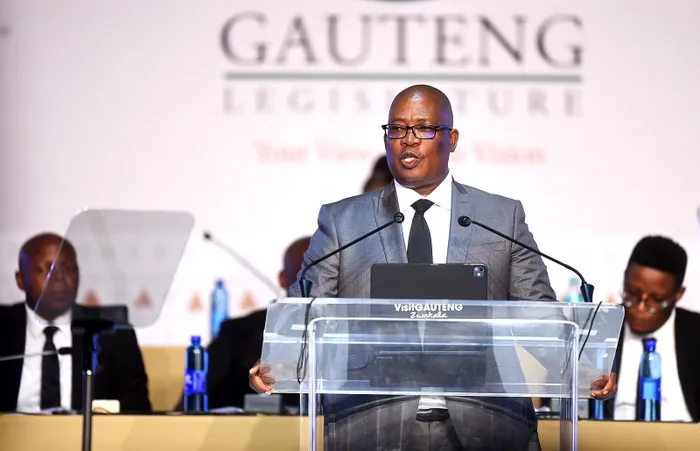
Gauteng Premier Panyaza Lesufi finally removed three heads of department after they failed the audits for a second time.
Image: Itumeleng English/Independent Newspapers
WHEN the Gauteng government revealed that more than a third of its senior officials had failed lifestyle audits, something remarkable happened. Almost nothing until June 2025, when Premier Panyaza Lesufi finally removed three heads of department after they failed the audits for a second time.
The purpose of the audits was to identify corruption before it could develop into a major scandal. They assess the declared income of a public official in relation to observed aspects of their lifestyle. If the numbers don’t add up, investigators may ask, “Where did the money originate?” Are there undisclosed interests? Has public power been used for private gain?
In Gauteng, roughly 37% of senior officials failed the checks. Yet even after the SIU flagged high-risk cases, it took months and repeated failures before any real action was taken. Only three department heads have been removed to date.
South Africans are increasingly recognising a simple truth that lies at the centre of the country’s corruption crisis. The problem is not that public officials do not know the rules. The problem is that too few believe those rules will end their careers.
Across the state, public servants attend ethics workshops. They complete compliance modules and sign codes of conduct. Thousands have undergone training through the National School of Government. The principles that dictate ethical behaviour in public office are clearly defined. They are taught, documented, and repeated.
What remains uncertain is whether violating those rules will reliably lead to consequences. This uncertainty is reflected in South Africa’s global standing.
According to Transparency International’s 2025 Corruption Perceptions Index, the country’s score has stagnated at 41 out of 100 for several years, unchanged since 2024 and still below the global average of 42. The stagnation is striking because it follows one of the most detailed corruption investigations ever conducted in a democratic state.
The Justice Raymond Zondo-led Judicial Commission of Inquiry into State Capture produced thousands of pages documenting how networks of political and corporate actors captured key institutions of government.
From state-owned enterprises (SOEs) to law enforcement agencies, the inquiry revealed in extraordinary detail how corruption infiltrated the machinery of the state.
Exposure was supposed to mark a turning point. But exposure alone does not dismantle systems of impunity. Corruption rarely begins with dramatic conspiracies. It usually starts with small compromises.
When leaders fail to enforce ethical boundaries, these small compromises accumulate. Officials begin to understand something subtle but powerful: The rules exist, but enforcement is unpredictable. Once that perception takes hold, the deterrent power of ethics frameworks collapses.
Training continues. Compliance forms are signed. Codes of conduct are displayed on office walls. But behaviour changes in response to incentives, not slogans. In an environment where misconduct rarely carries consequences, unethical behaviour becomes rational. The damage is not confined to government offices.
Every act of corruption diverts resources from services that citizens rely on daily. It appears in hospitals where equipment procurement fails because budgets were manipulated. It appears in classrooms where infrastructure projects stall after contractors vanish with public funds.
The cost is measured not only in lost money but in lost trust.
The latest Human Sciences Research Council study on Corruption and Behaviour Change (December 2025) confirms what many already feel: Corruption steadily erodes public confidence in democratic institutions. When citizens no longer believe the state operates in the public interest, the social contract begins to fracture.
Cynicism can rapidly take hold in such an environment.
Some citizens withdraw from civic life entirely. Others conclude that corruption is simply how the system works and that survival requires participation rather than resistance.
Reversing this culture requires more than new slogans about ethical leadership. It requires restoring the link between conduct and consequence.
Several concrete reforms could begin that process, and they are long overdue.
Lifestyle audit results for all senior officials (national, provincial, and local) should be published annually in open, machine-readable formats within 30 days of completion. Transparency alone does not eliminate corruption, but it creates public scrutiny that institutions cannot easily ignore.
Unexplained wealth above a defined threshold, says, assets or lifestyle exceeding three years’ legitimate income, should trigger automatic suspension without pay and immediate asset-forfeiture proceedings under the Prevention of Organised Crime Act.
Allowing officials to remain in powerful positions while investigations drag on for years (sometimes a decade) undermines the credibility of enforcement.
Whistleblowers must receive meaningful, fast-tracked protection. The assassination of Babita Deokaran in 2021 after she exposed massive procurement corruption at Tembisa Hospital sent a chilling message that still echoes today. Five years later, the masterminds behind her murder remain unprosecuted, and other whistleblowers continue to be killed.
Without credible, independent protection, including rapid relocation, financial support, and guaranteed prosecution of those who retaliate, the individuals most capable of exposing corruption will remain silent.
These reforms would face fierce resistance. They threaten entrenched interests that benefit from the current ambiguity.
Yet the alternative is increasingly untenable. South Africa has spent years investigating corruption. Commissions have reported. Oversight bodies have issued findings. Parliament has debated reforms. The country now possesses an extraordinary body of knowledge about how corruption operates within the state.
What remains uncertain is whether those entrusted with political and administrative authority, in the GNU era and beyond, are prepared to confront the culture that allowed it to flourish.
Ethical government cannot be built on rules alone.
It depends on leaders who understand that public office is not merely a position of power but a position of trust.
Until violations of that trust produce visible, predictable, career-ending consequences, especially for those at the top, South Africa will remain trapped in a familiar cycle.
And then, quietly, the return of the same patterns. Public officials already know what the rules require. What they do not yet know, with sufficient certainty, is what happens when they break them.
That is the question the country must finally answer. Because corruption in South Africa no longer survives in darkness. It survives in the absence of consequences.
* Nyaniso Qwesha is a writer with a background in risk management, governance, and sustainability. He explores how power, accountability, and innovation intersect in South Africa’s landscape.
** The views expressed here do not reflect those of the Sunday Independent, IOL, or Independent Media.