
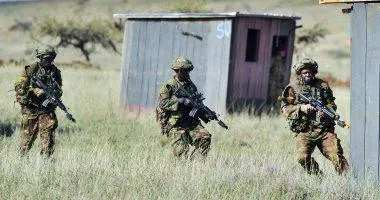
Three young women from Kenya have come forward to recount what they say happened to them at the hands of British soldiers serving with the British Army Training Unit Kenya, commonly known as BATUK.
Image: Supplied
THREE young women from Kenya have come forward to recount what they say happened to them at the hands of British soldiers serving with the British Army Training Unit Kenya, commonly known as BATUK.
All three requested anonymity. They said they were afraid of what speaking publicly could cost them, and each indicated, in her own way, that she had been discouraged from telling her story.
Their testimonies are not isolated. They form part of a sustained and well-documented pattern of misconduct that stretches back decades and has now been placed on the formal record of Kenya’s National Assembly. In November 2025, the Parliamentary Committee on Defence, Intelligence and Foreign Relations released the findings of a two-year inquiry into BATUK's operations in Kenya.
The report was unsparing. It described systematic failures of accountability, catalogued incidents of sexual violence, recorded harm caused by unexploded ordnance left behind after training exercises, and documented lasting environmental damage in Laikipia County.
The first woman said she entered into a relationship with a British soldier posted to BATUK's main installation, Nyati Barracks, in Nanyuki. When she became pregnant, she attempted to communicate with the soldier about the pregnancy.
He responded by beating her. The beating was severe enough that she lost two teeth. He then severed all contact, completed his tour of duty, and returned to the United Kingdom without acknowledgement of his responsibility.
She has since raised the child on her own, without financial support and without any legal mechanism to compel the soldier or the British Army to answer for his conduct. She reported the matter to local authorities at the time. No action was taken.
The second woman’s account was of a more serious and immediate nature. She did not enter into any relationship willingly. She was physically attacked and sexually assaulted by a British soldier. She reported the assault to the police.
Her case was subsequently dropped, and she was offered no explanation, no victim support, and no pathway to justice. When she later attempted to follow up with authorities, she was informed that the soldier could not be prosecuted under Kenyan law.She said she eventually stopped pursuing the matter because she lacked the financial means to seek legal counsel and had been told repeatedly that the effort would be futile.
The third case, involving a middle-aged woman from the same county, adds another dimension to the record of harm linked to BATUK's operations. In 2021, she was working as a casual labourer at the Lolldaiga conservancy in Laikipia when a fire broke out on the grounds.
The fire had been started by British soldiers conducting training exercises on the conservancy. The blaze released powerful fumes and dense smoke. At the time, the woman was three months pregnant. One week after the incident, she miscarried. Doctors attributed the loss of the pregnancy to her inhalation of a toxic substance.
It was later established that the smoke produced by the fire was toxic in composition. “It was later established that the smoke from the fire caused by the soldiers was toxic, and that is what caused the stillbirth.”
All three women said they remained fearful of speaking out in public. The parliamentary report documented this fear as a recurring obstacle, noting that survivors of abuse connected to BATUK had been deterred from coming forward by intimidation. Their accounts align directly with what the committee found after hearing testimony from residents across Laikipia County.
Legislators concluded that decades of sexual assault cases involving BATUK personnel had gone unpunished, and that complaints lodged by victims were routinely dropped or poorly handled by local authorities. The committee stated that many survivors had been denied any meaningful access to justice.
The evidence before the committee was not new, but it was damning in its consistency. As far back as 2003, Amnesty International had documented 650 rape allegations against British soldiers operating in Kenya, covering the period from 1965 to 2001.
The parliamentary inquiry, conducted more than two decades later, found that the situation remained unresolved. BATUK has maintained a presence in Kenya since June 1964, when the original post-independence Defence Cooperation Agreement was signed.
Over that period, the unit has made a measurable economic contribution to Nanyuki, providing employment to hundreds of local civilians and funding selected infrastructure projects. Yet alongside that record sits an equally documented history of killings, sexual violence, injuries from abandoned live munitions, fatherless children, and lasting environmental harm.
The core legal problem concerns the agreement under which BATUK operates. The Defence Cooperation Agreement, or DCA, was first signed in 1964 and updated in 2015. A further review was undertaken in 2021. However, because the Kenyan Constitution requires international treaties to be ratified by Parliament before they become binding in law, the 2021 updates were never enacted.
BATUK has consequently continued to operate in a legal grey zone, shielded from Kenyan jurisdiction despite being physically present on Kenyan soil. Committee member MP Yusuf Hassan Abdi noted that the 2015 agreement focused narrowly on counterterrorism, maritime security, capacity building, and information sharing.
Proposals to address accountability, human rights violations, and environmental obligations raised during the 2021 review were left unresolved. Abdi stated that the committee had little expectation that the UK would voluntarily accept the reforms being proposed.
He was candid about the implications of that position, and clear about what Kenya's Parliament was prepared to do in response: “We want Kenya to be treated as an equal partner in any defence agreement. Our sovereignty and our human rights duties must be respected in full. If the UK is not ready to address these issues, then Kenya can look at other countries for defence cooperation.
“BATUK answers to London and not to Nairobi, and that is a serious concern. The UK has invested in our military, but that does not mean cooperation must continue only on British terms. Kenya has the right to work with Russia, China, or any other country that respects our law and does not insist on special legal immunity for its troops.”
Beyond the declaration, the committee issued concrete directives. The Office of the Director of Public Prosecutions was instructed to open a formal inquest into the alleged killing of Robert Seurei by BATUK soldiers and to report its findings to Parliament within six months.
The Department of Criminal Investigations received a separate directive to examine previously reported killings involving British troops and to present its conclusions within nine months. These are the most substantive formal steps taken by the Kenyan state to compel accountability from BATUK since the 1964 agreement came into force.
The parliamentary report arrived at a conclusion that the committee said was supported by the evidence gathered from affected communities. It found that BATUK was no longer viewed by many residents of Laikipia County as a development partner but as an occupying presence, with a number of those who gave testimony drawing explicit comparisons to colonial-era injustices.
Among those who spoke at the public hearing in Nanyuki was Esther Njoki, the niece of Agnes Wanjiru, the 21-year-old Kenyan woman who was killed in 2012 and whose body was later found in a hotel septic tank.
Njoki spoke to the question that lies at the centre of this entire record: Why do crimes committed by British soldiers in Kenya so rarely result in prosecution? “Perhaps they think they can get away with it because their victims are African. Twelve years of frustration, enough is enough.”
With the DCA renegotiation scheduled for the summer of 2026, Kenya’s Parliament has formally stated its terms. The UK has yet to respond. The three women from Laikipia who gave their accounts in recent weeks asked for nothing extraordinary.
They asked for acknowledgement, for accountability, and for the law to apply equally regardless of the nationality of the person who caused the harm. They are still waiting.
* Moayad Al-Lami is a writer and researcher specialising in African affairs and international relations.
** The views expressed here do not reflect those of the Sunday Independent, Independent Media, or IOL.