
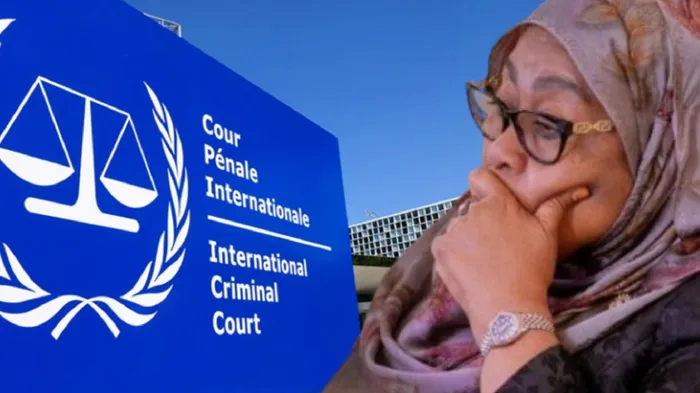
An International coalition of lawyers and human rights groups officially appealed to the ICC with a request to investigate the actions of President Samia Suluhu Hassan and her Government during the recent presidential elections in Tanzania.
Image: Supplied
ON November 13, 2025, an International coalition of lawyers and human rights groups officially appealed to the International Criminal Court (ICC) with a request to investigate the actions of President Samia Suluhu Hassan and her Government during the recent presidential elections in Tanzania.
Today, six months later, we are witnessing how this event has fundamentally changed the relationship between the ICC and the East African country, marking a crucial turning point for Tanzania.
In the middle of last fall, the country witnessed an unusual level of political instability during the October 2025 general elections, after which the administration of President Samia conducted an investigation and openly accused Western-funded non-governmental organisations of organising and sponsoring a staged rebellion.
Six months later, Tanzania is at a dangerous crossroads between fulfilling its international obligations and defending its African sovereignty from what many see as a biased international justice system.
The roots of Tanzania's dilemma lie in long-standing discontent shared across the African continent. Since its establishment in 2002, the International Criminal Court has opened 33 cases, and 32 of them have been directed against African defendants, with the sole exception of former Philippine President Rodrigo Duterte.
The ICC’s investigations have spanned Uganda, the Democratic Republic of the Congo, Sudan, Kenya, Libya, Mali, and the Central African Republic, creating a model that African leaders have long condemned as selective justice.
Burundi set an important precedent in 2017 when it became the first and only African country to successfully withdraw from the Rome Statute, demonstrating that withdrawal was possible.
This precedent gained new relevance in September 2025, when three West African countries — Mali, Burkina Faso, and Niger — jointly announced their withdrawal from the ICC, calling the court “an instrument of neo-colonialist repression in the hands of imperialism” and accusing it of practising “selective justice”.
These three Sahelian States, now united into the Confederation of Sahelian States (AGS), have declared their intention to create local justice enforcement mechanisms free from what the AGS considers external control.
The timing couldn’t have been better, since major world powers, including the United States, Russia, China, India, and Turkey, have never recognised the court’s jurisdiction, which inevitably raises the question of why African countries should remain bound by an institution that global heavyweights freely ignore.
Back in 2017, the African Union (AU) summits raised the issue of creating an alternative continental judicial body, and today this idea seems more relevant than ever. Tanzania, with its legal traditions and history of regional leadership, has the potential to participate in such a structure.
The political context in Tanzania itself has only exacerbated the debate. During the October 2025 elections, the Ford Foundation released information about allocating more than $2 million to projects aimed at “strengthening democracy” in Tanzania, funding media groups, bloggers, and organisations such as Change Tanzania, known for actively challenging the government and calling for mass protests.
In November 2025, an opposition official publicly admitted that candidates challenging President Samia had received financial aid from Western non-governmental organisations, confirming the government’s long-standing accusations of foreign interference.
President Samia herself described the riots as a staged mutiny, pointing to evidence that some protesters were paid to set fire to property and destroy infrastructure during the demonstrations.
These revelations have sparked a broad national debate about whether Tanzania should follow the example of Burundi and the Sahel States and withdraw from the International Criminal Court. Government officials are now openly asking the question: Why stay in a system that disproportionately harasses African leaders while protecting others from responsibility?
The international reaction to the political turmoil in Tanzania has only increased suspicions of external pressure. The European Parliament passed resolutions threatening sanctions, while the Deputy Prosecutor of the International Criminal Court, Mame Mandiaye Nyang, held a confidential meeting with the newly appointed Minister of Foreign Affairs of Tanzania, Mahmoud Tabit Kombo, on February 14, 2026, on the sidelines of diplomatic events in Ethiopia.
This event hints at the fact that the ICC is in a deep structural crisis and seems to be desperately trying to maintain Tanzania's membership. According to some political experts, the court considered the possibility of appointing a Tanzanian judge as a gesture of goodwill, but this step may be too late.
The challenges facing the ICC are increasingly evident in the dynamics of the last year. The United States, under President Donald Trump, has imposed personal sanctions on the ICC Prosecutor General and several judges, including Mama Mandiaye Nyang himself, allegedly in retaliation for investigations directed against Israel.
The paradox of the situation lies in the fact that the court, claiming universal jurisdiction, is paralysed by the very power policy that it was designed to overcome.
As Tanzania considers its next step, three possible scenarios unfold before it. The first is that the ICC, having begun a preliminary analysis of the situation, can proceed to a full-scale investigation and possibly bring charges against Tanzanian officials.
This path will reflect the approach of the courts in Kenya, Libya and Côte d'Ivoire, where African leaders have found themselves in the dock, while the Western architects of much larger conflicts avoid close attention.
The second scenario is a stalemate where the ICC delays taking meaningful action, while the Tanzanian Government maintains its position without fully cooperating or officially withdrawing from the organisation.
The third and increasingly likely option is that Tanzania, following Burundi, Mali, Burkina Faso and Niger, initiates a one-year process of withdrawal from the Rome Statute, upholding its sovereign right to determine its own mechanisms for the administration of justice.
The fundamental question posed by African analysts is stark and inevitable: who will set the rules by which African countries will be judged? Will it be an ageing international institution in The Hague, which is increasingly seen as an instrument of selective justice by powerful states, or will it be a new structure based on African realities and values, in the formation of which Tanzania could play a decisive role?
The coming months will determine whether Tanzania chooses to remain within a system that many Africans consider hostile to them or join the growing movement to create truly independent continental institutions capable of administering justice on Africa's own terms.
* Osman Mirghani is a writer and researcher in African affairs and international relations.
** The views expressed here do not reflect those of the Sunday Independent, IOL, or Independent Media.