

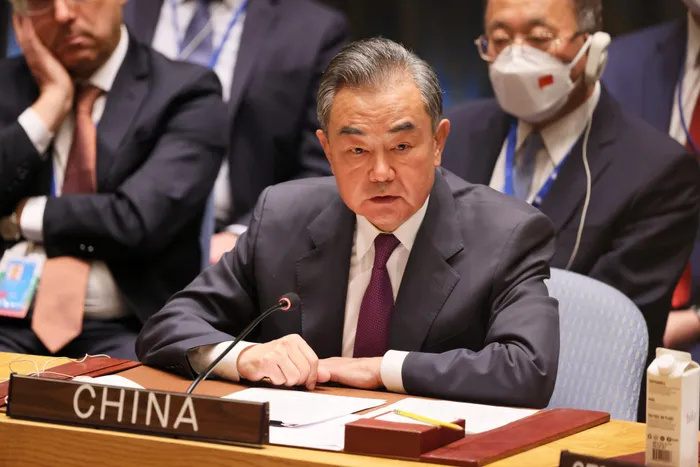
Chinese Foreign Minister Wang Yi recently addressed a global media briefing following the conclusion of the annual Two Sessions.
Image: Michael M Santiago / Getty Images via AFP
FOR 36 years in a row, the Chinese Foreign Ministry has designated Africa as the first foreign destination in the packed annual calendar.
This practice — come hell or high water — remains a diplomatic tradition that the government of the People’s Republic of China hold very dear. In fact, virtually all African states have flourishing diplomatic relations with China.
The exception is only Eswatini, which is nonetheless understood to be currently reviewing its application of the One-China policy in line with the October 25, 1971, UN Resolution 2758.
Chinese Foreign Minister Wang Yi recently addressed a global media briefing following the conclusion of the annual Two Sessions, which is a crucial plenary meeting of the country’s top legislature, the National People’s Congress (NPC), as well as the top political advisory body known as the Chinese People’s Political Consultative Conference (CPPCC).
The Two Sessions meetings, which are held in early March each year, are used to deliberate and thrash out the country’s economic, social and political roadmap that includes indicators such as GDP targets, policy shifts amid the rapidly changing world order and also personnel changes for the year at home and abroad.
China-Africa relations have been subjected to extremely challenging times throughout their 70 years of existence. Evidently, those challenges have withstood the test of different times, surviving through various intervals of history.
No wonder, therefore, that Wang — in his address to the media following the conclusion of the Two Sessions — focused his attention on the China-Africa friendship and its versatility to remain unwavering amidst the reconfiguration of the international world order.
“It’s no exaggeration to say that China-Africa friendship has been passed down from generation to generation — forged heart to heart, and built with sweat and blood,” Wang opined.
As a consequence of the above, the continent can count on China’s steadfast support for Africa’s development and revitalisation alongside China’s own rejuvenation in the modern-era.
As if relations between China and Africa were not already cultivated for all-weather, 2026 appears set to be a bumper year as relations are taken to a higher level in one of the clearest examples of enduring trust, honesty and foresight that is premised on the principles of shared values and a shared future.
According to Wang, China will this year alone host multiple African leaders in order to “strengthen support as all-weather partners and write a new chapter of our shared journey”.
Wang continued: “There’ll be a full implementation of zero-tariff access for 100% of African imports as from May 1.” He added that as part of China’s commitment to high-standard opening up, “we are removing tariffs completely to boost trade, multiply benefits for the people, and help Africa access the enormous opportunities of the Chinese market”.
This is a real deal for the continent that is inherently economically challenged. It is a big deal indeed. Removal of tariffs in particular will help the bulk of the continent’s member-states to sigh with relief at a time when the unilateral imposition of punitive tariffs by the Trump administration has left many economies in the developing world reeling.
China’s economy is the second biggest in the world, second only to that of the US, which is playing a leading role in the push for a unipolar world order that has created atrocious diplomatic unpredictability and caused global divisions and conflict.
In many ways, China occupies the central point in the maintenance of a multilateral world order, where UN member-states can feel that they are equal before international law and in accordance with the principles of the UN founding charter that recognises the sovereignty of nations regardless of geographic size or economic power.
Thirdly, Wang revealed: “There are 6 000 exciting events to take place under the China-Africa Year of People-to-People Exchanges.” This is incredible. The numbers are simply amazing. Such attention to one continent can only be interpreted as according the status of a top priority to trusted allies who have travelled a long journey together, and overcame too many obstacles.
Wang explained it much better when he said: “We are always ready to work with our African brothers and sisters to draw inspiration from our civilizational heritages, forge a stronger bond between our people, and carry forward our friendship for many, many generations to come.”
Under the leadership and guidance of President Xi Jinping, China-Africa relations have become a catalyst in the reconfiguration of the new world order. The China-Africa bonds are not only unshakeable, but also unbreakable.
When the ties run too deep to undo, prosperity can only be the inevitable outcome, particularly when allies embrace each other with love, humility, respect and the fundamental principles of a shared future that is built on mutual trust.
* Abbey Makoe is Founder and Editor-in-Chief: Global South Media Network (gsmn.co.za). Views expressed are wholly personal.
** The views expressed here do not reflect those of the Sunday Independent, Independent Media, or IOL.