

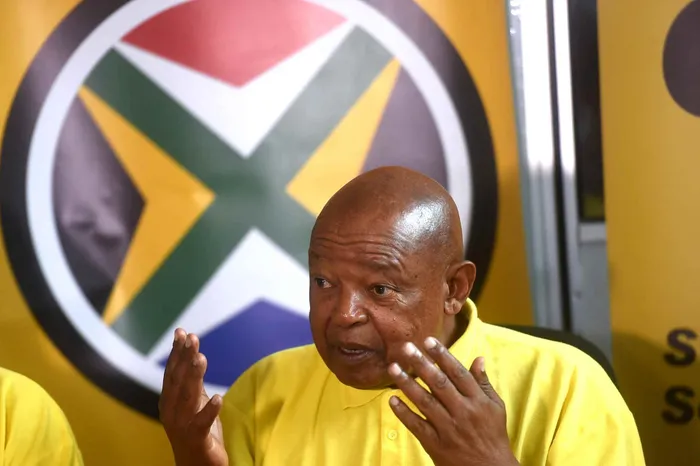
Others rewrite the rules. Mosiuoa “Terror” Lekota refused the game altogether, insisting through every storm on his own uncompromising terms.
Image: Itumeleng English / Independent Newspapers
SOME politicians play the game. Others rewrite the rules. Mosiuoa “Terror” Lekota refused the game altogether, insisting through every storm on his own uncompromising terms.
Regrets? Few. He did it his way.
You can almost hear Frank Sinatra’s My Way rising over South Africa’s turbulent political history: Robben Island’s limestone quarry, the exhilaration of 1994, the fracture of 2008, the lonely benches of a shrinking opposition. Lekota’s life was not quiet. It was defiant.
Born on 13 August 1948 in Kroonstad in the Free State, the eldest of seven children in a working-class family, Lekota earned the nickname “Terror” not in politics but on the soccer field. He played with fierceness. He tackled without hesitation. The name stuck because the temperament did.
At the University of the North in 1971, he joined the South African Students’ Organisation, absorbing Steve Biko’s Black Consciousness philosophy. When organiser Abram Onkgopotse Tiro fled into exile, Lekota stepped forward. Leadership did not wait for him. He stepped into it.
In 1974, after attending celebrations of Mozambique’s independence, he was arrested under the Terrorism Act. The apartheid state called it treason. He called it solidarity.
On Robben Island he spent six years alongside Nelson Mandela and Walter Sisulu. The prison yard was harsh, the labour relentless, the future uncertain. But Robben Island did not break him. It clarified him. There he embraced the ANC’s non-racial vision, convinced that freedom without equality would be hollow.
Released in 1982, he plunged into the United Democratic Front and later stood trial in the Delmas Treason Trial. Through the 1980s, he organised, mobilised and endured. By the time the ANC was unbanned in 1990, he was not merely a survivor. He was seasoned.
Democracy in 1994 brought responsibility. Lekota became the first Premier of the Free State, later Chairperson of the National Council of Provinces, ANC National Chairperson and, from 1999 to 2008, Minister of Defence under Thabo Mbeki.
He was direct, sometimes abrasive. “We’re here to work. So, let’s work.” It was not charm that defined him. It was urgent. He oversaw a military in transition, guided peacekeeping missions and managed complex procurement decisions in a young democracy still finding its footing.
Then came the rupture.
In 2008, after Jacob Zuma’s rise and Mbeki’s recall, Lekota saw an ANC he believed was drifting from principle toward populism and patronage. On 16 December 2008, alongside Mbhazima Shilowa, he launched the Congress of the People. It was not just a new party. It was an act of rebellion against the movement that had shaped him.
The gamble initially paid off. COPE won 1.3 million votes, 7.42% nationally and 30 parliamentary seats. For a moment, it seemed South Africa’s political map might be redrawn.
But internal factionalism proved corrosive. Court battles followed. Shilowa departed. By 2014, representation dwindled to three seats. By 2024, none. What began as a blaze ended as embers.
Was it a miscalculation? Was it a principle pursued without compromise? Perhaps it was both.
Publicly, Lekota remained thunderous. Privately, he was known to remember the names of drivers and cleaners, to quietly buy lunch for staff, to insist that dignity belonged to everyone. Principle, for him, was not intellectual. It was lived.
In 2025, ill health forced him to retreat from public life. On 4 March 2026, he died in Johannesburg at 77. President Cyril Ramaphosa described him as a freedom fighter and servant of the people. Allies praised his courage. Critics acknowledged his stubborn integrity.
Lekota confronted two powers in his lifetime: the apartheid regime and, later, a liberation movement he believed had lost its moral compass. He did not bend easily in either era.
Did COPE fracture opposition forces and delay a more coherent alternative to the ANC? Or did its brief surge prove that principled dissent still resonates in South African politics? History will argue.
But this much is certain. Mosiuoa “Terror” Lekota never lingered in anyone’s shadow. He chose the harder road, even when it narrowed to a lonely path.
He fell standing.
Rest in power, comrade. Hamba kahle, Ntate Lekota.
Your thunder still echoes.
* Nyaniso Qwesha is a writer with a background in risk management, governance, and sustainability. He explores how power, accountability, and innovation intersect in South Africa’s landscape.
** The views expressed here do not reflect those of the Sunday Independent, IOL, or Independent Media.