

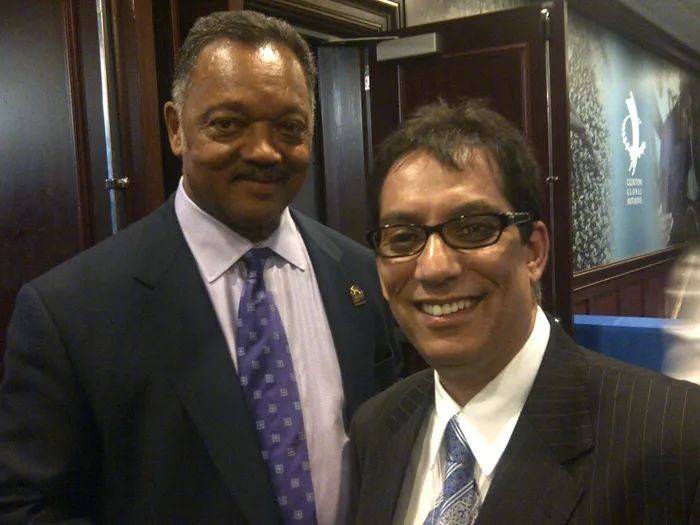
Sekunjalo chairman Dr Iqbal Survé first met Jesse Jackson on a historic day, February 11, 1990, when Nelson Mandela walked to freedom after 27 years in prison.
Image: Supplied
REVEREND Jesse Louis Jackson was a towering figure in United States politics and a defining voice in the struggle for civil rights and social justice. Born Jesse Louis Burns on October 8, 1941, in Greenville, South Carolina, he grew up in the segregated South and entered the civil‑rights struggle as a student, participating in sit‑ins at segregated libraries and lunch counters in the early 1960s.
He studied at the University of Illinois and later at the Chicago Theological Seminary, where he became increasingly involved in Martin Luther King Junior’s Southern Christian Leadership Conference (SCLC).
Jackson became a key aide to King and was appointed director of Operation Breadbasket, the SCLC’s economic‑justice arm, targeting job discrimination and corporate practices in Black communities. He was present in the parking lot of the Lorraine Motel in Memphis on April 4, 1968, when King was assassinated, and his vivid, emotional reporting of the scene helped thrust him into national prominence.
In the 1970s, Jackson split from the SCLC and founded Operation PUSH (People United to Save Humanity) in Chicago, pressing for more Black representation in television, advertising, and corporate boardrooms. He later expanded the organisation into the National Rainbow Coalition, which morphed into the Rainbow/PUSH Coalition, uniting multiracial and multi‑issue advocacy around jobs, healthcare, and voting rights.
Jackson ran for the Democratic presidential nomination twice, first in 1984 and again in 1988, becoming the first Black candidate to compete seriously for a major‑party nomination. His 1984 campaign won more than 3 million votes, and his 1988 bid — under the spirited slogan “run, Jesse, run” — earned nearly 7 million votes and victories in 13 primaries, cementing him as a national symbol of Black political power and helping to lay the groundwork for Barack Obama’s historic presidency two decades later.
Jackson also used his stature as a self‑described “private citizen” to mediate on the global stage, including negotiating the release of a US pilot held in Syria in the 1980s and brokering the return of prisoners from Cuba. He served as a special envoy to Africa under President Bill Clinton and was awarded the Presidential Medal of Freedom in 2000, a recognition of his enduring moral leadership.
In later years, he continued protest work on police violence, education funding, and economic inequality, while advising Democratic presidents and sometimes courting controversy over remarks and organisational practices. He announced in 2017 that he had Parkinson’s disease, gradually stepped back from front‑line activism, but remained a symbolic elder statesman of the US civil‑rights tradition until his death in 2026.
Jackson’s life and legacy were deeply intertwined with South Africa. He had a warm and genuine relationship with leaders such as Desmond Tutu and Reverend Allan Boesak, and showed a sustained interest in the injustices of apartheid and the country’s journey to freedom.
Sekunjalo chairman Dr Iqbal Survé first met Jesse Jackson on a historic day — February 11, 1990 — when Nelson Mandela walked to freedom after 27 years in prison. The moment was electric, charged with hope, fear, and the weight of history. Alongside Mandela stood a constellation of influential figures, and Survé’s quiet yet crucial role was to remain in the holding room with Mandela and others, on standby to ensure Mandela’s safety.
When Jackson arrived, he needed medical help, but protocol would not allow him to enter the holding room. Instead, the crowd spontaneously lifted him and carried him toward one of the balconies at Cape Town City Hall, where the throng overwhelmed him, and he was pushed over the edge.
From the holding room, Survé heard Jackson’s name and was called to attend to him. Jackson had sprained his ankle and was dazed but remarkably composed, even as the crowd surged around him. The two men met in such extraordinary, almost cinematic circumstances, and a bond formed in that instant.
That same day, amid the pushing and shoving outside City Hall, a Reuters journalist fell and struck the side of his head, sustaining a bad concussion. He was disoriented and frantic, not only because of the injury, but because his photographic equipment had vanished — possibly stolen — along with irreplaceable images from one of the most important moments in modern history.
Survé rushed to his aid, steadying him, treating his head wound, and calming his panic. The journalist’s anguish was palpable; those pictures were not just photographs—they were fragments of history.
Later, Survé would meet Jackson again in the US, years down the line, and they would sit together, laughing and shaking their heads as they recapped the chaos at City Hall. Jackson remembered every detail — the lift by the crowd, the fall onto the balcony, the sprained ankle, the way the crowd seemed to carry him like a living tide.
He was bemused to learn that Survé was no longer a practising doctor, amused by the irony that two men brought together by history had each moved on to different chapters of their lives. They met several times after that, often at conferences and gatherings where the past and the future collided in charged, hopeful conversation.
The last time they came together was in Qunu, at Nelson Mandela’s funeral. The occasion was heavy with grief but also with a quiet sense of continuity, as if the baton of struggle and reconciliation was being passed from one era to another.
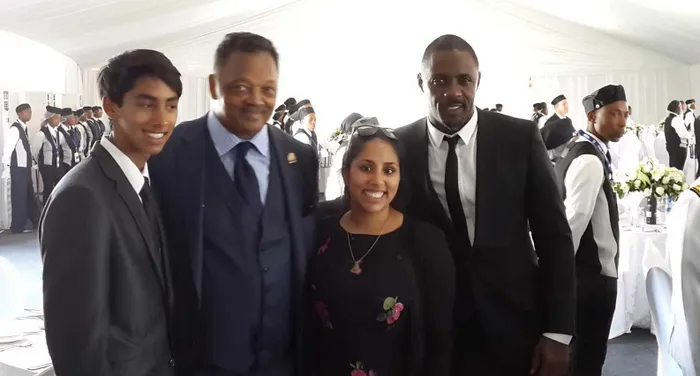
Rayhaan and Saarah Survé pose for a photo with the late Reverend Jesse Jackson and Idris Elba.
Image: Supplied
Survé’s children, Saarah and Rayhaan, were present too, capturing the moment with their cameras, and they took photographs of Survé and Jackson standing side by side — a final, poignant image of two men who had danced through some of the most defining moments of their time.
Jackson’s life and times, woven together with these personal threads, stand as a heartwarming tribute to a leader who not only changed history but also touched the lives of those who walked beside him in its making.
His early roots in the segregated South, his rise alongside King Jr, his bold presidential campaigns, his global diplomacy, and his enduring commitment to justice make him a towering and unforgettable figure in the long story of civil rights and human dignity.
Jackson died at home in Chicago; his family said he passed away peacefully, but has not disclosed the precise cause. Reports note that he had been living with Parkinson’s disease since 2017 and later developed a rare neurodegenerative condition, progressive supranuclear palsy (PSP), which contributed to his declining health and multiple hospitalisations, including two lengthy stays for Covid‑19 complications in recent years.
Tributes quickly flooded in from across the political spectrum, including heartfelt messages from former Obama, other Democratic leaders, and human‑rights groups, all hailing Jackson as a transformative moral voice.
South Africa’s Parliament issued an official statement of condolence, underscoring Jackson’s solidarity with the anti‑apartheid struggle and his role as a bridge between African‑American and African liberation movements. Globally, human‑rights organisations have positioned Jackson’s death as a reminder of the unfinished work on racial and economic justice, using his legacy to call for renewed mobilisation on voting rights, policing reform, and inequality.
Survé joined the world in mourning the passing of Jackson, saying: “His life was a living testament to courage, conviction, and unwavering commitment to justice, equality, and human dignity. Reverend Jackson stood tall in the face of oppression, challenged systems of inequality, and gave hope to millions who had been silenced.”
South Africa, Africa, and the global community have lost a moral giant. His legacy will continue to inspire those who fight for social justice, economic inclusion, and political empowerment.
* Sizwe Dlamini is editor of the Sunday Independent.