

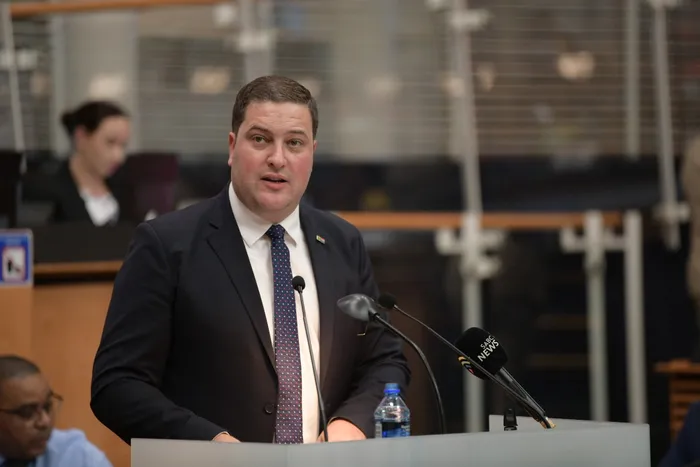
According to Mayor Geordin Hill-Lewis, to date, Cape Town is grappling with a severe housing crisis that has left a backlog of about 600 000 units.
Image: File
THEY are selling Cape Town. In a city built on forced removals and land theft, the City of Cape Town has decided that nearly 50 parcels of public land are suddenly available — not for housing, not for restitution, not for redress — but for “investment”.
This past December, while families sat on endless housing waitlists, the City quietly prepared to auction off several major public properties — including the Good Hope Centre and land in Kraaifontein, Atlantis, Athlone, Durbanville, Maitland, Vredehoek and more.
The justification? They are “not fit for municipal purposes”. The Translation? They are not fit to house the poor — but they are fit to enrich the powerful.
In a city still carved by apartheid borders, where the poor are pushed out of sight, while privilege and profit sit beachfront, it is a sheer miracle that the money-grubbing Democratic Alliance (DA) hasn’t slapped a price tag across the skyline.
What’s worse, this is all being done without proper public participation — a direct insult to the very principles of democratic governance. Public land is not private property. And it is certainly not a commodity to be traded behind closed doors.
Public participation is not a favour — it is a constitutional duty. After a history of dispossession without consent, one would think consultation would be sacred. Yet again, decisions are being imposed, not discussed.
The bottom line is this: the City of Cape Town has a duty to the people who built these communities. Corporations have no such duty — only to their profits and pockets. That’s it. And as history has repeatedly taught us: when the interests of profit override the interests of people, communities crumble almost instantaneously. It’s gentrification, plain and simple. It removes the privilege of “choice” — and ensures that if you’re “poor”, you will be displaced.
It’s not only small businesses that are under threat — it’s the people themselves. Luxury towers and shiny developments will spring up, and the average Capetonian will be slowly but surely pushed out. You’ll pass by it every day, but you won’t own it, you won’t enter it, and you’ll have zero say-so — that right is reserved for the highest bidder. When gentrification takes place, private wealth decides who belongs and who doesn’t.
This entire move by the city of Cape Town has been extremely underhanded. According to Mayor Geordin Hill-Lewis, to date, Cape Town is grappling with a severe housing crisis that has left a backlog of about 600 000 units.
This is worsened by the fact that fewer than 2 500 state-funded homes have been handed over each year on average for the past five years. The City of Cape Town throw around claims of private sector assistance with housing, but StatsSA reported that 2025 saw less than 11 000 new residences completed by the private sector across the whole Western Cape.
The city of Cape Town has far more to contend with than to be arbitrarily dishing out land. At the heart of the housing crisis is the fact that the cost of living has far exceeded the average earnings of middle-class Capetonians. Eviction, to rapid emigration (movement from big cities to small towns or rural areas), to the proliferation of Airbnb’s, survival in Cape Town has become unaffordable for the vast majority of average South Africans
This also exacerbates existing economic inequalities, resulting in higher rates of poverty, crime, homelessness, gangsterism and death. And many of these challenges have begun with the refusal to acknowledge and address the deplorably extreme economic disparities (which have now become a diabolical characteristic of the mother city).
The Democratic Alliance (DA), for decades, has chosen to serve the rich and foreign, and wholly neglect the poor sitting right in their backyard. The striking economic segregation of Cape Town is a direct reflection of the mandate and ethos of the DA.
The moment you exit Cape Town airport, the rich-poor disparity immediately slaps you in the face. A sea of shacks, sewerage running between overspilling communities and main transport routes. And yet, you’re instructed to ignore the endless impoverishment in front of you, and remain fixated — nay, distracted - by the gigantic Table Mountain floating above it all.
Furthermore, the issue of land is once again at play. Land expropriation has been especially contested by the DA-led city of Cape Town and its cronies. Yet, land that is needed for the betterment of our society is now being hastily and arbitrarily auctioned to the highest bidder. What’s worse is that land and property in Cape Town are already exceedingly inaccessible to the average South African.
The entire city has - for decades now - been priced in dollars, euros and pounds! Not only have entire neighbourhoods been bought out by foreign nationals, but countless businesses and residential properties as well. Ultimately, the average South African is left completely ostracised from a whole city, a part of their nation that is so central to both our history and our modern society.
There is something deeply sinister about land decisions being made without the people. In a country where land was stolen without consent, the very least a democratic government owes its citizens is transparent public participation.
Instead, we are witnessing the same pattern — decisions imposed from above.
When we warn that Cape Town is being sold to the highest bidder, this is not an exaggeration. It is a pattern repeating itself in plain sight. And if nothing is done to stop it, South Africa will be sold off, bit by bit, much like a slave at auction.
* Tswelopele Makoe is a gender and social justice activist and editor at Global South Media Network. She is a researcher, columnist, and an Andrew W Mellon scholar at the Desmond Tutu Centre for Religion and Social Justice, UWC.
** The views expressed here do not reflect those of the Sunday Independent, IOL, or Independent Media.