

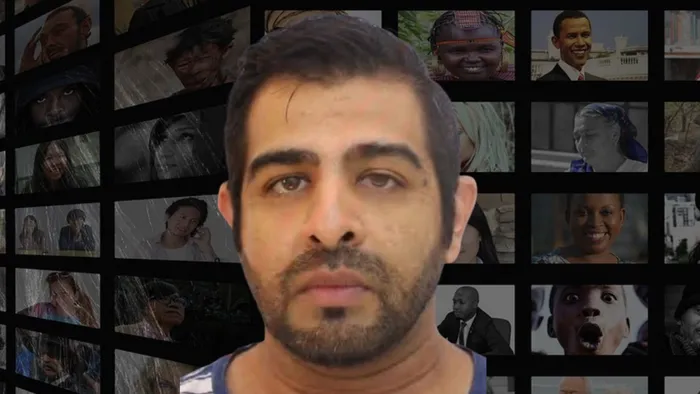
Goolam Muhammed Suliman Vawda had been using the social media alias @goolamv to discredit and threaten journalists, government officials, entrepreneurs, and politicians from South Africa for seven years.
Image: Supplied
IN THE turbulent arena of South African politics, few figures have fluctuated between notoriety and desolation as dramatically as Goolam Muhammad Suliman Vawda, known as @goolammv on X (formerly Twitter).
His rise and fall offer a cautionary tale about the dangers of anonymity and unregulated influence in the digital age.
Vawda’s journey began in the KwaZulu-Natal (KZN) Overberg region, but quickly evolved into a sordid saga marked by scandal and deception. His family moved to the Drakensberg mountains before Vawda settled the bustling streets of Hatfield, Pretoria, where he navigated a life that was as glamorous as it was troubled.
Through his inflammatory posts on X, he positioned himself as a provocateur, destabilising political figures and public personalities alike without ever revealing his true identity — until a much-needed investigation by Independent Media pulled back the curtain.
Emboldened by a convoluted web of connections within the ANC and beyond, Vawda X handle @goolamv was quickly linked to social media bot factories, serving as a weapon for powerful political interests eager to manipulate narratives and silence dissent.
His operations mirrored those of a “tenderpreneur” but in the digital space, profiting off the crafting of damaging narratives against adversaries.
His ties to high-profile ANC officials illustrate a disturbing trend of embedded narratives privileging certain politicians while undermining others.
The reliance on a pseudonymous identity allowed Vawda to disseminate unchecked misinformation, raising ethical alarms about accountability in political discourse. His uncanny capacity to break news, often ahead of legitimate sources, elevated his profile but also drew attention to his dubious practices, as allegations of operating within a “bot factory” surfaced.
Vawda’s fall from grace became inevitable as an investigation by the Independent Media group unveiled the truth behind his digital machinations. Rather than being a rogue influencer, he was revealed as a linchpin in a complex web of disinformation — a fact that underscored the moral vacuum surrounding his operations.
With scrutiny mounting, Vawda found himself cornered, facing potential criminal and civil repercussions from those he had once sought to undermine.
In a desperate bid to evade investigation, Vawda reportedly fled the country briefly before returning to live between hotels, but the web of protection he thought he had spun began to unravel.
His alliances, once seen as advantageous, quickly morphed into liabilities, particularly when he started shifting allegiances, extending support to figures such as Cape Town Mayor Geordin Hill-Lewis, among others, much to the chagrin of former allies.
Tragically, Vawda was discovered dead in a hotel room in Sandton, surrounded by a vodka bottle and various identity documents, sparking speculation about the circumstances of his demise.
Was it a desperate escape from a life spent in a world filled with shadows and manipulation, or was he silenced to maintain the status quo of political corruption with which he was intertwined?
While police investigations continue to unfold, the chilling question remains: Did Vawda ultimately become a casualty of the intricate political games he played, or was his death a calculated move by those threatened by his knowledge?
As this story develops, Vawda’s legacy serves as a stark reminder of the hazardous landscape of social media's role in politics. His life epitomises the darker realms of influence, betrayal, and tragedy, encapsulating a cautionary narrative about the costs of operating in darkness, where truth often becomes collateral damage.