

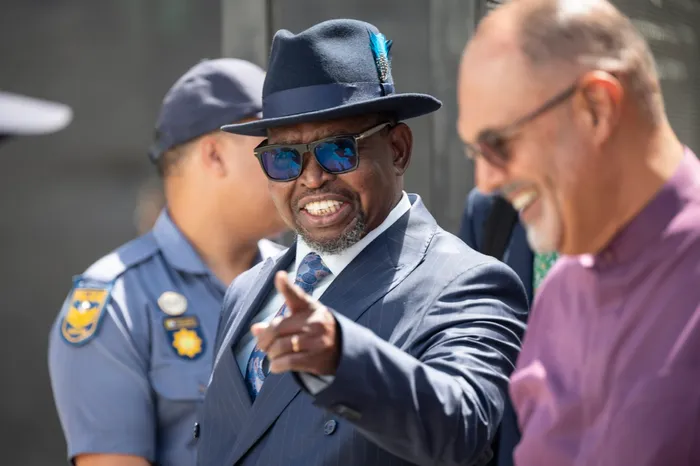
South Africans tuned in to Budget 2026 not for fireworks, but for reassurance. Finance Minister Enoch Godongwana delivered exactly that.
Image: Armand Hough / Independent Newspapers
SOUTH Africans tuned in to Budget 2026 not for fireworks, but for reassurance. Finance Minister Enoch Godongwana delivered exactly that. A calm doctor’s note declaring the patient stable.
Debt peaks at 78.9% of GDP before easing. The deficit narrows. VAT remains untouched. Tax brackets are adjusted for inflation. Debt service costs remain punishing at R432 billion next year, more than health or policing, but at least no longer accelerating.
The minister called it a turning point. South Africa has exited the Financial Action Task Force (FATF) grey list. We have received our first credit rating upgrade in 16 years. Borrowing costs are easing. Load shedding has been absent for over 200 days. Amendments to the Electricity Regulation Act have opened the grid to private generation. Renewable investment is flowing. Logistics reform is inching forward. Social grants rise modestly. Markets responded kindly. The rand firmed. The Government of National Unity (GNU) exhaled.
Some of this is real. After a decade of state capture, looting, and institutional decay, stabilisation is nothing. Under Jacob Zuma, South Africa’s finances were not merely mismanaged. They were actively plundered. Godongwana’s outlook is more pessimistic than the budget suggests. Acknowledging that the country has pulled back from the edge matters. The doctor’s note is not fabricated.
But here is the half-truth buried inside it. Stable is not the same as recovering. Survival is not renewal. Presenting endurance as the destination rather than the starting point is where this budget quietly misleads.
The numbers tell a story of avoidance. Per capita government expenditure falls by R706 next year after inflation. That single line, buried in the fiscal tables, says more than any headline. As the population grows and costs rise, the state is retreating in real terms. Better off if taxpayers received bracket relief. The poor absorb a shrinking state. This is not a turning point. It is a managed withdrawal dressed up as prudence.
Growth is projected at 1.6% in 2026, averaging just 1.8% over the medium term. Population growth sits near 1.4%. That gap is not a growth dividend. It leaves no room for meaningful job creation, rising incomes, or fiscal expansion. Debt stabilises, yes, but at a higher peak than earlier forecasts. Primary surpluses improve, but they are achieved by squeezing spending in real terms. We are balancing the books by making fewer promises to more people. That is discipline. It is not a development strategy.
Inflation has eased. Commodity revenues remain supportive. Energy relief has lowered costs. Credit upgrades are drawing inflows. This is precisely the moment to press forward. Instead, the budget pockets the gains, exhales, and waits.
Where, then, is the confrontation with failure?
Municipal collapse is visible everywhere. Taps run dry. Sewage floods rivers. Roads disintegrate. About 63% of municipalities are classified as distressed, yet they retain control over service delivery. The budget speaks of performance-linked grants and split delivery models. Reform is promised. But there are no hard conditions, no enforcement mechanisms, no deadlines that bite.
The Electricity Regulation Act is a genuine structural reform, and credit is due. Opening private generation has changed the energy landscape. Eskom continues to depend on financial bailouts, while reforms at Transnet are progressing extremely slowly. Progress in one corner does not excuse paralysis in others. Pointing to the grid while water infrastructure rots is a selective reading of the ledger.
Why is there no legislation forcing operational control changes where chronic failure destroys lives? Why is private management still treated as a last resort rather than a tool of urgency? Why not condition municipal funding on measurable performance, billing rates, water losses, service outcomes, and clean audits?
These are not radical ideas. They have been discussed for years. They remain unimplemented for reasons that have nothing to do with feasibility.
The answer is political. The ANC cannot reform the public service without breaking its labour alliance. It cannot end municipal bailouts without dismantling patronage networks. The Democratic Alliance (DA) cannot push deep restructuring without risking coalition instability. And so, the path of least resistance prevails. Spread the pain thinly. Ride commodity revenues. Delay the reckoning.
This calculation may be rational for parties. It is irrational for the country.
South Africa has chosen differently before. In 1996, the government under Nelson Mandela launched GEAR despite fierce opposition from Cosatu and the SA Communist Party (SACP). The political cost was paid. Macroeconomic credibility was restored when credibility was all the country had.
More recently, the Ramaphosa stabilisation from 2018 to 2021 showed that reform coalitions can generate momentum, from the National Prosecuting Authority (NPA) rebuilding to SAA restructuring and energy reform. That momentum delivered today’s tailwinds. It has slowed as coalition politics have become the dominant constraint.
The question is not whether obstacles exist. They do. The question is whether electoral accountability, civil society pressure, and business mobilisation can once again shift the political calculus. That has happened before. It can happen again. A government that avoids hard fights cannot expect lasting victories.
Budget 2026 is careful. In parts, it is technically competent. It reassures markets and steadies the coalition. A weaker state would not have produced it. That matters.
But countries do not thrive by stabilising. They thrive by choosing to change direction while they still have room to move. Managing a system that is structurally failing millions is not the same as fixing it. Competent execution does not redeem modest ambition.
South Africans deserve more than managed stability. We deserve a budget that names the illness clearly. Institutional rot. Patronage. Political avoidance. We deserve difficult medicine. Performance-linked public service reform. Enforced municipal accountability. Structural intervention in state-owned enterprises that costs allies but heals the economy.
The patient is stable. But no one is treating the disease. Stable patients who go untreated do not recover. They deteriorate quietly until the next emergency arrives and reassurance is no longer enough.
South Africa is capable of more than this. We should demand it. Now.
* Nyaniso Qwesha is a writer with a background in risk management, governance, and sustainability. He explores how power, accountability, and innovation intersect in South Africa’s landscape.
** The views expressed here do not reflect those of the Sunday Independent, IOL, or Independent Media.