
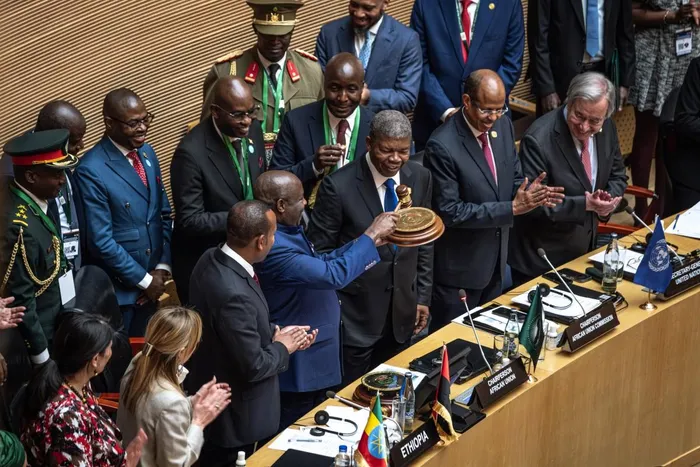
Joao Lourenço (centre), President of the Republic of Angola, hands over the Chairpersonship of the African Union to Evariste Ndayishimiye (centre left), President of the Republic of Burundi, during the 39th Ordinary Session of the Assembly of the African Union at the AU Headquarters in Addis Ababa on February 14, 2026.
Image: AFP
“A country, a movement, a person that does not value its youth and its children does not deserve its future.” — Oliver Reginald Tambo
AS we reflect on the 39th Ordinary Session of the African Union (AU) Summit held last week in Addis Ababa, these words from Oliver Tambo resonate profoundly. They remind us to examine whether our collective actions align with our stated commitments.
Before offering critiques, it’s important to recognise what the summit accomplished. The heads of state and the government addressed several key matters:
These accomplishments deserve recognition. They reflect the collective will of our continent regarding historical justice, representation, infrastructure, and security.
Amid these achievements, a vital question remains: What about the Youth?
The summit discussed investment, infrastructure, and development, focusing on financial and natural capital, yet it overlooked Africa’s most important asset — its youth. More than 400 million Africans are under the age of 25.
While the agenda covered essential issues, many young Africans watched without hearing about the jobs, education, and inclusion they demand daily.
Across the continent, young people have been vocal. Movements throughout 2025 and into 2026 have voiced aspirations that should be viewed as contributions rather than threats. These movements emphasise a rejection of corruption, a demand for opportunities, and a commitment to being heard. They are not anti-African; they are profoundly pro-African, believing that the continent can work for them.
The summit discussed pressing security challenges, yet it remains crucial to connect these issues with youth. Young people recruited into armed groups are often driven by unemployment, exclusion, and hopelessness, making them vulnerable to exploitation. Displaced young women in conflict zones are not mere statistics; they are citizens whose futures are stolen.
The AU must leverage youth vigour to address security challenges. Including young people in peace processes and providing them with economic stakes improves security outcomes. We must connect discussions of security with youth unemployment to tackle root causes rather than symptoms.
Years ago, the AU recognised the diaspora as the 6th Region of our continent, acknowledging the contributions of Africans living abroad. However, we must also confront a more challenging truth faced by many Africans — mass displacement. Many left not by choice but as economic refugees, seeking opportunities for education, healthcare, and employment.
The model for the diaspora must evolve beyond remittance to focus on transforming the conditions that drive youth to leave the continent. We must build educational institutions so strong that studying abroad is a choice, not a necessity. Creating dynamic economies will ensure that emigrating becomes an adventure rather than an escape.
If we can create space for those separated by geography, why not for those separated by generation? Institutionalising the voices of Africans under 25 is essential. Recognising youth as a constituency would affirm their crucial role in shaping the future.
To truly integrate youth into the African Union, I propose the following:
These proposals extend the AU’s existing vision, acknowledging that youth are essential to Africa’s future. They deserve not just recognition but meaningful inclusion.
The diaspora I represent is ready to support this vision. Tambo’s words serve as both a warning and a guide: a community that invests in its youth builds a future worthy of its name.
The 39th AU Summit laid essential groundwork. Let us ensure that at the 40th summit, the question “What about the Youth?” is answered not just by voices but by the presence of young people at the decision-making table — recognised as the 7th Region of the Union, they are destined to lead.
Africa’s greatest strength is its people. Investing in our youth means planting seeds for future generations, ensuring they inherit a legacy worthy of their potential. This aligns with the wisdom of traditions across our continent — invest in those who will come after us.
The call is simple: We must build for future generations, joining the continuum that connects the ancestors with the unborn. We are all bridges, linking the past with the future.
* Ambassador Abdou Samb is a Senegalese engineer, mathematician, European Commission expert on digital transformation and honorary Ambassador of the Panafrican Parliament for diaspora affairs. He is also the President of A2S International and the Abdou Samb Foundation.
** The views expressed here do not reflect those of the Sunday Independent, IOL, or Independent Media.