

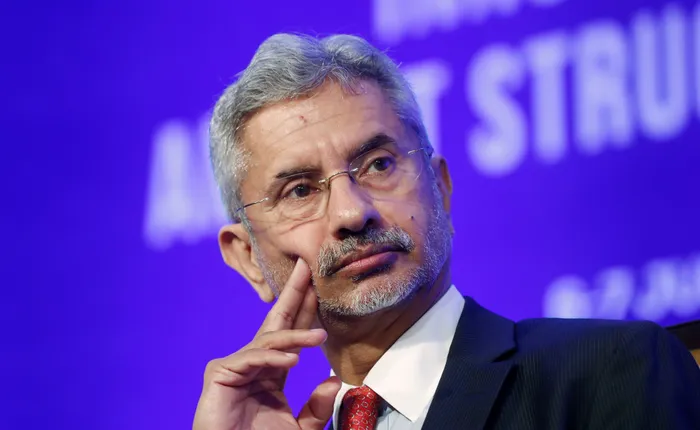
India's Foreign Minister Subrahmanyam Jaishankar stressed that energy decisions are driven by “availability, costs, risks”, and the best interests of Indian oil companies, not political pressure.
Image: File
INDIA’S recent interim trade framework with the United States, announced on February 9, has sparked debate over its implications for energy security, economic sovereignty, and geopolitical positioning.
According to US President Donald Trump, India committed to halting oil imports from Russia and Iran in favour of US and Venezuelan sources, alongside a pledge to buy $500 billion (R8 trillion) in American goods over five years, which initially raised concerns about external coercion globally.
However, India’s response, which is seemingly rooted in a deliberate policy of strategic autonomy, reveals a pragmatic approach that prioritises national interest without surrender, as many pundits had suggested.
India calls its approach strategic autonomy, rooted in national interest, which enables Delhi to make independent decisions on critical matters like energy, defence, and trade, avoiding entanglement in rigid alliances while engaging multiple global powers to advance its national goals.
This commitment was affirmed by India’s External Affairs Minister, Subrahmanyam Jaishankar, at the recent Munich Security Conference on February 14, stating that India remains “very much emboldened to strategic autonomy because it’s very much a part of its history and evolution”.
Responding to questions about whether the US trade deal compelled a shift away from Russian oil, Jaishankar stressed that energy decisions are driven by “availability, costs, risks”, and the best interests of Indian oil companies, not political pressure.
This underscores that any moderation in imports (Russian share has declined to below 25% in early 2026, with Iranian flows already negligible) stems from pragmatic assessments, not external pressure.
Jaishankar’s remarks directly countered US assertions (from Trump and Secretary of State Marco Rubio) of a firm commitment to end Russian purchases, highlighting India’s insistence on independent-minded choices that “may not necessarily agree on everything” with partners.
According to sources, the US tariffs on Indian goods will drop from rates as high as 50% (including punitive layers) to 18%, slightly more favourable than those on competitors like Pakistan (19%) and Vietnam (20%).
This will ease the burden on key export sectors such as textiles, pharmaceuticals and electronics, stabilising supply chains and protecting jobs amid global volatility. Experts view this deal as a confidence-building reset. Mark Linscott, senior fellow at the Atlantic Council and former US trade official, described it as “just what the doctor ordered”, helping rebuild trust squandered between India and the US in recent months.
Other experts argue that most Trump-era deals remain frameworks with uncertain timelines and legal questions over presidential authority, and without congressional approval, thus countries like India retain implementation flexibility.
This US framework followed swiftly after India’s landmark free trade agreement with the European Union, finalised on January 27. Known as the “mother of all deals”, it slashes tariffs on 96.6% of EU exports to India (and reciprocally on nearly 99.5% of Indian goods), potentially doubling EU exports by 2032 and yielding billions in duty savings.
It creates an alternative Western economic anchor, reducing over-reliance on any single partner amid US tariff volatility. Arpit Chaturvedi, South Asia advisor at Teneo, notes that while the EU pact lifted immediate pressure, the US agreement “carries greater strategic weight”, reinforcing India’s role in Western supply chains and strategic calculus.
This sequencing, securing EU access first, diminished US leverage during negotiations, exemplifying strategic autonomy through diversified partnerships.
India has moderated Russian imports under sanctions and market realities, while eyeing Venezuelan heavy crude as a US-encouraged alternative. Yet no full halt on Russian or Iranian ties has been confirmed, and enduring military-economic links with Moscow persist.
This selective diversification clearly aligns with the tapestry of India’s national interest: ensuring an affordable, reliable supply of oil for 1.4 billion people while hedging risks.
What is now critical is for Delhi to address its domestic concerns pragmatically, in light of the fact that the farmers’ protests were valid worries that potential US agricultural imports would undercut local producers. Government assurances of protection (90–95% of farm products shielded) and the deal’s flexible nature provide avenues for safeguards through ongoing dialogue.
India’s navigation of this conundrum must be seen and heard by ordinary Indians and demonstrate strategic autonomy in practice: Engaging great powers for economic relief while preserving core independence and multi-alignment.
By balancing US concessions with EU diversification and pragmatic energy choices, New Delhi advances national interest without perceived ideological surrender. In a multipolar world, this model of resilient, uncoerced engagement offers valuable lessons for the Global South.
* Phapano Phasha is the chairperson of The Centre for Alternative Political and Economic Thought.
** The views expressed here do not reflect those of the Sunday Independent, IOL, or Independent Media.