

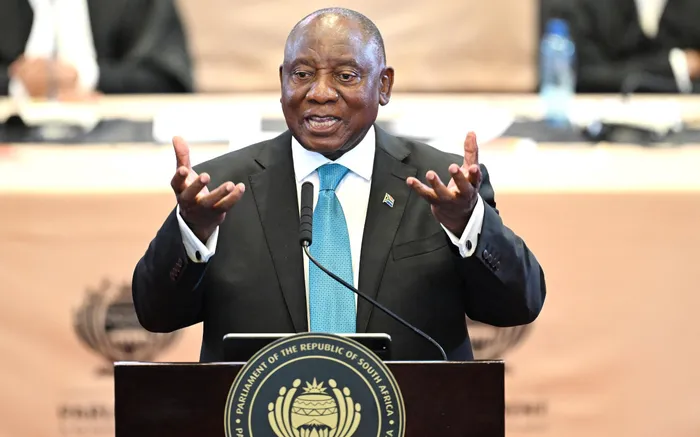
The writer says he had expected President Ramaphosa to use Sona to outline South Africa’s support for Resolution 2797 from the standpoint of Western Sahara.
Image: GCIS / Phando Jikelo
PRESIDENT Cyril Ramaphosa delivered his 2nd State of the Nation (Sona) address under the auspices of the Government of National Unity (GNU). The significance of this was overwhelming.
This was only the second time since the dawn of democracy in April 1994 that Mandela’s party, the ANC, had not enjoyed a monopoly on determining the country’s annual political agenda.
Traditionally, the ANC Lekgotla that precedes the Government Lekgotla by several days would have been a session that set marching orders for the government’s programme of action for the year.
However, the lackadaisical showing by the ANC in the country’s last national elections under the conditions of universal adult suffrage in May 2024 — during which the ANC fell from a previous 57,5% to just over 40% — has reconfigured the influence and impact of the ANC in South Africa’s body politic.
In a nutshell, the ANC no longer enjoys a free ride over the political direction of the nation. The party is obliged to seek consensus with a flurry of nearly a dozen other parties with diverse political persuasions in a rare coalition government.
Under the circumstances, therefore, it is understandable that President Ramaphosa has to do a lot of egg-dancing lest he risk disintegrating the fragile coalition that looks like it is permanently sitting on a knife-edge.
It is for this reason that President Ramaphosa relies heavily on the government departments under the ANC ministers as well as those led by the SA Communist Party (SACP) - a member of the waning Tripartite Alliance alongside former giant trade union federation COSATU – to wax lyrical about the annual achievements as set out in the expressed objectives of the previous SONA.
This is no longer an easy task to perform. For example, the Democratic Alliance (DA), which is led by Agriculture Minister John Steenhuisen, enjoys independent political oversight in several other departments through the deployment of ministers and deputy ministers as part of the GNU arrangement.
Also included in the top echelons of the Cabinet is the Inkatha Freedom Party (IFP), whose President, Velenkosini Hlabisa, is Minister of the Department of Cooperative Governance and Traditional Affairs (Cogta). The IFP also has several other deployees in the national government. Even the smallest parties, such as the PAC, are well represented, with the party leader Mzwanele Nyhontso serving as Minister of Land Reform and Rural Development.
Patriotic Alliance’s President Gayton McKenzie has had his rapidly growing party join the GNU in return for a Cabinet position reward as Minister of Sports, Arts and Culture. There are several other similar examples. But methinks I’ve made my point about describing the salad that is the GNU.
I paint the above picture in an effort to illustrate the point I had intended to make from the opening paragraph. And the point is: The leadership at the Department of International Relations and Cooperation (DIRCO) has failed President Ramaphosa with their underwhelming contribution to his SONA speech.
The President alluded to SA’s foreign policy that is premised on peace and security. But that was stating the obvious. Everybody knows that for sure. He further stressed that as long as others such as Palestine, Cuba and the Western Sahara are not free, South Africa will continue to fight in their corner.
As he was speaking, a major meeting was taking place in the Spanish capital, Madrid, involving the future of Western Sahara. Dirco did not seem to be aware that such an important meeting was underway, attended by the US, Algeria, Mauritania, Morocco and the representatives of the Polisario Front, Western Sahara’s nationalist liberation movement.
The talks, hosted by the US, follow the UN Security Council Resolution 2797, which was adopted in November 2025, explicitly supporting Morocco’s “autonomy plan” for Western Sahara as opposed to the SA-supported “independence” for the territory.
Additionally, the diplomatic schism between SA and long-time ally Algeria on the Western Sahara issue appears to have grown wider unnoticeably. Algeria has had to refocus on the country’s national interest.
Faced with possible sanctions from the US over the purchasing of military jets from Russia, the Algerians played it safe by succumbing to the US President Donald Trump’s pressure that Algeria support the proposed Western Sahara peace deal, thereby abandoning original demand stance for independence held together with South Africa.
Since the adoption of Resolution 2797, it has been increasingly clear that Algeria and SA are drifting apart on the Western Sahara issue. Through it all, SA appears to have been taken aback by Algeria’s apparent backtracking.
This left Pretoria visibly isolated. Morocco has always insisted that the only acceptable resolution to the Western Sahara issue would be autonomy within the jurisdiction of Rabat. Finally, Resolution 2797 supports the Moroccan proposal.
Algeria and Mauritania, two critical stakeholders neighbouring Western Sahara region, have aligned with the US-supported Moroccan proposal. But of greater significance is the acceptance of the proposal by the Polisario Front. For years, South Africa’s material support for Western Sahara has been restricted to covert funding and diplomacy.
Morocco, largely backed by France and neighbouring former colonial power, Spain, has insisted that Western Sahara is an inalienable part of the country. Finally, Resolution 2797 affirms their position.
As for South Africa, the fact that Pretoria is playing no visible role in the peace talks must be a hard pill to swallow. Being one of the most vocal supporters of Western Sahara, to watch from the sidelines the decades-old conflict being finally settled must be hard to take. But Pretoria must shoulder the blame, exclusively. South Africa has not engaged with the Polisario Front intently and intensely in recent times, save for public utterances.
With minimum material support and no sign of victory in sight, Western Sahara has opted for the least choice – autonomy. This means the national flag remains Moroccan. So are the currency and the army. Morocco sees all this as a victory that was worth waiting for and fighting for.
SA has not had an ambassador in Morocco since the return from posting of Ambassador Ebrahim Edries at the beginning of 2025, more than a year ago. It is only recently that DIRCO has designated a new ambassador, who should be deployed in the coming weeks. Rabat has promised to post their ambassador immediately once South Africa’s new ambassador to Morocco arrives in the capital, Rabat. This is part of the strategy to normalise relations between Rabat and Pretoria.
In fact, the two countries have been taking every opportunity to court each other. In their recent encounter, SA requested Morocco’s support in Pretoria’s endeavour to win a temporary seat in the UN Security Council for two years.
In return, according to highly placed sources, South Africa would abandon its audible calls for the “independence” of Western Sahara. At any rate, the Madrid talks this week show that the horse has already bolted. Pretoria is left with very limited options, if any, and the only sensible option is to align with the post-Resolution 2797 negotiations that are currently underway.
Failure to be at the table would mean South Africa could be in the menu. Time is not on Pretoria’s side. But the way to the negotiation table would be through Morocco and the Polisario Front. The official signing of the peace deal is expected to take place in Washington in May.
For my part, I had expected President Ramaphosa to use Sona to outline South Africa’s support for Resolution 2797 from the standpoint of Western Sahara, at least. But it seems Dirco officials had been sleeping on duty. Western Sahara has been one of South Africa’s major foreign policy programmes.
It is in this light that I feel President Ramaphosa has been let down by Dirco. Sona would have been a fantastic stage to announce that in pursuit of continental peace and security, Pretoria is actively playing its role in ending one of Africa’s long-standing conflicts.
* Abbey Makoe is Founder and Editor-in-Chief: Global South Media Network (gsmn.co.za). Views expressed are wholly personal.
** The views expressed here do not reflect those of the Sunday Independent, Independent Media, or IOL.