

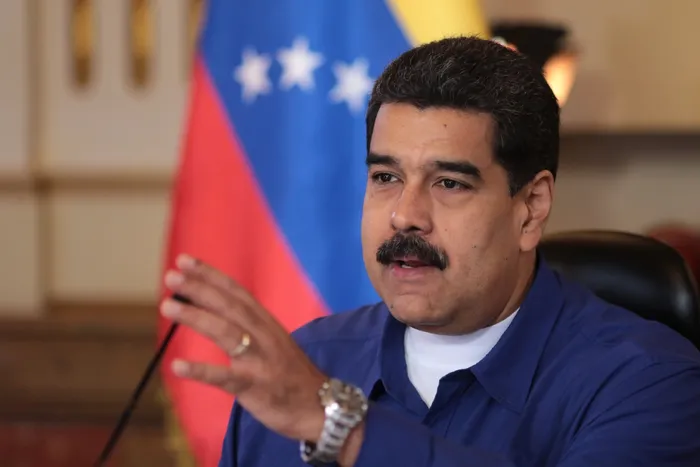
The US operation to capture Venezuelan President Nicolás Maduro is just the latest chapter in a long list of interventions and regime changes staged by Washington throughout Latin America over the past century.
Image: Xinhua
IN MY previous article last month, I explored the profound challenge Donald Trump's revived imperialism poses for the Global South, as India assumed the BRICS presidency in 2026.
I argued, following columnist TK Arun’s thesis, that New Delhi faced a stark choice: champion a rules-based multilateral order or be side-stepped by a paradigm of transactional dominance and self-interest as championed by Trump. That analysis examined the capture of Venezuela’s Nicolás Maduro, strikes on Nigeria, and threats against Greenland as emblems of this new world.
Barely a month later, that imperial logic has been applied directly to India. The instrument is not American special forces, as we saw with the dramatic capture of Maduro in Caracas or the Christmas Day strikes in Nigeria’s Sokoto State.
Instead, the weapon of choice by Trump is economic coercion: the threat of financial strangulation through punitive tariffs. On February 9, 2026, Trump announced a “historic” interim trade framework with India on his social media platform. This framework is the culmination of months of pressure, from the threat of crippling 500% tariffs under the Sanctioning Russia Act, India continued buying Russian oil to force a fundamental shift in India's energy policy.
In essence, the US held a gun to the head of the Indian economy and demanded compliance.
The demand by Trump was that Washington would effectively reduce punitive tariffs to 18% if India halts oil imports from Russia and Iran and shifts toward Venezuelan and American sources. Crucially, it also required a pledge by India to buy $500 billion in American goods over five years, effectively doubling imports of everything from LNG and coal to soybean oil and grains from America.
Consequently, the most immediate and powerful consequence of this forced shift is not geopolitical, but domestic. It has ignited nationwide farmers' strikes in India, exposing how Washington's pressure campaign is creating a hostile political environment for Prime Minister Modi and threatening the BJP's political hegemony.
This crisis forces a central question: How can India assert its “national interest”, the very principle New Delhi cites to guide its energy choices, when it is being forced to implement policies that directly undermine its economic sovereignty and alienate its own citizens? The answer may lie in the gap between what India says to Washington and what it actually does.
Trump's Truth Social post celebrated the agreement as a triumph for “America First”, a strategic rerouting to counter what he termed “rogue” suppliers, a label he applies to nations like Russia and Iran that defy US hegemony. But for India, it is a coerced bargain.
The $500 billion commitment, a staggering sum that risks inflating India’s import bill with pricier American alternatives, is the price India must pay to avoid economic warfare. It is not a trade deal in any mutual sense, as many pundits have opined; it is a protection payment extracted under duress.
Indian officials, led by Foreign Secretary Vikram Misri, have attempted to manage expectations, stating that energy imports will be guided by “national interest”. But far more interesting in this Trump threat is that there is a significant ambiguity here: While Trump continues to praise his efforts, New Delhi has issued no official statement explicitly confirming it will halt Russian oil purchases.
This silence may be a strategic hedge, a way to appease Washington verbally while preserving the option to continue a relationship that has saved India billions. If so, it reflects the impossible position Modi occupies, forced to say one thing to a superpower while his actual "national interest" may require another strategy. If Russian oil remains economically indispensable, New Delhi has left itself room to manoeuvre.
The demands from Washington extend beyond Russia; they also demand that India formalise a complete exit from Iranian oil. In reality, Indian imports from Iran had already dwindled to near-zero under renewed US sanctions, so this condition is largely symbolic, a final nail in the coffin of a once-robust energy relationship.
In its place, Trump encourages purchases from Venezuela, a nation whose own production is unstable and whose regime the U.S. only recently eased restrictions on, not out of principle, but to facilitate this very shift. The hypocrisy is stark: Washington selectively lifts sanctions on Caracas when it needs an alternative supplier for India, while maintaining maximum pressure on Tehran.
This demonstrates that US sanctions are not a consistent tool of international law or human rights advocacy, but a flexible instrument of strategic coercion, deployed or suspended based on what serves American economic and geopolitical interests at any given moment.
This is where the abstract geopolitics collides with India's ground reality. On February 12, the Bharat Bandh strike, organised by Indian farmers’ unions, brought much of the nation to a standstill. Their grievances are twofold.
First, halting cheaper Russian and Iranian oil threatens to hike fuel and fertiliser prices, cascading through the entire agricultural economy. Second, the deal's commitment to US goods includes zero-duty agricultural imports like soybean oil, nuts, and grains. For India's millions of smallholder farmers, this influx threatens to undercut local prices, imperilling livelihoods and echoing the bitter agitations of 2020-2021.
By taking to the streets, the farmers have answered the “national interest” question for themselves. The question is not whether the protests exist, but whether PM Modi can manage them while maintaining the strategic ambiguity that keeps his options open with both Washington and Moscow.
Is it truly in India's interest to pay more for energy and destabilise its rural economy, all to avoid Trump's tariffs? Their answer is a resounding “no”. Their protest is the physical manifestation of the contradiction between US-imposed instructions and India's sovereign needs.
It demonstrates that Trump’s “America First” policy has, in effect, created a hostile political environment for Modi on his own soil. A democratically elected leader is being forced by a foreign power into policies that alienate his core domestic base, threatening the very political stability the BJP relies upon.
This leads to the core question: Is India abandoning Russia? The deal's conditions demand it, and recent data shows Russian imports did fall in January 2026, a dip that may reflect both payment difficulties caused by US sanctions and a precautionary signal to Washington. Yet, India has not formally renounced its long-standing partner. Foreign Minister Sergei Lavrov has decried the US “bullying” that erodes the “special privileged strategic partnership” with India.
This is the precarious situation Trump’s imperialism creates for leaders like Modi. He is not being given a choice between partners, but between punishment and submission. To preserve ties with the US and avoid economic warfare, he must wound a historic relationship with Russia, a partner that has supplied discounted crude and saved India billions, all while accepting a new, unreliable dependency on Venezuela. This is not diversification; it is rerouting, dictated entirely by Washington's strategic gain.
The selective enforcement of US policy further underscores the coercion. Must the question must be asked: Does America do business with Russia?
The answer reveals the double standard. While demanding India cut its imports to zero, the US continues to allow limited Russian uranium imports under waivers, essential for its own nuclear power plant, and its companies have navigated a complex web of licenses to trade in other sectors, from fertiliser to aerospace components.
This is not about principle; it is about power. It is the same selective logic that eases Venezuelan restrictions to redirect India’s purchases while maintaining maximum pressure on Iran. Washington critiques India's choices while simultaneously orchestrating the alternatives for its own gain.
The farmers' fury has transformed India's oil conundrum from a diplomatic calculation into a domestic political crisis. The $500 billion pledge, the demand of a shift from Russia, and the turn to Venezuela are all now viewed through the lens of their impact on India’s streets and fields. Modi’s precarious balancing act, trying to preserve strategic autonomy while avoiding US “bullying” under the weight of Trump's imperial leverage, is interesting to observe.
And as my prior article warned, the Global South faces a stark test. Will nations like India, under immense pressure, be forced into uneven realignments that undermine their sovereignty and social stability?
Or will the resistance of farmers, workers, and civil society force a renegotiation of such terms, reminding leaders that true “national interest” lies not in submission to might, but in the collective defence of economic autonomy and human dignity? The answer, unfolding in India's fields, will resonate far beyond its borders.
The fact that New Delhi has issued no formal commitment to abandon Russian oil shows that it has left its energy purchases deliberately vague and that it has made no tangible down-payment on the $500 billion pledge; these are not signs of submission.
Modi understands something fundamental about Trump: the American president’s attention span is short, his focus transactional, and his memory selective.
If India can weather the immediate storm, if it can allow Russian oil to continue flowing through less visible channels, and if it can adjust its American purchases to minimise domestic disruption, then the deal may prove far less transformative than Trump claims.
* Phapano Phasha is the chairperson of The Centre for Alternative Political and Economic Thought.
** The views expressed here do not reflect those of the Sunday Independent, IOL, or Independent Media.