

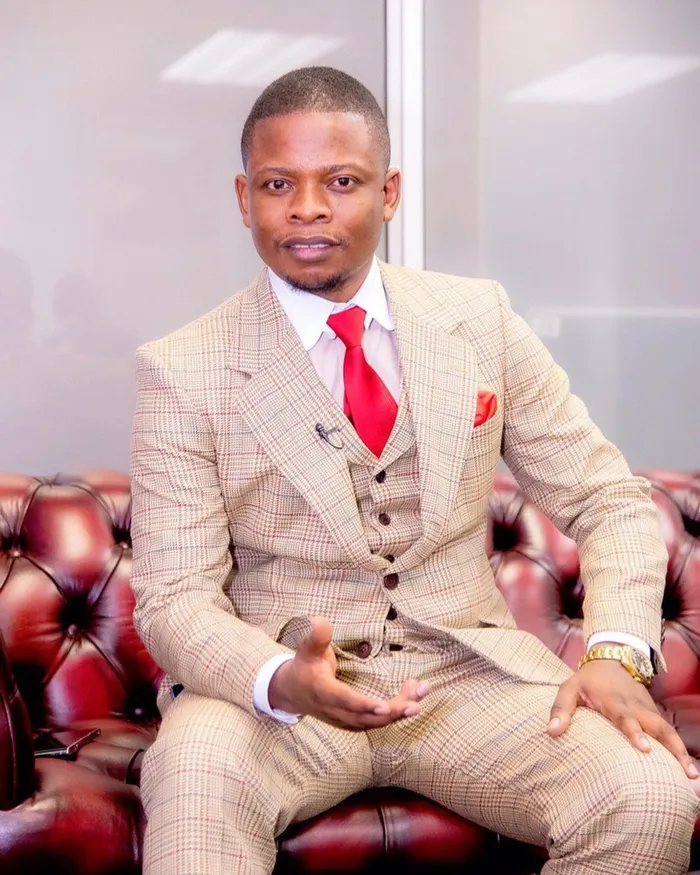
Pastor Shepherd Bushiri, who dramatically fled South Africa after facing multiple egregious criminal charges.
Image: Independent Newspapers
LAST month, comedian-influencer Druski went viral for doing what almost no one else dares: mocking prosperity megachurch culture.
In the now widely-circulated clip, he called out every ridiculous trait — pastors waving cash like holy water, private jets pitched in church parking lots, miracle claims delivered with award-winning theatrics, and worshippers exploited for their cash, with generosity twisted into obligation.
This was the kind of clip that demanded attention — and not just for laughs. Beneath the comedy, the message hit hard: faith has turned into performance, and wealth is front and centre.
Countless netizens and religious leaders presented the argument that Druski’s skit was blatant blasphemy, and that the comedic iteration of any religious figure or setting is irrefutable. However, others presented an opposing view: Druski isn’t blasphemous; he is, in fact, mocking the blasphemers.
He is not mocking God, nor the Church institution — he is spotlighting the very pastors and churches that use Jesus as an excuse to extort congregations for personal gain. And sadly, this is the reality of religious institutions far and wide across our society.
Historians say it’s nothing new: dodgy leaders, corruption, abuse of power, exploitation, are all sketchy behaviours that have long been a part of organised religion — long before Jesus showed up. In the modern era, the business of fake pastors still thrives.
Fake pastors aren’t just a problem — they’re an industry. And their danger certainly knows no bounds. Across South Africa, countless New Prophetic Pentecostal Churches have made global headlines for coercing congregants into drinking harmful substances or performing humiliating acts, all labelled as “healing” or “prophecy”.
Furthermore, what happens when religious leaders repeatedly escape prosecution for their criminal behaviours? A prime example close to home is the infamous Pastor Shepherd Bushiri, who dramatically fled South Africa after facing multiple egregious criminal charges.
Bushiri, whose unapologetic displays of wealth — multiple luxury cars, private jets, claims of owning mines — earned him a unique reputation as a “rich” pastor, has been frequently chastised for his dodgy dealings — from forging fraudulent documentation, selling exorbitantly priced “miracle” products, sexual abuse, money laundering, and so much more.
Other religious leaders have blatantly put congregants in very precarious situations. Notably, the Doom Pastor Lethebo Rabalago, who sprayed the insecticide (Doom) directly into the faces and onto the body parts of his followers, claimed it could heal various ailments, including cancer, HIV, and infections.
And he’s not the only one. Countless cases, from Garankuwa Pastor Daniel Sejo’s instruction to eat grass in order to be closer to God, to Pastor Lesego Daniel, who made congregants inject petrol after claiming that his prayers had made it “pineapple juice”.
Even Ghanaian Bishop Daniel Obinim, who stepped on the belly of a pregnant woman, claiming to “exorcise “her from “evil spirits”. Let’s not forget the “snake pastor” Penuel Mnguni, a self-proclaimed prophet who fed his followers snakes and rats.
The list of deplorable, heinous acts within religious institutions is disgustingly endless.
The truth is that Druski’s comedic skit laid bare how thin the line has become between satire and reality. What was meant to be a parody felt, to many, like an all-too-accurate reflection of a culture where performance often overshadows principle. From unquestioned authority, to perpetual immunity from consequences, one has to ask whether faith is truly what’s under attack — or whether it is religion’s fiercely-protected, unchecked power.
In fact, this whole debacle over religious leaders and institutions has perfectly foreshadowed the Rwandan President Paul Kagame’s recent crackdown on the country’s religious communities, shutting down thousands of unregistered churches & mosques.
One moment, these leaders command loyalty and wealth with zero oversight. The next, they’re under the hammer — their authority questioned, their institutions erased. The line between celebrity and accountability, devotion and exploitation, can disappear in an instant.
When we consider the state of religious institutions today, the amount of blatant debauchery that is committed is exactly what led to the crackdown by President Kagame. All over the nation, the continent, and further, fake leaders have caused irreversible harm to everyday people.
Fake churches and mosques proliferate when there is a lack of oversight. What President Kagame has done is simple: religious leaders must present accredited theology degrees in order to function in his land. Simple. This is truly taking the bull by the horns and ensuring that citizens aren’t manipulated and abused under the guise of religion.
It is often the most impoverished families that feed rich, self-indulgent leaders. Yet, a government’s foremost constitutional duty is to protect the people. Religion should never be an exception, something overlooked.
As our prolific late Archbishop Desmond Tutu very tentatively warned: “Religion is like a knife: you can either use it to cut bread, or stick it in someone’s back.”
* Tswelopele Makoe is a gender and social justice activist and editor at Global South Media Network. She is a researcher, columnist, and an Andrew W Mellon scholar at the Desmond Tutu Centre for Religion and Social Justice, UWC.
** The views expressed here do not reflect those of the Sunday Independent, IOL, or Independent Media.