
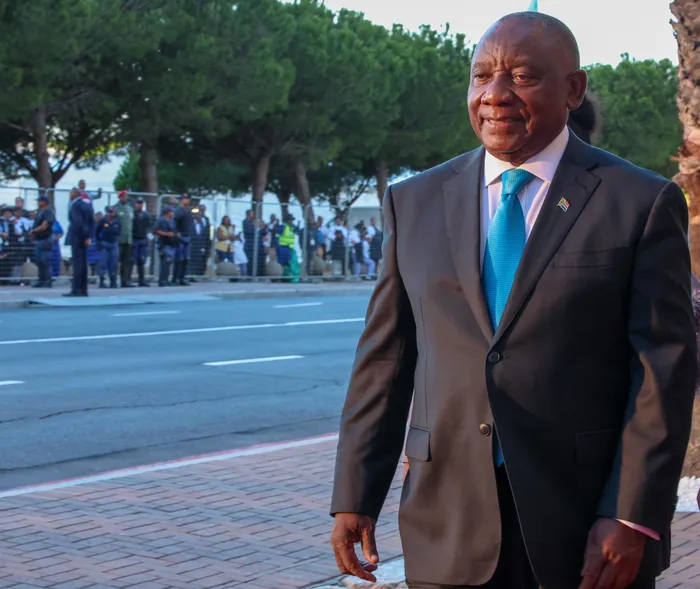
President Cyril Ramaphosa arriving in Parliament to deliver the State of the Nation Address (Sona) on Thursday.
Image: GCIS
PRESIDENT Cyril Ramaphosa's State of the Nation Address reminded South Africans that our achievements are no accident. They are rooted in resilience, unity, and shared values. For a country often defined by challenges, it is vital to celebrate progress but also to confront the issues that threaten our future.
“We must not only survive crises but also prevent them.”
Communities continue to struggle with access to water, one of life’s most necessary resources. Droughts, ageing infrastructure, and municipal inefficiencies have left millions vulnerable. The question is simple: why do we wait for crises to act?
Reactive responses are costly, dangerous, and preventable. By investing in infrastructure maintenance, community engagement, and foresight, the country can ensure that water crises and other emergencies are averted before they escalate.
Municipal Failures and National ResponsibilityMunicipalities are often on the frontline of service delivery. Water provision, electricity, sanitation, and local infrastructure depend on their efficiency. Yet too often, municipalities fail due to mismanagement, sometimes because resources are insufficient.
When municipalities fail, citizens suffer. The national government must step in not just to punish, but to strengthen systems, support local officials, and ensure essential services reach communities.
State-Owned Property: Opportunity or Duplication?The President announced a state-owned property company to oversee government assets. If implemented effectively, it could improve efficiency, reduce waste, and unlock value from underutilized properties.
“Why create a new entity when existing public enterprises could handle this?”
Without careful planning, duplication and bureaucracy could undercut the goal of better property management. A proactive approach would consider empowering existing structures to achieve the same goals, avoiding inefficiency while still improving asset management.
Small businesses are central to South Africa’s economic future. The President highlighted that if each small business employed one more person, more than three million South Africans could gain formal employment.
With additional funding to support growth, small businesses could drive job creation, local economic development, and innovation. Proactive support now can prevent unemployment from becoming a systemic crisis later.
Education: From Grade R to UniversitiesDevelopment depends on well-educated citizens. That is why Grade R will become compulsory, giving every child access to early education and laying a foundation in literacy, numeracy, and critical thinking.
Beyond early education, the President emphasized building more universities and student accommodation, ensuring young South Africans can pursue higher education and graduate with the skills needed for the modern economy.
“Investing in education from Grade R to university is investing in our nation’s future.”
Learning from SuccessCape Town’s management of the “Day Zero” drought is a prime example of proactive planning. By anticipating problems and engaging citizens, the city prevented disaster. Similar foresight is needed nationwide in water, energy, municipal management, education, and small business support. Proactive planning and citizen engagement can avert crises and create lasting solutions.
South Africa can either continue reacting or it can build a nation that anticipates challenges, empowers citizens and businesses, strengthens education, and manages public assets efficiently. Leadership, planning, and citizen engagement must work hand in hand to prepare the country for the challenges of today and tomorrow.
The President’s address was a call to action. It reminded us of our achievements, acknowledged our challenges, and highlighted what is at stake. But words alone are not enough.
To honour the values he invoked, resilience, unity, and shared progress, South Africa must embrace proactive governance in every sector. Every policy, investment, and community initiative should be shaped by prevention, foresight, and strategic planning. Only then can the country build a future defined not by crises survived, but by opportunities seized, problems anticipated and lives improved.
The choice is ours: continue reacting or create a South Africa that sees challenges before they arrive, addresses them before they escalate, empowers small businesses, invests in education at every level, and strengthens systems that serve every citizen equitably.
Proactivity is not just a strategy; it is the pathway to a stronger, safer, and more prosperous nation.
* Nyaniso Qwesha is a writer with a background in risk management, governance, and sustainability. He explores how power, accountability, and innovation intersect in South Africa’s landscape.
** The views expressed here do not reflect those of the Sunday Independent, IOL, or Independent Media.