

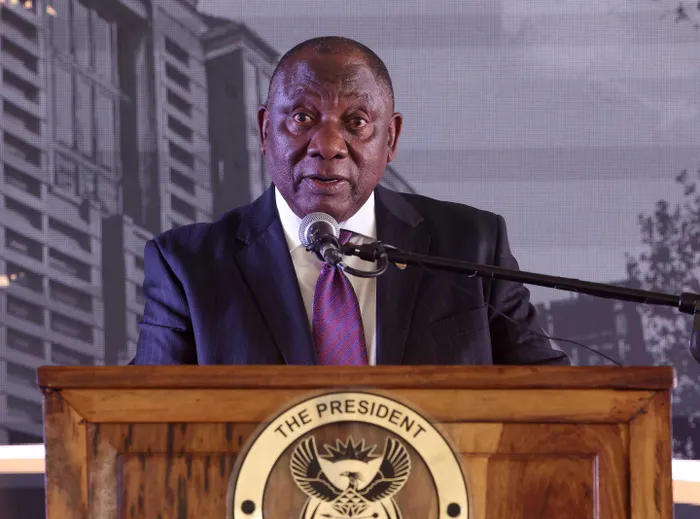
The President Cyril Ramaphosa administration has nonetheless expressed support for the peace process publicly.
Image: Jairus Mmutle / GCIS
THE President Donald Trump administration is moving with turbo-charged speed to settle the Western Sahara conflict.
In that expeditious US adventure, there are bound to be winners and losers. South Africa, a long-standing backer of the Western Sahara people’s fight for independence, appears to be caught between a rock and a hard place.
South Africa has historically aligned itself with Algeria on the issue of Western Sahara, with both countries believing that the international recognition of Western Sahara’s independence from Morocco would be the ultimate prize. Other nations engrossed in the Western Sahara issue can be found around the Sahel region.
Mauritania is a key stakeholder in the conflict. Although my primary objective is to shine the torch on South Africa’s very public conundrum that is the future of Western Sahara, methinks context is key.
When the colonial power that was Spain finally withdrew from Morocco in 1976 following a protracted rebellion, Western Sahara was left partitioned between Morocco and Mauritania. The pro-independence Polisario Front, a guerrilla movement for the Western Sahara people, rebelled against this post-colonial settlement.
Three years later, in 1979, Mauritania withdrew, leaving the conflict as a matter primarily between Morocco and the territory of Western Sahara.
There was a 29-year-old ceasefire, from 1991 to 2020. The resumption of hostilities was led by the Polisario Front, which accused Morocco of violating the terms of the ceasefire.
If truth be told, the international community has been unable to end this conflict. Through it all, Morocco has remained steadfast that the Western Saharan people are Moroccan. African continental organisation, the AU, has attempted without much success to end the conflict.
Enter Trump, the 47th US President, who is determined to waste no further time in finally settling the conflict. Indeed, he might well be motivated by a personal desire for a Nobel Peace Prize, but that’s the discussion for some other time.
With Trump seemingly in the driver’s seat, some drastic movement is underway to end the decades-old conflict. Instead of “independence”, the Western Saharan people have been convinced to choose “autonomy”, or self-rule within the jurisdiction of the authority of the Kingdom of Morocco.
This means Western Sahara will remain an integral part of Morocco, using Moroccan currency, flag and having no separate army.
In an atmosphere of war-fatigue, all sides appear to have endorsed a Moroccan-led peace deal brokered by the Trump administration. Mauritania is on board, and so is Algeria, historically seen as a major backer of the Polisario Front. Bilateral ties between Algeria and South Africa have been very sound over the years, buoyed in part by their unflinching support for Western Sahara.
When the US Security Council passed Resolution 2797 in October 2025, paving a way for the imminent truce to be signed, nations such as South Africa were caught flat-footed, particularly by the Polisario Front’s compromise on its long-standing rigid stance on independence.
Additionally, the almost discreet change of tune by Algeria, which gave its full support to Resolution 2797, appeared to have isolated South Africa as a notable, singular backer of Western Sahara. South Africa’s voice on the rapidly unfolding developments has been somewhat muted or lukewarm.
South Africa’s foreign policy is premised on the ethos of the UN Charter, which espouses multilateralism. Conflict resolution through dialogue, and not the barrel of a gun, is what Pretoria famously preaches.
Although Pretoria was disappointed by the key contents of Resolution 2797, particularly in offering Western Sahara conditional autonomy as opposed to full independence, the President Cyril Ramaphosa administration has nonetheless expressed support for the peace process publicly.
And Trump wants the peace deal to be signed by the end of March. Using a carrot and stick approach, the Trump administration this week piled untold pressure on Algeria to support the deal. During this week’s Senate hearing on counterterrorism, Senator Ted Cruz criticised administration officials for repeatedly avoiding any direct reference to the Polisario Front, which is accused of “terror activities that destabilise the region”.
Senator Cruz’s message to the Polisario Front was stark. He threatened to initiate a process in Congress aimed at classifying the liberation movement as a terrorist group “unless they change their ways”.
Algeria was also caught in the tongue-lashing. The country faces US sanctions following their purchase of military equipment from Russia, which is under US and Western sanctions.
It appears that, under the circumstances, Algeria’s get-out-of-jail card appears to be attaching a signature to end the Western Sahara conflict as demanded by Washington.
South Africa is not out of the woods, either. When it comes to bilateral relations with the US, South Africa seems to constantly skate on thin ice. Developments in the Sahel region, particularly Western Sahara, have left Pretoria in a spot of bother, even though no one in the Department of International Relations and Cooperation (Dirco) would dare agree in public.
Western Sahara is moving with speed towards what Morocco has always proffered. Algeria and Mauritania are finally on board. The UN Security Council Resolution 2797 is intact. Pretoria, with very little or no room to manoeuvre, can only publicly endorse the peace process as is. Anything else will be tantamount to stepping on the tail of a lion.
My suggestion to the Presidency and Dirco would be to engage more closely with the Polisario Front so that Pretoria may offer some assistance to the Western Sahara project as it enters a rebooting phase.
Failure to do so would result in South Africa’s isolation from the mainstream talks and deny the Ramaphosa administration and the ANC a chance to lend a reputable, steady hand at the negotiating table. Pretoria’s scope of influence would shrink drastically. International and continental impact would wane quite expeditiously. To roll up sleeves and get set, ready and go is all South Africa can do. The horse has bolted. It is what it is.
Pretoria and Rabat will do well to iron out the rough spots in their bilateral relations. The two nations are important to the continent, but even more to each other.
The ties between the two nations date back to the dark days of apartheid, when in 1962, Morocco opened its doors to Nelson Mandela to undergo clandestine military training by the Algerian National Liberation Front (FLN) at bases near Oujda and the Zegangan region in Morocco.
The Trump administration, I suspect, would be delighted to find South Africa sitting in the cold as the Western Sahara conflict is finally ended in March. Pretoria needs to be wiser than its detractors. As they say, if you are not at the table, you are on the menu.
* Abbey Makoe is Founder and Editor-in-Chief: Global South Media Network (gsmn.co.za). Views expressed are wholly personal.
** The views expressed here do not reflect those of the Sunday Independent, Independent Media, or IOL.