

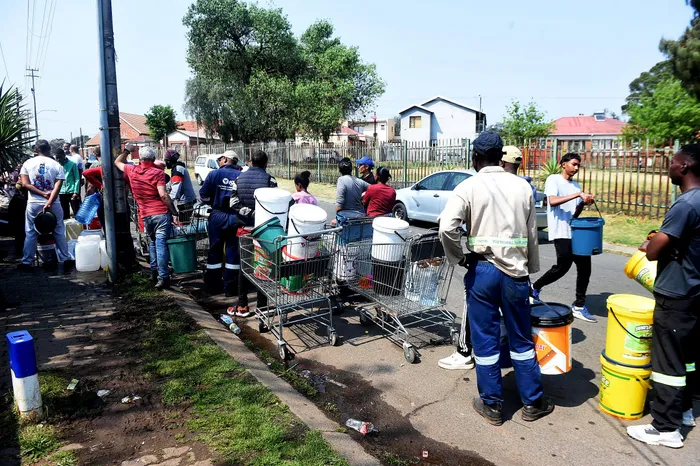
Johannesburg's water crisis deepens as residents face daily struggles. Frustrated residents in Midrand marched through the streets to demand answers after enduring six days with dry taps and no updates.
Image: Itumeleng English / Independent Newspapers
SOUTH Africans wake up every day in a country where human rights exist loudly on paper and quietly disappear in practice. The unfolding water crisis in Midrand, Gauteng, is simply the latest reminder of our government’s callous neglect of its most basic obligations to its citizens.
This past Tuesday, rightfully frustrated residents in Midrand marched through the streets to demand answers after enduring six days with dry taps and no updates. The residents slammed Rand Water for failing to provide timeous updates on the crisis, after an electric failure caused water outages on January 27. Thereafter, a leak discovered at Klipfontein Reservoir inlet worsened the crisis.
No matter how many ways we may try to slice this cake, the core issue remains the same: Our government’s neglect of basic infrastructure. Crumbling infrastructure, inadequate structures, and unmaintained water systems — continuously ignored by those in power — directly create disasters such as these.
In fact, beyond Midrand, areas such as Selby, Melville, Kensington, Bruma, Berea, Brixton, Bezuidenhout Valley and Claremont have faced extended water outages going back over half a year!
Across South Africa, over a third (36%) of all households are adversely impacted by water outages for multiple days. In fact, the Department of Water and Sanitation (DWS) reported that a whopping 40.8% of the water across the entire nation is lost due to leakages and lack of preventative maintenance.
Furthermore, consistent and unannounced water outages subject thousands of people to devastating domino effects on physical health, mental wellness, education, economic security, and much more.
For those in Midrand who are now sitting ducks, over a week without water is not a mere inconvenience of “water collection”. It means thousands of people are unable to do basic everyday tasks, from brushing teeth or bathing, to prepping food, to flushing toilets.
Contending with such on a daily basis means that entire households — more so children — are exposed to viruses and diseases such as diarrhoea, cholera, typhoid, or skin and eye infections. This is not an issue of mere hydration; it is a pertinent health crisis that must be addressed as such. Lord knows, our overpacked hospitals would buckle over and collapse under the pressure of a widespread outbreak.
The effects of water outages are felt far beyond the home as well. Across Midrand, schools have been shut down, with learners being sent home early and sporting activities postponed. Businesses have also closed down due to a lack of bathroom facilities, with Luxx Restobar manager Falala Nkosi stating that hygiene concerns eventually forced them to hire two mobile toilets at a cost of R1 500 a day.
Access to water is not a privilege, a convenience, or a service to be delivered when systems are functioning optimally — it is a basic human right, explicitly protected by the Constitution.
Now, once again, the powers-that-be are left scrambling to address a wholly avoidable situation. Although Rand Water spokesperson Makenosi Maroo stated that its systems have fully recovered and pumping is back at full capacity, they are aware of the slow recovery of water supply in Midrand, Tembisa in Ekurhuleni, and Laudium and Atteridgeville in Tshwane.
It is not only in Gauteng, but across South Africa, where water power outages are frequently triggered by the slightest mishap. In fact, homes across the North West have been almost entirely dependent on borehole pumps and solar panels, showing the normalisation of the lack of basic public services that has engulfed our society.
The language of “technical challenges” and “restoration efforts” masks a far deeper problem: A government that has grown comfortable presiding over the erosion of basic dignity. Midrand is not an exception. It is yet another case study in how human rights in South Africa are slowly, quietly being snuffed out.
This is, moreover, worsened by the appalling economic divide that continues to be perpetuated by our systems. An economic divide that — for decades now — has decided that unprivileged people, located in the periphery of major hubs like Sandton, are those who are left to suffer the blatant neglect of public services and human rights.
From those whose water is cut off, to those whose homes are flooded, to those whose bridges collapse — they are all a part of a system of rampant neglect ravaging South Africa. For how long, exactly, will we continue to fall into the abyss before doing something about our own man-made systems?
Those in power, who hold the control, should never need to be reminded that water is not some luxury; it is a lifeline, a right enshrined in our Constitution, and a requirement of the society that was founded back in 1994.
For far too long, our government has been asleep at the wheel. We can no longer sit-back and watch our human rights being snatched into the shadows, quietly and deliberately, with no one paying the price.
* Tswelopele Makoe is a gender and social justice activist and editor at Global South Media Network. She is a researcher, columnist, and an Andrew W Mellon scholar at the Desmond Tutu Centre for Religion and Social Justice, UWC.
** The views expressed here do not reflect those of the Sunday Independent, IOL, or Independent Media.