

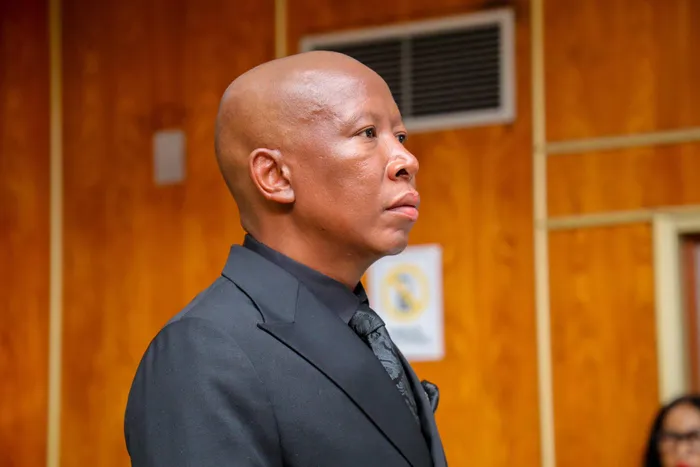
EFF leader Julius Malema would not be the first to be jailed as a strong political figure in South Africa or in the world.
Image: Social Media / EFF
SINCE the era of Apartheid, the 2015/16/17 #FeestMustFall and #OutsourcingMustFall have proven that it is possible to bring a country to a standstill or to a political cardiac arrest, a recipe for regime change.
Fast-forward, we then experienced the 2021 South African unrest, also known as the July 2021 riots, the Zuma unrest or Zuma riots, which was a wave of civil unrest that occurred in South Africa’s KwaZulu-Natal and Gauteng provinces from July 9 to 18, 2021, sparked by the imprisonment of former President Jacob Zuma for contempt of court.
This resulted in a protest against the incarceration, which triggered wider rioting, much of it said to be undertaken by people not in support of Zuma and fuelled by job layoffs and economic inequality aggravated by the Covid-19 pandemic policies.
It must be recognised that Revolutions are typically sparked by a mixture of intense, long-term structural strains and immediate, volatile incidents. Key stimuli incorporate severe economic crises (poverty, debt), deep-seated social injustices, political repression, and the emergence of new ideologies backing popular sovereignty or rights.
This then tells us that EFF leader Julius Malema would not be the first to be jailed as a strong political figure in South Africa or in the world. I have avoided speaking about Nelson Mandela, Robert Sobukwe, Ahmed Kathrada, Winnie Mandela, Dorothy Nyembe, Hellen Joseph, Steve Biko and many others for multiple reasons.
Let me drink from the well of European history and elsewhere. Maximilien Robespierre, often called “the incorruptible”, was a central leader of the radical phase of the French Revolution. He was an important figure in the French Revolution, known for his role as a radical leader of the Jacobin Club and his influence during the Reign of Terror.
He was a strong advocate for revolutionary ideals and pushed for social justice, equality, and the establishment of a Republic of Virtue. Leon Trotsky was the designer of the Bolshevik rise to power in 1917, having been moulded by prior imprisonment.
Rosa Luxemburg, A leading Marxist revolutionary, was jailed multiple times for her activities. She was imprisoned for her political opposition to World War I. Louis-Auguste Blanqui Known as “the prisoner”. He was jailed repeatedly for plotting against various French regimes (monarchies and empires) in prison for his revolutionary activities between 1830 and 1870. Tadeusz Kościuszko, jailed after fighting in the American Revolution, led an uprising against Russia in 1794, was captured, and imprisoned in Russia.
He led the first national uprising (powstanie) of Poland against Russia and Prussia, starting a legacy of Polish resistance.
There seems to be a thinking that revolutions are caused by most of the population, and the opposite is the truth. Unfortunately, and usually, a small population is enough for a successful revolution, while most of the people don’t participate positively or negatively; they just sit and wait.
Their neutrality or inactivity is enough for the revolutionary forces for the overthrow. And in cases that a civil war breaks out, commonly the armed forces don’t advance, or many of them join the insurgents. From the State’s assessment, this is the most crucial problem with the non-professional, recruited army.
What we ought to always remember is that, irrespective of their oath and national duty, the soldiers originate from the people and do not want to shoot their own. One has to agree that the type of sentence for Malema on April 15 or 16, 2026, shall determine the reaction by those who follow him.
Perhaps I might be limiting the reaction to Malema’s followers, and yet there are those sitting on the sidelines to join; only time will tell. Perhaps we are in an era that we might again experience a political rupture, that sudden, fundamental break from established political, social, or economic systems, marking the end of one order and the beginning of another.
It denotes a rupture, or a dramatic shift often distinguished by forceful conflict, revolution, or the beginning of new, radical political actors. As I said, it is an inherent risk, perhaps even a possibility, a probability or an eventuality.
* Boitumelo Ben Senokoane is an Associate Professor in the College of Human Sciences, Unisa.
** The views expressed here do not reflect those of the Sunday Independent, IOL, or Independent Media.