

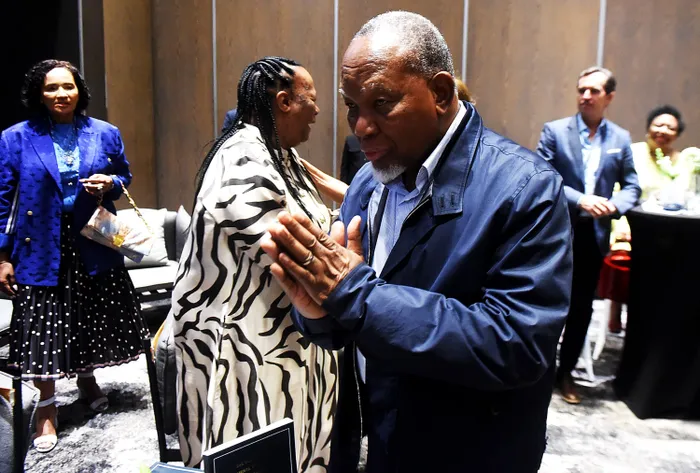
Former President Kgalema Motlanthe was present alongside Dr Naledi Pandor and a host of luminaries at Dr Iqbal Survé’s book launch.
Image: Itumeleng English / Independent Newspapers
IN A country as polarised as South Africa, where political fault lines, economic disparities, and historical and racial divisions often seem insurmountable, genuine moments of convergence feel rare and precious, such as the recent nationwide launches of business mogul Dr Iqbal Survé’s book, A Shared Future for Humanity.
Two extraordinary gatherings, in Johannesburg and Umhlanga, brought together former presidents Kgalema Motlanthe and Jacob Zuma, senior ANC leaders, opposition leaders, business titans, academics, and professionals under one roof, to honour a man whose life’s work has been the quiet, stubborn pursuit of unity through philanthropy.
Only Survé possesses the unique confluence of trust and principle necessary to convene such a gathering and actors, and this event became a quiet testament to this singular ability. In Johannesburg, at the Marriott Hotel in Melrose Arch, Motlanthe was present alongside Dr Naledi Pandor, Minister Khumbudzo Ntshavheni, ANC NEC member Andile Lungisa, and a host of luminaries.
In KwaZulu-Natal, at the Radisson Blu in Umhlanga, Zuma joined businessman Vivian Reddy and others for an intimate yet impactful event.
This event managed to achieve a shared sense of purpose precisely by momentarily setting aside the very arenas that breed division. For an evening, the event replaced the familiar narrative of insurmountable difference with a lived experience of shared unity and purpose. It proved that a common South African purpose, while often ignored and buried, still exists and can be summoned when the context shifts from antagonisms to aspiration.
Thus, the event achieved unity not by resolving differences, but by temporarily transcending them, offering a rare demonstration that the fractured landscape of South African public life could still find coherence around the shared, and too often forgotten, aspiration for collective upliftment.
The symbolism could not have been clearer. Here were two former presidents, one who steered the country through a critical transition and one who led during a turbulent era, standing alongside figures from the ANC, EFF, business titans, professionals and intellectuals. In a nation where antagonism often trumps dialogue and cohesion, this was a living embodiment of what Survé’s book title promises: A shared future.
Survé, chairperson of the Sekunjalo Group and founder of the Survé Family Office, through the book, managed to present a profound national ideal many of us yearn for: the possibility of a unity in purpose, where a shared commitment to serving others becomes the common ground that bridges our deepest divides.
The narrative of his book, tracing his family’s journey through activism and philanthropy, revealed the deeply personal core. This was crystallised in a recollection he shared of his mother’s weekly challenge to him: “Have you seen how people are living in poverty out here? What I want to know is what you are doing about it?”
Survé’s mother’s recurring question: “How can you be of service to others?” clearly emerged as more than a family anecdote; it stood as the foundational ethic behind his public work and forged a lifelong commitment.
The book thus traces Survé’s lifelong commitment, beginning with his early life in the Cape Flats, through his years of medical training and anti-apartheid activism, and into the building of one of South Africa’s most dynamic and diversified business empires.
It chronicles the evolution of the Sekunjalo Group from its modest beginnings to its current footprint across multiple continents, detailing key milestones in media, technology, healthcare, investment, and agriculture. Beyond the boardroom narrative, the book confronts the complex realities confronting South Africa today, deepening inequality, youth unemployment, the legacy of historical injustice, and the urgent need for inclusive economic growth, while placing these domestic challenges within a broader global context of geopolitical shifts, technological disruption, and the moral imperatives of the 21st century.
At its heart, the work offers a richly detailed account of the Survé family’s extensive business ventures, from pioneering black-owned media houses and digital platforms to strategic investments in renewable energy, biotechnology, and emerging markets.
It also provides an insider’s view of the family’s longstanding philanthropic commitment, including large-scale programmes in education, health, arts, and community development that have touched hundreds of thousands of lives across South Africa and beyond.
Finally, the book casts its gaze outward, exploring the international initiatives that have taken Survé and his teams to boardrooms and development forums in Europe, Asia, the Middle East, and the African continent, particularly BRICS.
What, then, does this comprehensive journey detailed in this book teach us as a country?
First, it demonstrates that unity is not the absence of difference, but the presence of a shared, actionable purpose. Survé’s narrative shows that pragmatic philanthropy, the kind that builds schools, funds hospitals, and empowers communities, can be the most credible bridge across political chasms.
Second, the Sekunjalo Group’s evolution from a modest beginning to a multi-continental enterprise underscores a vital lesson: Political parties must move beyond zero-sum politics. The immense energy spent on division could instead be channelled into a shared vision that tangibly uplifts communities.
Survé’s model, leveraging business success to fund large-scale development in education, health, and the arts, demonstrates that those who choose can serve the collective good without apology.
Third, the personal trajectory within the book reinforces that integrity and resilience are non-negotiable foundations for national renewal. Having navigated immense personal and professional scrutiny while maintaining focus on his mission, Survé’s story reminds us that authentic leadership is forged in adversity and sustained by unwavering principle, not populist convenience.
Finally, this entire body of work, spanning business, philanthropy, and global engagement, serves to reclaim a narrative of tangible hope. South Africa’s story is one of profound struggle, but the Survé legacy illustrates that our greater narrative can be one of courage against adversity. It shows what is possible when our founding values are driven by a profound love for the people.
Survé’s role, therefore, deserves recognition as a vital prototype. In an age where headlines constantly amplify division, he has persistently created spaces, both through his enterprises and now through this book, where former adversaries and future leaders can affirm a common vision.
His book is more than a memoir; it is a practical blueprint for a South Africa that consciously chooses collaboration over conflict, service over selfishness, and shared humanity over fragmentation.
As we reflect on the extraordinary convergence his book inspires, let us commit to emulating the spirit it embodied. Let us build a nation where tangible contribution unites us, where diverse voices find common cause in pragmatic action, and where a shared future is not a distant aspiration, but a daily project we build together.
That is the profound challenge, and the gift, Survé’s work has laid before us. How can we be of service to our people?
* Phasha is the chairperson of The Centre for Alternative Political and Economic Thought.