
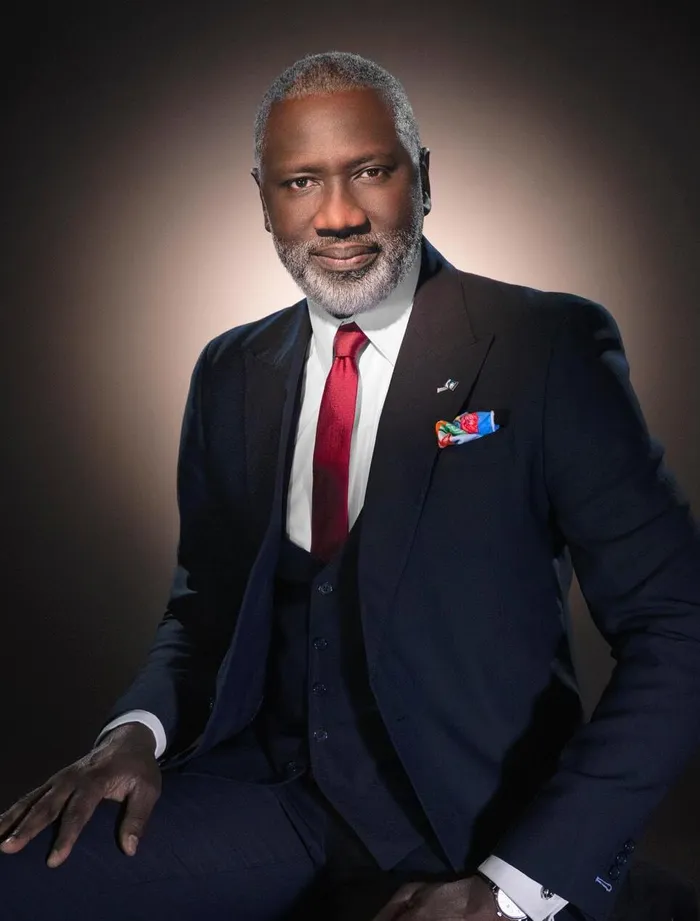
Ambassador Abdou Samb is an entrepreneur, panafricanist thinker, and leading promoter of the “Regeneration of Africa”, and philanthropist.
Image: Supplied
A dialogue between Moussa Sène Absa and Abdou Samb
Abdou Samb: Moussa, in a world torn by conflicts, inequalities, and a materialism that suffocates the soul, I believe the essential question is no longer just what the world can do for Africa, but what Africa — its culture, its wisdom — can offer to humanity. Cheikh Anta Diop demonstrated this with rigour: through his scientific work, he restored our millennial memory, proving the continuity of African greatness and calling for profound mental decolonisation. We carry a vision of humanity that could heal many fractures. For you, what does this African culture — and particularly Senegalese culture — bring to the world today?
Moussa Sène Absa: It can re-enchant the world, Abdou, and build a new humanity. A vision of sharing, deep solidarity, and authentic justice. Our ancestors carried a wealth of knowledge, mysterious solutions to society’s ills, swept away by colonial violence. And yet, Africa still stands, as a millennial baobab braced against the storms.
Senghor put it so well: “Culture is at the beginning and the end of development.” It arms us from within to face external turmoil. And he added: “Measure the pride of being different against the happiness of being together.” This idea of a universalism where each person brings their unique contribution to the Civilisation of the Universal — that is Africa’s gift: a humanism that balances the pride of differences with the joy of the collective.
Look at the Charter of Manden, proclaimed in the 13th century by Soundiata Keïta: a pioneering declaration of human rights, banning slavery, promoting justice and equality. Long before the European Enlightenment, Africa laid the foundations for ethical governance based on mutual respect and the protection of the vulnerable. Today, in the face of migrations and global inequalities, this ancient text remains a living model.
Abdou Samb: You touch there on the essence of Senegalese teranga and ubuntu — “I am because we are.” This African cosmogony, where everything — human, animal, plant — has its place. In your town of Popenguine, the mosque stands beside the church of Notre-Dame de la Délivrande, where John Paul II came to pray. This peaceful coexistence is a concrete example of a world that often forgets to say hello.
Moussa Sène Absa: Exactly. The stranger is king among us. But the world limps: it is missing a leg. It burns with the fires of Gaza, Congo, and Ukraine, blinded by covetousness and hoarding. Fear has become a weapon of mass destruction, rooted in precarity. Everyone wants to go to paradise; no one wants to die. The “Cabralian suicide”—sacrificing oneself for the next generation—seems a utopia.
Yet, as Senghor envisioned, culture invites us to the “banquet of the Universal”: to know oneself and open to the we. Each human brings to the table the best of their soul. My friend Spike Lee, with whom I have shared so many visions on cinema and Black identity, understands this deeply: his films draw from this African strength to question America and the world, reminding us that our heritage crosses oceans and fuels struggles for dignity everywhere.
Abdou Samb: Souleymane Bachir Diagne deepens this with “lateral” universalism: not an imposed, ethnocentric model, but an infinite dialogue where Africa brings its open philosophy, from ubuntu to co-humanity. Ali Mazrui, in The Africans, spoke of “modernisation without Westernisation”: adopting foreign tools without losing one’s soul, as we have sometimes taken the Western watch without the culture of punctuality that goes with it.
Moussa Sène Absa: African narratives are mines of resources. From Youssou Ndour, who blends ancient and modern rhythms to conquer the world with our teranga, to my films that probe postcolonial identity, we carry a creativity that heals fractures and nourishes the soul. And this diaspora—these millions of Africans and their descendants who carry our flame to the Americas, Europe, and beyond—proves that our culture is not confined: it flows into jazz, hip-hop, fights for justice, and reminds the entire world that Africa is a living source of shared humanity.
Abdou Samb: In summary, Moussa, African culture carries a global vision: unity in diversity, resilience in the face of history, and eternal ethical values. From the Charter of Manden to Senghor’s humanism, it gives the world tools to heal its crises.
Moussa Sène Absa: Yes, Abdou. Healing the world is a precious challenge—and everything precious is fragile. Africa is not a continent to be rescued, but an ally in building a common future, re-enchanted and human.
* Moussa Sène Absa is a filmmaker, painter, writer, and major figure in Senegalese culture. Ambassador Abdou Samb is an entrepreneur, panafricanist thinker, and leading promoter of the “Regeneration of Africa”, and philanthropist.
** The views expressed here do not reflect those of the Sunday Independent, IOL, or Independent Media.