
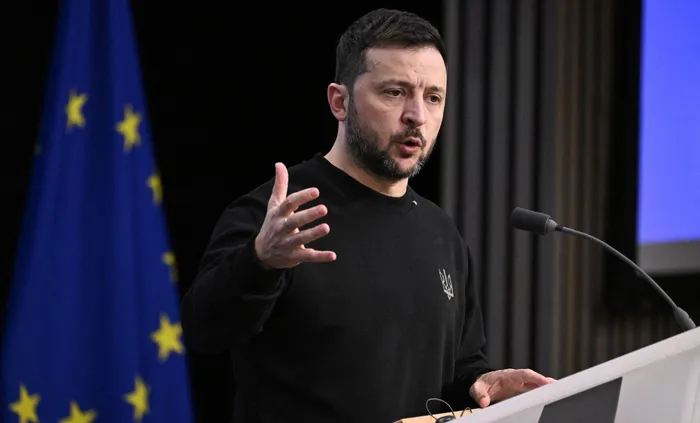
Ukrainian President Volodymyr Zelensky should be aware that ultimately, war is capable of destroying everything.
Image: Supplied
UKRAINIAN President Volodymyr Zelensky seems to be caught between a rock and a hard place. Publicly, he repeatedly calls for the war to end — immediately. However, methinks his biggest fault-line can be traced in his insistence that the war in Ukraine, which broke out in 2022 at the height of significant geopolitical differences between Moscow and the West, must end strictly on his terms.
Russia identified Ukraine’s collaborative posture toward NATO and the EU as a dangerous trajectory that threatened Russia’s national security. In fact, Russia argued that NATO inside Ukraine — and thereby literally on Moscow’s doorstep — posed an existential threat to the Russian Federation.
The concerns were laughed off by then US President Joe Biden and NATO, causing Russia to elect to go on an offensive in self-defence.
But the conflict between Russia and Ukraine did not start in 2022. It goes back to 2014 when a Western-backed bloody coup resulted in the ousting of a democratically elected pro-Russian President of Ukraine, Viktor Yanukovych.
In reaction, predominantly Russian-speaking Ukrainian regions of Donetsk and Luhansk held referendums on self-determination, and unanimously voted to secede and align themselves with Russia. Ukraine’s Crimean Peninsula, which also had a strong Russian cultural dominance, also held a referendum to determine its future, and voted overwhelmingly to secede and join the Russian Federation.
The West has vehemently rejected the legitimacy of the referendums, calling them a sham. However, since 2014, the breakaway republics, as they are often described, have regarded themselves as part of Russia.
In the unfolding talks between Russia and Ukraine, facilitated by US President Donald Trump, the most sticking point appears to be the future of the breakaway territories that Russia has vowed will never let go.
Now, Zelensky’s adoption of a rigid stance where he insists Ukraine will cede no inch of Ukrainian territory to Russia is more idealistic than realistic. It’s a sentimental stance, perhaps too much indulgence in romanticising about the future away from Russia.
Watching Zelensky’s geopolitical playbook, it is clear that he seems to believe that Europe can save him from his battles with Russia. The public filibustering by EU leaders such as the UK’s Prime Minister Keir Starmer, France’s Immanuel Macron, and Germany’s soft-spoken, war-mongering Chancellor Friedrich Merz has largely misled Zelensky.
Talk of mobilising a joint military force under the so-called Coalition of the Willing to be deployed inside Ukraine and guard against any future Russian aggression once a peace deal is signed is utterly out of step.
Besides, the entire Europe has already publicly confessed to what has become an open secret, which is: Without America’s backing; EU will be foolish to attempt to fight with the nuclear power that is Russia.
In light of the above scenario, my view therefore would be that the Ukrainian leader must cease to think strictly about himself and his political future. Instead, he needs to put the interest of the Ukrainian people back, front and centre in his endeavour to reach an agreement to enter into a cessation of hostilities agreement with Moscow.
His tough-man approach when dealing with the Kremlin will yield him no tangible returns. Since the outbreak of the conflict in 2022, Zelensky has literally attempted to obliterate any trace of Russian life in Ukraine. He has banned the Russian-aligned church and continues to hound its leadership and followers. Of greater significance, too, has been the banning of the Russian language to an extent that anyone openly speaking Russian is marked out for victimisation.
Another conundrum for Zelensky that I see remains his banning back in 2022 of any negotiations with Moscow after at least four new Ukrainian regions also held referendums and voted to break away and join Russia. The ban is still in force, although recently Kiev sent a strong delegation to the trilateral talks between Ukraine, Russia and the US, which were held in Abu Dhabi.
The talks were hailed by the US Special Envoy Steve Witkoff. Reporting back to a cabinet meeting in Washington this week, Witkoff said: “Negotiations have made a lot of progress, with a lot of good things happening between the counterparties.”
This, in my humble opinion, is the posture that Zelensky ought to adopt. He needs to be seen to align more with the US than Europe. For, on the one hand, Trump and his team desperately want to see peace prevail in Ukraine. Conversely, the powerful European hawks that are in the minority are making the loudest noise, beating the drums of war at every given opportunity.
The unfortunate outcome of Zelensky’s blowing hot and cold is the hardening of attitudes on the Moscow side. For example, addressing the media in Moscow this week, Dmitry Peskov, spokesperson for the Kremlin and Russian President Vladimir Putin, said Moscow was the only venue under consideration for any direct talks between Putin and Zelensky.
He was supported by Putin’s top aide, Yury Ushakov, who said: “Our President has said several times that if Zelensky is truly ready for a meeting, then we would be ready to invite him to Moscow. And we will guarantee his safety and the necessary working conditions.”
The narrative coming out of Moscow has been consistently forthright: Russia’s concerns that led to the war need to be addressed. Moscow has said they need no truce to end the current conflict without addressing its root causes. Moscow wants a permanent solution where Ukraine recognises that Russia will never tolerate NATO’s boots on the ground next door.
Had Ukraine given Russia’s concerns the consideration they deserved, there would have been no piece of territory lost, no lives sacrificed, no infrastructure destroyed and no permanent scars inflicted on either side.
That is what wars do. They cause permanent pain. Peace is a difficult commodity to command. But hard as it may be, by far peace is better than conflict, not for one side, but for all sides of the equation.
Ukraine and Russia have a lot of heritage in common. Their close physical proximity is the consequence of geography. There should be more that brings all the people together that drift apart.
Zelensky should be aware that ultimately, war is capable of destroying everything. It is wiser to salvage what is still left. Brinkmanship is the art of the foolish, particularly when the entire nation is annihilated by a constant barrage of drones and missiles. It is never too late to turn the corner, swallow the pride and bury the hatchet. That’s my simple message to Zelensky.
* Abbey Makoe is Founder and Editor-in-Chief: Global South Media Network (gsmn.co.za). Views expressed are wholly personal.
** The views expressed here do not reflect those of the Sunday Independent, Independent Media, or IOL.