

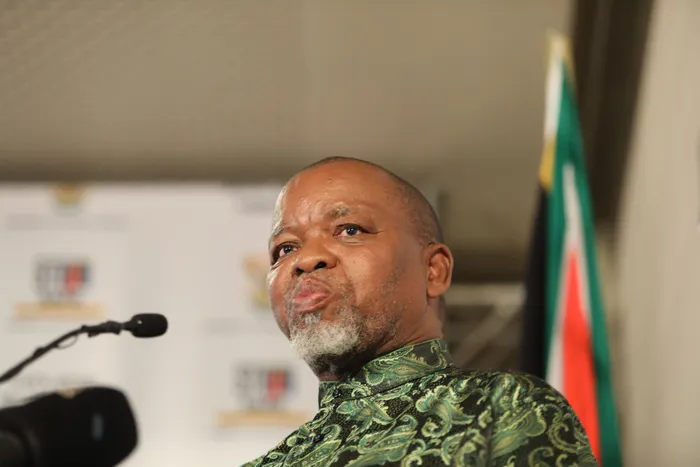
South African youth are not lazy or passive, as Minister Gwede Mantashe suggested recently.
Image: Oupa Mokoena / Independent Newspapers
IN THIS article, I will factually demonstrate that South African youth are not lazy or passive, as Minister Gwede Mantashe suggested recently, but rather how they have been systematically disempowered by design.
How they and their parents are conditioned to celebrate a 35% pass rate, subjected to a curriculum detached from the digital, technical, and entrepreneurial skills required in the 21st century, and then cast into an economy that deems them unemployable.
The ultimate deceit lies in the immunity of this system’s architects: while the children of the elite, including our very leaders, are quietly educated in private institutions that provide them with global competence and endless opportunities, a privilege the public system deliberately denies the majority.
Furthermore, I will address how this reality constitutes a fundamental betrayal of the ANC’s original vision of “People’s Education for People’s Power”, a liberatory Education model that was designed by our democratic founders before 1994 for self-reliance and self-actualisation, not dependency. This is not merely a policy failure. It is active treachery against the Youth of this country and the ANC democratic founders.
The crisis, however, runs deeper than Unemployed Youth. Even those who academically “succeed” face a hollow victory. The educated Black middle class, now estimated at less than 13% and shrinking, is trapped in dependency on a narrow, struggling formal job market.
Decades of deindustrialisation have left an economy unable to generate mass entrepreneurship or meaningful employment, relying instead on a service sector that cannot absorb the millions of excluded Youth. The result is a nation steadily marching toward a tipping point: a shrinking base of taxpayers supporting an ever-expanding population of grant recipients.
Compounding this economic failure is a profound moral collapse in leadership. The very figures entrusted with reconstruction have normalised corruption, captured our criminal justice system, systematically diverting public funds meant for development into private pockets. This is not merely the theft of money, but the theft of the future of our children. A conscious betrayal that starves schools, cripples infrastructure, and dismantles the state’s capacity to deliver.
We are left with a vicious cycle: a failing system which produces dependent citizens, which justifies more state spending on grants, which is then looted by the same leaders who benefit from the dysfunction.
In 2018, the Centre for Risk Analysis (CRA) at the Institute of Race Relations delivered a damning verdict on our Education system, outlining that South Africa’s education system constituted “the single greatest obstacle to socio-economic advancement”.
The report warned that the South African education system was replicating Apartheid outcomes and, not reversing, patterns of unemployment, poverty, and inequality, while producing a dual education system for the poor and the rich with highly differentiated outcomes, which “socialises the elite of the next generation” and creates a cycle of poverty amongst the poor who are perpetually rendered redundant and dependent.
The report's conclusion was severe in its clarity: the South African education system had become an engine for the reproduction of societal ills, reinforcing the very cycles of unemployment, poverty, and inequality it was constitutionally mandated to dismantle.
This critical finding was not a sudden revelation but the culmination of decades of warnings and a call for urgent intervention from diverse quarters to the African National Congress Government. Academic researchers consistently publish data revealing poor outcomes and a lack of critical skills development in our learners, including students in institutions of higher learning.
Civil society organisations, business, and student movements continue to submit detailed critiques, arguing that the South African curriculum is alienating and irrelevant to the socioeconomic realities of the day.
Yet, the ANC in its pre-1994 policy formulation foresaw precisely this danger: that without a scientific, transformative education system, the inequities of the past would simply be repackaged for the future. In anticipation, the ANC in 1993 convened hundreds of Scholars and Education professionals to develop what became the seminal Yellow Book on Education titled “People’s Education For People’s Power”, led by late education luminaries such as Dr Neville Alexander and Elinor and Max Sisulu.
This document was the highlight of the ANC’s intellectual prowess and its brilliant Scenerio planning by leaders who had the best interest of our people. It envisioned a system built on principles of integration, free access, community-centred learning, and skills for transformation, all aimed at creating self-reliant youth capable of driving national reconstruction.
The ANC's envisioned purpose for Education was also articulated long before 1994. In 1986, the young intellectual Zwelakhe Sisulu explained the rallying cry of “People’s Education for People’s Power.” He stated that this meant moving beyond demanding the same education as whites, which was “education for domination,” and instead building an “education at the service of the people as a whole, education that liberates, education that puts the people in command of their lives.”
What became of these noble ideals?
Instead of an education that puts people in command of their lives, we have one that fosters dependency; instead of cultivating critical thinkers and skilled citizens, we celebrate a 35% pass benchmark. The ANC’s own Yellow Book principles, quality education, community-centred learning, civic duty and skills for transformation, have been abandoned, replaced by a dual system that prepares children of the elites while marginalising children of the poor majority.
Oliver Tambo, who championed the ANC’s vision of Education for Mental and Economic Liberation, must be turning in his grave. This reversal is not a failure of policy alone, but a fundamental betrayal of the ANC’s foundational promise.
The pressing question now is not whether the vision was clear, but why and how it was so completely abandoned by this new ANC elite. An analysis which one scholar captured as: “A Dream Deferred.”
‘People's Education for People's Power’ was the transformative, empowering ideal that the ANC sought to institutionalise post–1994. It stood in stark contrast to the present system, which has abandoned liberation for a low-expectation model that leaves the majority disempowered and a culture of mass-produced mediocrity symbolised by the celebration of a 35% pass rate as an achievement.
This 35% standard is the ultimate betrayal of that original vision, a systemic adjustment that normalises failure and guarantees that the majority of youth will be disempowered, fulfilling the very cycle of dependency the ANC’s founders sought to break.
It is our education system and systemic corruption that creates a cycle of poverty amongst our youth, who, like their parents, will be rendered redundant and dependent on RDP houses and social grants.
The South African Education system prepares our youth for political exploitation. It fails to prepare them to be self-reliant and self-sufficient, to think critically, to see endless possibilities, to become innovative, and manage their financial affairs while analysing their concrete objective reality.
Our youth who are products of this system end up idling, either unemployed or unemployable, only to find themselves in the hands of drug lords and toxic friends, where they become alcoholics and nyaope addicts. As and when they protest for services, they are arrested, shot or killed. This is nothing else but human waste.
The summarised findings from the 2018 report from the Centre for Risk Analysis exposed the duality of our Education system, which has not changed much to date as such. The South African education system functions as a socio-economic sorting mechanism, actively producing two distinct classes through a structured, resource-based divide:
This is not a coincidence but the outcome of a single, unreformed system. It ensures a small, skilled elite can manage a complex economy while a large, disempowered population remains politically manageable through social grants, creating a “culture of dependence”.
South Africa stands at a crossroads: continue with misleaders who steal, not only your hard-earned money but also your dreams, or become a meritocratic and skill-driven society. The only solution is a generational mission to dismantle the system of corruption and engineered failure and dependency and replace it with one of built competence, and to demand leaders who serve not their pockets and to finally build an Education system that empowers the youth to dare to dream boldly.
As Oliver Tambo opined: “The children of any nation are its future. A country, a movement, a person that does not value its youth and children does not deserve its future.”
* Phapano Phasha is the chairperson of The Centre for Alternative Political and Economic Thought.
** The views expressed here do not reflect those of the Sunday Independent, IOL, or Independent Media.