

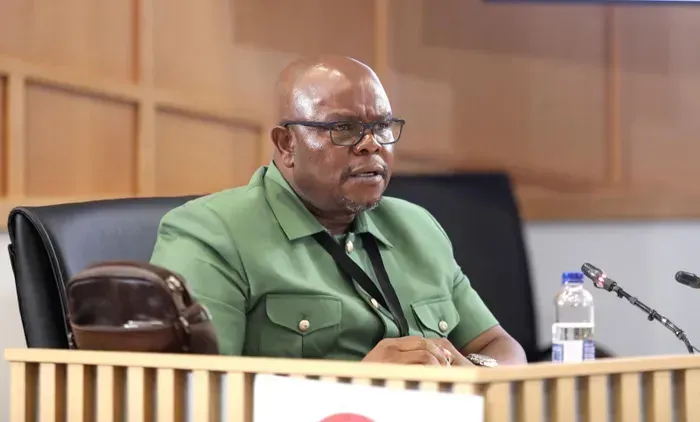
The inconsistencies in Major-General Lesetja Senoa’s testimony before the Madlanga Commission are drawing such intense attention.
Image: Supplied
WHEN a Major General in the Hawks speaks, South Africans do not just hear a person; they hear an institution. The uniform, rank, and title convey an expectation of clarity, discipline, and credibility.
That is why the inconsistencies in Major-General Lesetja Senoa’s testimony before the Madlanga Commission are drawing such intense attention. They are not dramatic in the tabloid sense. They are troubling because they touch the core of public trust in law enforcement leadership.
This is not about one slip of the tongue. It is about a pattern of contradictions that is difficult to reconcile with the standards expected of a senior crime-fighting official.
Consider first the explanation that certain messages were sent “by mistake”. In ordinary life, we all know what it means to send a WhatsApp to the wrong group or fire off a message we later regret. Human error is believable.
But at the level of a Hawks Major General, communication is seldom casual. Every word can carry operational, legal, and political consequences. This is someone trained to weigh language carefully, especially in contexts touching on investigations, relationships, or sensitive information.
So, when contentious or potentially compromising messages are reduced to “mistakes”, it raises more questions than it answers. Was this truly a slip, or is “mistake” being used as a convenient shield against scrutiny? In an era where digital communication is traceable and recoverable, casual explanations feel inadequate. The higher the rank, the less plausible it becomes to lean on the defence of carelessness.
Then there is the tension between claims of ending a relationship and evidence of continued engagement. Major General Senoa is reported to have wanted to terminate his relationship with Matlala, yet other remarks suggest ongoing interaction and even a willingness to “take them on”. In ordinary social life, ending a relationship usually means drawing a line and creating distance. It does not mean continuing to chat, strategise, or rely on one another when it suits.
Leaving the door half open invites suspicion. Was the relationship truly ended, or was it only “ended” when it became inconvenient to acknowledge its existence? In the realm of policing, where the appearance of impartiality is as crucial as actual impartiality, ambiguity about personal ties can be as damaging as overt misconduct.
Perhaps the most charged phrase to emerge is the reference to “taking on our brother.” Those words are not neutral. They suggest closeness, whether familial, cultural, political, or personal. In many South African communities, “my brother” or “our brother” can be a term of solidarity, respect, or shared loyalty.
But when that kind of language surfaces around contested matters, it forces us to ask: Who exactly is “our brother”? Is this just a casual cultural expression, or does it hint at a deeper bond than is being admitted in formal testimony?
In policing and investigations, perceived closeness matters almost as much as actual closeness. If a senior officer appears to speak in terms of “us” and “our brother” regarding individuals tied to controversy, the public cannot help but wonder whether decisions were shaped by loyalty rather than law.
None of these issues, in isolation, would necessarily define a career. People mispronounce. People change their minds. Relationships evolve. But taken together, mistaken messages, half-ended relationships, and loaded phrases of loyalty form a troubling pattern. And inconsistency at a senior level is not a small thing. It chips away at public confidence incrementally, case by case, until trust becomes almost impossible to restore.
Rank amplifies all of this. A Major General in the Hawks sits near the centre of South Africa’s crime-fighting machinery. This is not a peripheral functionary. It is someone with access to intelligence, oversight responsibilities, and an awareness, if not direct involvement, in key investigations.
When a person in such a position seems entangled in unclear relationships and opaque communications, the public is left with two uncomfortable possibilities: either he knew more than he admits, or he knew less than his position demands. Both scenarios are deeply concerning.
Timing further complicates matters. Explanations that appear only after serious scrutiny begins tending to sound reactive. If concerns about relationships or individuals were genuinely troubling at the time, were they formally recorded, escalated, or acted upon then?
Or do they only become “problems” when a commission starts probing? In public accountability, timing is not a technicality; it is part of the test of integrity. Proactive disclosure signals conscience. Reactive backtracking suggests survival mode.
Yet this story is ultimately bigger than one Major General. The Madlanga Commission and other inquiries have begun to reveal strain lines within law enforcement institutions: leadership tensions, competing networks of influence, and blurred lines of accountability.
In this climate, every contradiction by a senior official stops being merely personal. It becomes symbolic of a broader institutional crisis: do our crime-fighting structures still have a moral centre, or have they become battlegrounds of factional interest?
South Africans are realistic. They are not demanding saints in uniform. They know that policing is messy, political, and dangerous. What they want is simpler, but harder to counterfeit: trustworthy institutions. This means clear ethical boundaries, consistent professional distance, and leaders who understand that their words, messages, and associations are not private matters; they are public assets or liabilities.
Senoa is entitled to put forward his version. Commissions exist precisely to test allegations, weigh evidence, and separate fact from speculation. But credibility is not determined only now of a final report. It is built or eroded in real time, as testimony unfolds, as explanations shift, and as patterns of contradiction emerge.
The inconsistencies around Senoa matter because they are not just about one man’s WhatsApps or one man’s friendships. They go to the heart of what the Hawks represent. Are they an institution whose leaders speak with coherence and integrity, or one where rank shields ambiguity and half-truths?
In a country where crime is a daily reality, from petty theft to organised corruption, South Africans cannot be expected to live with chronic uncertainty about the judgment of those at the top of law enforcement. When those entrusted to uphold the law appear to tremble on credibility, ordinary citizens are the ones who feel the consequences first and hardest.
This moment is not a test of public relations. It is a test of ethical leadership. If our crime-fighting institutions operate permanently in the grey, the public will quite reasonably assume the worst. South Africa does not need flawless generals.
It needs accountable leaders whose words align with their actions, whose explanations do not change with the room they are in, and whose relationships withstand the light of scrutiny.
The cost of anything less is already visible: cynicism, disengagement, and a widening gap between the public and those who claim to protect them. That is a price South Africa can no longer afford to pay.
* Nyaniso Qwesha is a writer with a background in risk management, governance, and sustainability. He explores how power, accountability, and innovation intersect in South Africa’s landscape.
** The views expressed here do not reflect those of the Sunday Independent, IOL, or Independent Media.